- Archaeological News
-
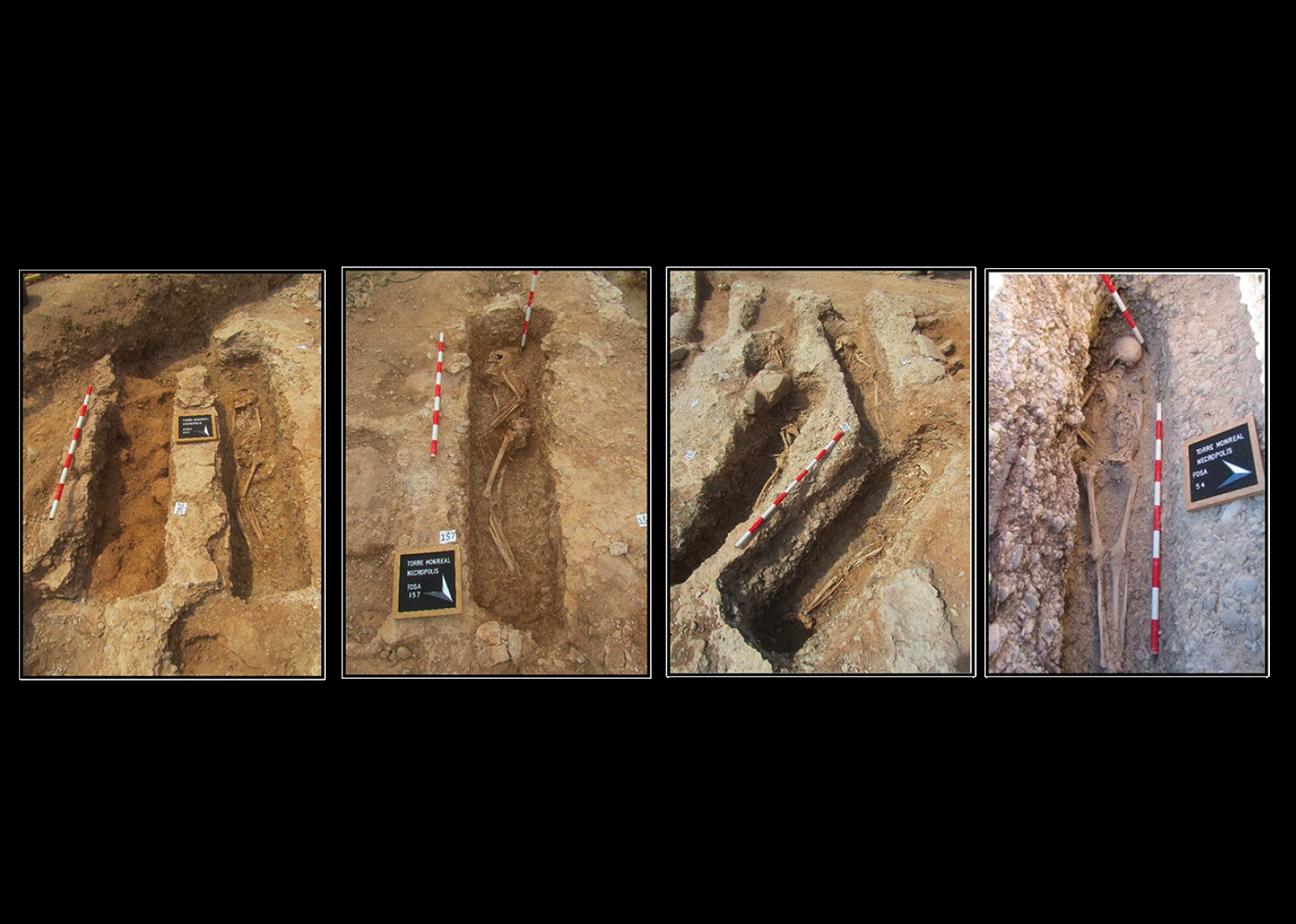
 Representative burials from the Torre Monreal Muslim cemetery in Tudela, Spain, showing different grave forms used between the late eleventh and fifteenth centuries.
Image Credit:
Pérez-Ramallo et al., Antiquity (2026)
From River Fish to Livestock: How Muslim Diets Changed in Medieval Spain
A large isotopic study of human remains from medieval Spain is revealing how a Muslim community changed the way it obtained food after coming under Christian rule, showing shifts between river fish, livestock, rabbit and poultry that researchers interpret as practical adaptation rather than straightforward assimilation into the diet of the Christian majority. Instead, food choices appear to have changed repeatedly as access to markets, fishing rights, taxation and local resources shifted over several centuries.
The research centres on Torre Monreal in Tudela, Navarre, where the town’s main Muslim cemetery developed after the Christian conquest of 1119 and the relocation of the Muslim population from the urban centre. Excavations between 2019 and 2021 uncovered 439 graves dating from the eleventh to fifteenth centuries. From these, researchers selected 120 individuals for carbon and nitrogen stable-isotope analysis, creating the largest and chronologically broadest dataset of its kind for a medieval Muslim minority in Iberia.
The burials were divided into four broad chronological groups, beginning around the late eleventh and twelfth centuries and extending into the fifteenth century. By analyzing collagen from the ribs, the researchers could examine long-term differences in the foods that contributed protein to people’s diets. Local animal remains were also analyzed to establish a regional baseline, while Bayesian models helped estimate changes in the relative importance of different food sources.
The results reveal a distinct sequence. Freshwater fish and poultry appear to have contributed more strongly around the period of the Christian conquest. During the following centuries, their importance declined while terrestrial resources—including sheep and goats, cattle and rabbits, became more prominent. By the fourteenth and fifteenth centuries, however, freshwater fish and poultry increased again.
For the researchers, the decline in freshwater fish doesn’t mean that Muslims in Tudela simply abandoned fishing. Historical documents indicate that access to the Ebro and other rivers remained possible after the conquest, but it became increasingly regulated. A charter from 1127 confirmed fishing rights while reserving valuable sturgeon for the Crown, suggesting that river resources were divided according to status and regulation. Later evidence identifies controlled fishing zones around Tudela but doesn’t clearly show Muslims participating in their management.
Food access was also closely tied to the urban market. Muslim, Jewish and Christian butcheries were formally separated because of different slaughter practices, yet documentary evidence shows substantial interaction between them. In 1280, Muslim and Jewish butcheries paid considerably more tax than Christian ones, apparently reflecting strong sales, while Christians were even fined on occasion for purchasing meat from Muslim butchers. The Muslim quarter was therefore not an isolated food economy, but part of a wider network of exchange shaped by both religious rules and commercial realities.
The growing importance of terrestrial foods may consequently reflect more than changing taste. Rabbit, for example, may have offered an inexpensive, locally available and religiously acceptable protein source. The increase in cattle-related isotopic signatures is harder to interpret, because bone collagen can’t distinguish meat from milk, cheese or other dairy products. What appears to be greater cattle consumption could therefore partly represent increased use of dairy rather than simply more beef.
A particularly interesting change occurred during the fourteenth and fifteenth centuries. The estimated contribution of river fish rose again, alongside poultry, at a time marked by political instability, climatic deterioration and the economic disruption associated with the Black Death. Rather than viewing this as a return to an earlier diet, the study interprets it as evidence of flexibility: households may have turned toward foods that were easier to obtain, exchange or produce during periods of stress.
Differences between men and women were generally small. Overall isotopic values show no significant sex-based difference, suggesting broadly similar access to dietary protein. Older women, however, show some evidence of reduced access to certain enriched protein sources, a pattern the researchers cautiously relate to the economic vulnerability faced by older Muslim women and widows in late medieval Iberia.
The authors stress that the dietary percentages remain estimates rather than exact measurements. Local environmental conditions complicate isotope interpretation, some chronological groups are small, and individual values overlap considerably. Even so, the long-term pattern is clear enough to show that food practices changed repeatedly rather than moving in a simple line from “Islamic” to “Christian” habits.
The story preserved in the bones is therefore one of adaptation. Tudela’s Muslim community negotiated minority life not only through law, taxation and religious identity, but through something far more ordinary and immediate: what could be caught, bought, raised, prepared and eaten.
Published on: 19-10-2026
Edited by: Abdulmnam Samakie
Source: Antiquity