- Archaeological News
-
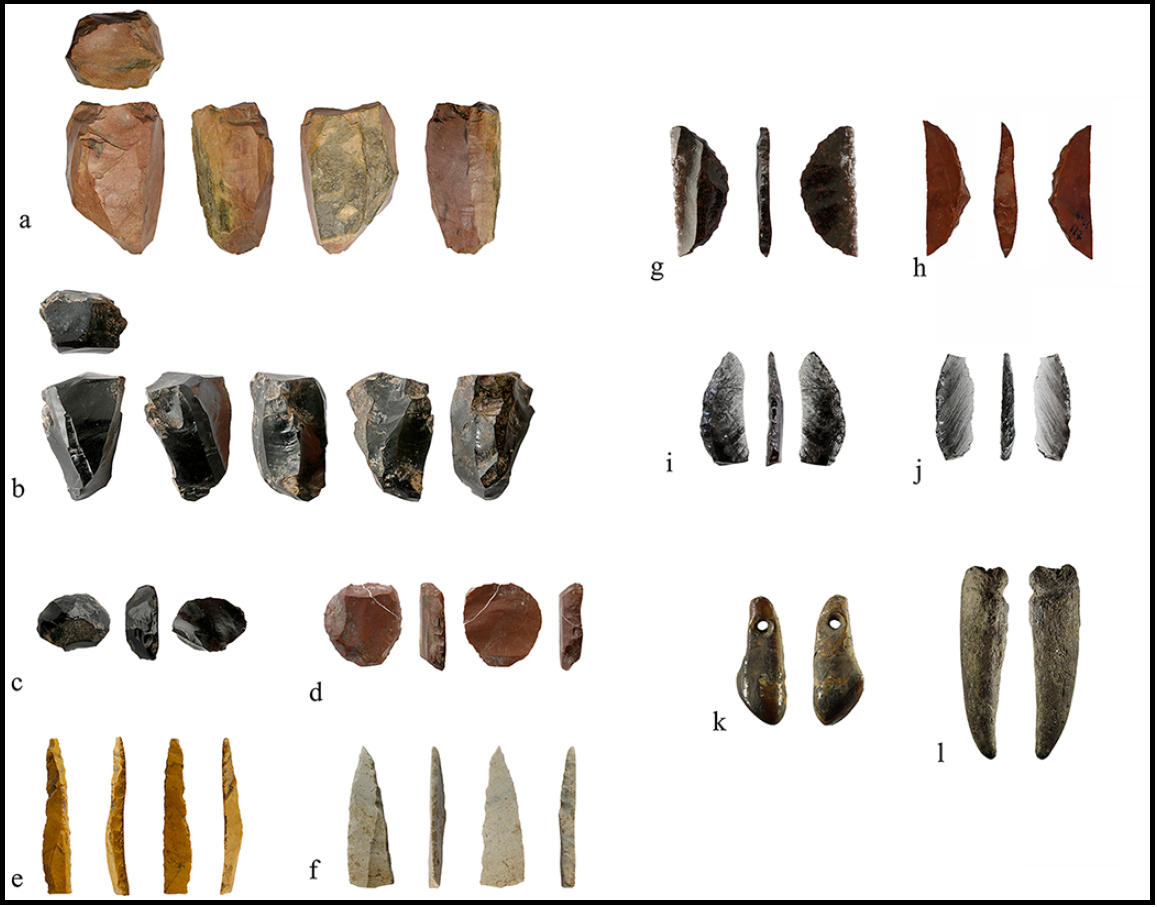
 Selection of stone tools and personal ornaments from Koskarlı Cave.
Image Credit:
Çalışkan Akgül et al., Antiquity (2026)
Selection of stone tools and personal ornaments from Koskarlı Cave.
Image Credit:
Çalışkan Akgül et al., Antiquity (2026)
Koskarlı Cave Reveals Epipalaeolithic Life on Türkiye’s Black Sea Coast
Excavations at Koskarlı Cave in Türkiye’s eastern Black Sea region have uncovered the first securely documented Epipalaeolithic occupation investigated systematically in this part of the country, providing new evidence for hunter-gatherer communities living there at the end of the Pleistocene.
The cave lies about 40 kilometres south of Trabzon in the Söğütlü Valley, at an elevation of approximately 1,030 metres. Discovered in 2019, it became the focus of systematic excavations in 2024. Radiocarbon dates and the associated stone-tool assemblage place the intact occupation broadly between about 12,900 and 12,000 cal BC.
The site is particularly important because most Epipalaeolithic research in Anatolia has traditionally concentrated farther south. Koskarlı therefore provides a new reference point for exploring human activity near the eastern Black Sea during the transition from the Late Pleistocene to the Early Holocene.
During the 2024 season, archaeologists investigated three areas: the interior of the cave, a section immediately east of it, and disturbed runoff deposits near the approach to the entrance.
In the main excavation area, an upper ashy layer contained a mixture of Epipalaeolithic and much older Middle Palaeolithic artefacts. Researchers interpret this mixed assemblage as the result of later disturbance and post-depositional processes rather than a single intact occupation.
Below this disturbed layer, however, archaeologists found an intact Epipalaeolithic deposit between about 20 and 40 centimetres thick. It contained ash, fine sediment, charcoal, burnt soil and heat-altered flint, providing evidence for a fireplace used at the site.
Radiocarbon measurements from charcoal and bone date the occupation to the end of the thirteenth millennium BC, supporting the chronological interpretation provided by the stone tools.
The lithic assemblage includes flint of several colours, obsidian and a small quantity of stone from dacitic rocks. The sources of the flint and obsidian have not yet been identified.
Preliminary analysis shows that the inhabitants produced blades and bladelets directly at the site. Numerous cores, crested blades and manufacturing debris indicate that stone-tool production was an important activity inside or around the cave.
Among the recovered tools are end-scrapers, backed blades and bladelets, perforators, burins, microgravette points and distinctive crescent-shaped microliths known as lunates. Some of these lunates were modified using bipolar backing, while several display Helwan-type bifacial retouch.
These technological characteristics closely resemble Epipalaeolithic traditions documented elsewhere in Anatolia, the Levant and the Caucasus. The parallels suggest that Koskarlı was not an isolated community but formed part of broader networks of technological knowledge and regional interaction.
Other finds provide clues to personal appearance and symbolic behaviour. A grooved fragment of antler and a perforated animal tooth appear to have been used as personal ornaments. Faunal remains and mollusc shells were also recovered, although detailed species identification and broader environmental analysis remain underway.
The importance of Koskarlı lies partly in its geographical position between Anatolia and the Caucasus. Continued excavations may help archaeologists examine how hunter-gatherer communities moved through this region, exchanged technologies and adapted to environmental changes at the end of the Ice Age.
Because it is the first systematic investigation of an Epipalaeolithic context in the eastern Black Sea region, the site could significantly improve understanding of settlement, mobility, subsistence and cultural connections in an area that has remained comparatively little studied.
Published on: 10-08-2026
Edited by: Abdulmnam Samakie
Source: Antiquity