- Archaeological News
-
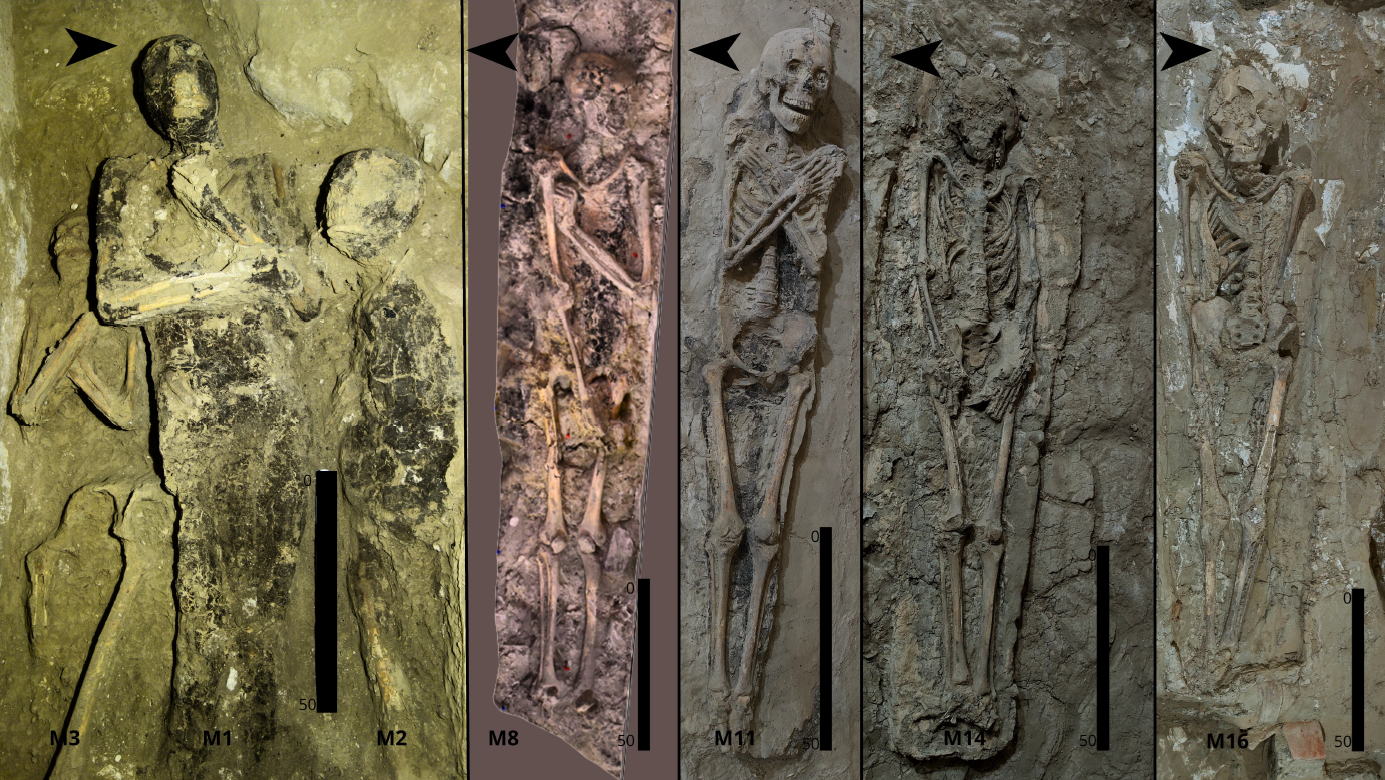
 Selected mummies from Side Chamber 3 of Theban Tomb 209, showing different body orientations and arm positions.
Image Credit:
Carballo-Pérez & Molinero Polo, Frontiers in Environmental Archaeology (2026)
Selected mummies from Side Chamber 3 of Theban Tomb 209, showing different body orientations and arm positions.
Image Credit:
Carballo-Pérez & Molinero Polo, Frontiers in Environmental Archaeology (2026)
Ancient Theban Tomb Reveals Centuries of Changing Burial Practices
A new archaeological study of Theban Tomb 209 in Luxor has reconstructed how an Egyptian burial chamber was repeatedly reused over several centuries, transforming from a space of relatively individual burials into a densely organized accumulation of mummified bodies.
The research focuses on Side Chamber 3, an underground room within the monumental tomb on the West Bank of Luxor. The tomb was originally constructed during the Kushite Twenty-Fifth Dynasty, but continued to be used through the Persian and Ptolemaic periods.
Unlike some other parts of the monument, the chamber escaped early modern excavation and disturbance, preserving an unusually valuable sequence of funerary deposits. Archaeologists used an archaeothanatological approach, examining the positions of bodies, anatomical connections, coffins, associated objects and the stratigraphic relationships between successive burials.
The chamber contained 16 human individuals in primary or partially primary contexts, together with a mummified canid. A separate secondary deposit contained 1,775 fragmented bones representing at least four additional people.
The earliest burials, probably dating to the Twenty-Fifth Dynasty, were comparatively individualized. Mummified bodies were placed in coffins and arranged in separate areas of the chamber, with funerary objects closely associated with particular individuals.
Over time, however, this organization began to change. From the late Twenty-Fifth Dynasty onward, new burials were increasingly inserted into spaces that were already occupied. During the Persian period, bodies began to be placed directly above earlier mummies or their coffins. By the Ptolemaic period, this process had developed into a dense system of vertical accumulation.
In several cases, earlier burials physically influenced the placement of later ones. One mummy was deposited directly over another, while other bodies were positioned above earlier coffins. In one group, two mummies were closely superimposed and a mummified canid was placed over their lower limbs.
At least six of the nine identified funerary deposits show clear evidence of vertical superposition. Researchers argue that the arrangement was not simply a consequence of running out of space. Instead, it reflects a changing funerary system in which earlier burials became part of the physical setting for new ones.
The role of coffins also changed significantly. In the earliest phases they clearly separated individual burials and organized associated objects. Their use gradually declined, however, and no clear evidence of coffins survives in the latest deposits.
Rather than indicating disorder, researchers interpret this as a new form of funerary organization. The chamber itself—and the bodies, sediment and structures already present within it—became increasingly important in determining where subsequent burials were placed.
The archaeological sequence was further complicated by natural and human processes. The tomb lies within a drainage channel and experienced repeated flooding, introducing water and sediment that displaced and damaged remains. Coffins and textiles also deteriorated under humid conditions.
One secondary deposit presents another unusual feature: nearly 89 percent of its 1,775 bone fragments show evidence of exposure to heat, with some approaching complete calcination. The researchers cannot yet determine whether these burnt remains originally came from the chamber itself or were relocated from another part of the tomb.
The study therefore presents Theban Tomb 209 not as a monument used for a single burial event, but as a changing funerary environment repeatedly reorganized over generations.
Its transformation from individualized coffin burials to vertically accumulated mummies demonstrates how tomb reuse in ancient Thebes could follow an organized and evolving logic, shaped by earlier burials, changing funerary practices, environmental events and the physical limits of the tomb itself.
Published on: 19-08-2026
Edited by: Abdulmnam Samakie