- Archaeological News
-
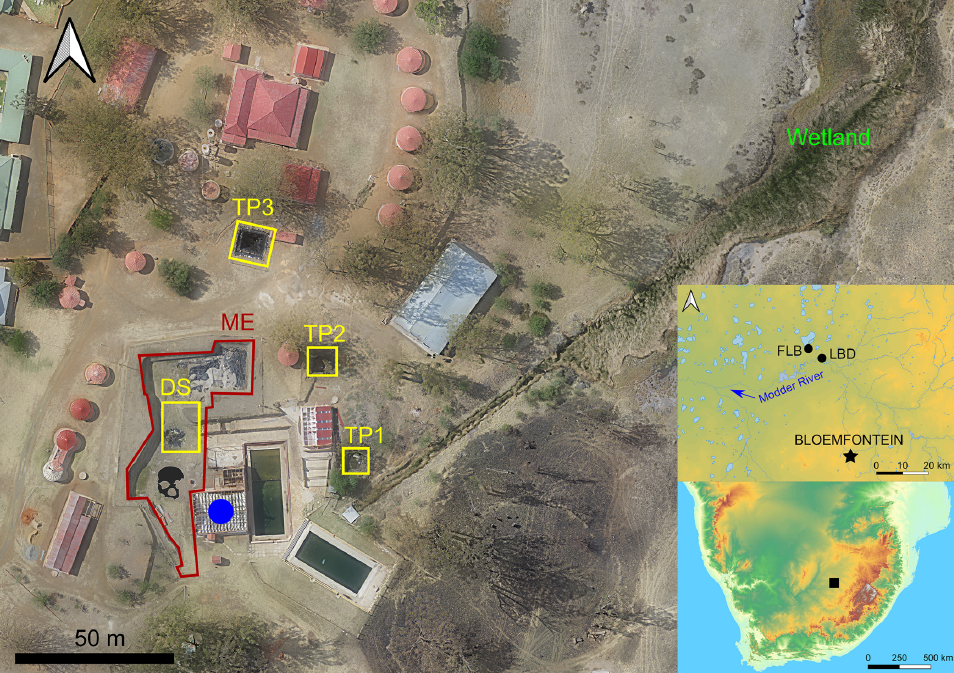
 Aerial view of Florisbad in South Africa, showing the excavation areas, the approximate find spot of the Florisbad human cranium, and the present-day spring. Insets locate Florisbad and Lombard’s Drift within the Free State and southern Africa.
Image Credit:
Ecker et al., Communications Earth & Environment (2026)
Lost Landscapes of South Africa Reveal How Early Humans Adapted 200,000 Years Ago
Around 200,000 years ago, the interior of South Africa looked very different from the grasslands that dominate the region today. New research from Florisbad and nearby Lombard’s Drift suggests that early humans lived amid combinations of vegetation, water and seasonal conditions with no close equivalent among the country’s modern ecosystems.
The study also provides new dates for Florisbad, one of southern Africa’s most important Middle Pleistocene fossil sites. By combining luminescence dating with chemical traces preserved in ancient plant waxes, researchers reconstructed changing environments and reconsidered how those landscapes may have influenced human behaviour.
Florisbad is particularly significant because a partial human cranium was discovered there in 1932. A tooth associated with the remains had previously produced an electron spin resonance age of about 259,000 ± 35,000 years. The new study instead dated the sedimentary layers immediately above and below the spring vent in which the remains were found.
Quartz grains from Unit N, near the top of the older peat deposits, produced an optically stimulated luminescence age of 198,000 ± 14,000 years, while the overlying Unit M was dated to 168,000 ± 14,000 years. Because the spring vent containing the human remains cut through the older deposits and was later sealed by Unit M, the researchers place the fossil between approximately 212,000 and 154,000 years ago, when the uncertainties of the two measurements are included. The result is significantly younger than the earlier central ESR estimate, although the two age ranges overlap when broader uncertainties are considered.
The environmental evidence is equally revealing. Researchers analysed carbon and hydrogen isotopes in plant-wax molecules preserved in sediments from Florisbad and Lombard’s Drift. These chemical signatures provide clues about vegetation, moisture and rainfall patterns stretching from the Middle Pleistocene into the Holocene.
Much of the Pleistocene record falls outside the range measured in modern South African biomes. Around 200,000 years ago, Florisbad supported a mixture of C4 grasses and substantial C3 vegetation, probably including plants associated with wetlands, cooler conditions and fynbos- or karroid-type communities. Cooler temperatures and reduced evaporation may also have produced a more evenly distributed seasonal moisture regime than the strongly seasonal conditions seen in the region today.
The researchers describe these combinations as “non-analog environments”: ecological conditions that do not correspond neatly to the modern vegetation zones used to understand South Africa today. The finding warns against imagining ancient landscapes simply as earlier versions of existing grasslands, shrublands or fynbos.
The changing environment may also help explain differences in stone-tool behaviour at Florisbad.
In Unit M, researchers draw on previously published archaeological evidence showing a relatively small assemblage of around 150–200 stone artefacts. Hornfels dominates, but dolerite and other raw materials are also present. Retouched pieces and scrapers are comparatively common, suggesting that some tools were maintained and used for longer periods rather than discarded quickly. The authors propose that this more curated strategy may have helped people manage resources in a fluctuating and potentially less productive environment.
The later Unit F presents a different picture. Thousands of artefacts were recovered there, almost entirely made from locally available hornfels. Retouch was uncommon and formal tools were rare, while abundant flakes and refitting pieces indicate extensive tool production at the site.
Animal remains from the same layer contain widespread cut marks and evidence of intensive marrow extraction, while an in-situ hearth contained burned bone. Together with the dominance of grazing animals, these finds point to repeated local processing of carcasses in a more open grassland-wetland environment that may have offered greater food productivity.
The researchers do not argue that environmental change alone determined human behaviour. The archaeological assemblages come from different periods and contexts, and no new technological analysis of the stone tools was undertaken for this study. Instead, the authors reinterpret previously published archaeological evidence alongside their new environmental reconstruction.
What emerges is a picture of considerable flexibility. At Florisbad, people appear to have altered how they acquired raw materials, maintained tools and processed animals as landscapes changed around them.
Rather than evolving against a single stable environmental background, early humans in southern Africa encountered shifting wetlands, grasslands and vegetation communities that often bore little resemblance to those visible today. Their ability to adjust to those changing conditions may have been one of the important features of early Homo sapiens adaptation.
Published on: 02-11-2026
Edited by: Abdulmnam Samakie