- Archaeological News
-
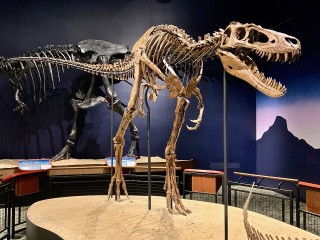 Reconstructed skeleton of the tyrannosaur specimen known as “Jane,” displayed at the Burpee Museum of Natural History.
Image Credit:
Zissoudisctrucker, CC BY-SA 4.0, via Wikimedia Commons
Reconstructed skeleton of the tyrannosaur specimen known as “Jane,” displayed at the Burpee Museum of Natural History.
Image Credit:
Zissoudisctrucker, CC BY-SA 4.0, via Wikimedia Commons
Fossil Teeth Reveal T. rex Maintained a Body Temperature of Around 36°C
Chemical traces preserved inside fossilized teeth have provided one of the clearest estimates yet of the body temperature of Tyrannosaurus rex. Analysis of three teeth from the Late Cretaceous Hell Creek Formation in Montana produced an average temperature of 36.3 ± 2.5°C, placing the giant predator within the range of many modern warm-blooded animals and significantly above the temperatures measured in crocodilians living in the same ancient environment.
The estimate was obtained through clumped-isotope thermometry, a technique that examines how particular carbon and oxygen isotopes bond within minerals. Because tooth enamel forms at temperatures influenced by an animal’s body, these chemical relationships can preserve information about temperature millions of years after death. Unlike some earlier isotope approaches, the method does not require researchers to know the precise isotopic composition of the animal’s body water.
Two teeth belonged to the same young adult T. rex, an animal estimated to have weighed more than 3,000 kilograms, while a third came from another individual. The individual measurements yielded approximately 37.3°C, 35.9°C and 34.7°C. Taken together, they produced the average of 36.3°C. By comparison, five crocodilian teeth from the Hell Creek Formation produced an average estimated temperature of about 30.9°C, a statistically significant difference.
Before interpreting these values biologically, the fossil enamel was examined for signs that burial and fossilization might have altered its original chemistry. Several independent tests found no clear evidence that the enamel had undergone substantial post-burial alteration. The researchers also compared enamel with dentin, which is more vulnerable to chemical change, and found differences consistent with better preservation of the enamel signal.
The estimated T. rex temperature is remarkably close to those reported for large living mammals such as elephants, which maintain body temperatures around 36°C. It is somewhat lower than temperatures typical of many modern birds, although it overlaps with estimates for large flightless birds such as ostriches and emus. More importantly, the dinosaur’s calculated temperature was significantly higher than environmental estimates reconstructed from freshwater bivalves and climate simulations for the same general region.
This difference indicates that T. rex maintained a body temperature above its surroundings rather than simply matching ambient conditions. Additional oxygen-isotope evidence also produced differences between body water and environmental water broadly resembling those seen in modern terrestrial warm-blooded animals, rather than the pattern observed in semi-aquatic crocodilians.
The findings add to evidence that T. rex possessed a thermoregulatory system capable of maintaining relatively stable elevated temperatures. However, the results do not by themselves prove exactly how that regulation was achieved. Very large animals can retain heat because of their body size, a phenomenon sometimes known as inertial homeothermy, potentially producing high and relatively stable temperatures even without metabolic rates identical to those of modern birds or mammals. The researchers therefore caution against using body temperature alone as a direct measurement of metabolic rate.
The temperature estimates were also incorporated into climate models to examine where T. rex might have been physiologically capable of living across Late Cretaceous North America. The resulting maps indicate extensive areas of suitable climate, including much of the continent’s middle latitudes and some colder regions farther north. Known T. rex fossil localities generally fall within areas predicted to have high climatic suitability, while the model suggests that potentially suitable territory extended considerably beyond the currently known fossil record.
These geographical results are consistent with evidence for tyrannosaurids at very high northern latitudes, where seasonal temperatures could fall below freezing. Such environments would have demanded considerable tolerance of cold conditions.
Important uncertainties remain. Only three T. rex teeth were analyzed, and the portions sampled from each crown represent limited periods of tooth formation. A seasonal bias therefore cannot be completely excluded, although measurements from different parts of two teeth produced similar results and no obvious temperature outliers were detected.
Despite these limitations, the fossil teeth provide unusually direct evidence about the living biology of one of the best-known dinosaurs. Rather than revealing only what T. rex looked like or what it ate, the chemistry preserved in its enamel offers a glimpse of the temperature at which its enormous body actually operated.
Published on: 21-09-2026
Edited by: Abdulmnam Samakie
Source: Science Advances