- Archaeological News
-
 Image Credit:
Mjærum et al., Antiquity (2026)
Image Credit:
Mjærum et al., Antiquity (2026)
Stone Age Fish Traps Reveal Early Environmental Management in Norway
A new archaeological study from Norway suggests that Mesolithic hunter-fisher-gatherers introduced fish into mountain lakes as early as 5000 BC, offering rare evidence of planned environmental management before the spread of farming.
The study focuses on Lake Tesse, a mountain lake in central southern Norway, located 854 metres above present sea level in the Jotunheimen region. After the retreat of the Fennoscandian Ice Sheet around 8000 BC, this high inland landscape became accessible to humans, but many upland lakes remained naturally fishless because waterfalls and steep watercourses prevented fish from migrating upstream.
Despite these natural barriers, Lake Tesse later became known as one of Norway’s most productive brown trout lakes. The new research suggests that this was not the result of natural fish migration, but of deliberate human introduction.
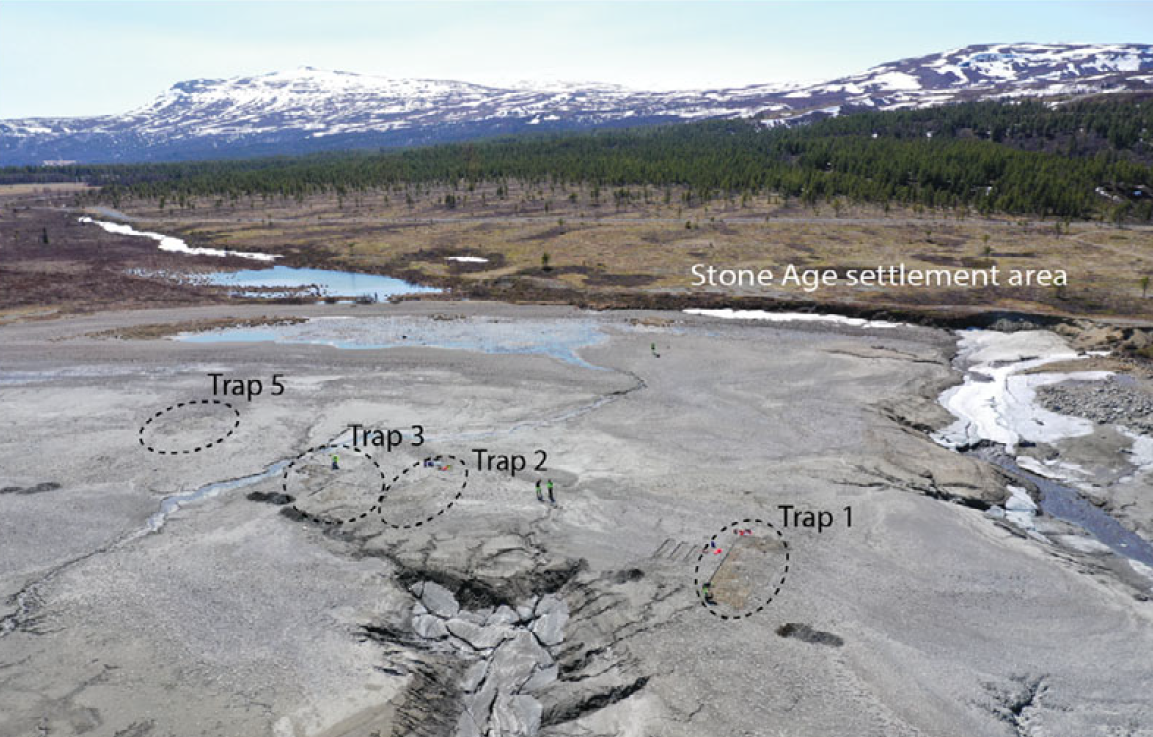
In 2022, several stationary fish traps were discovered on the exposed bed of Lake Tesse, where modern hydropower regulation lowers the water level each spring. Archaeologists excavated four traps, made of wooden poles set into the lakebed. One of the best-preserved traps included a circular chamber about 3.5 metres in diameter, with additional poles probably forming a guiding fence that directed fish into the structure.
The researchers used dendrochronology and radiocarbon dating to date the wooden poles. The earliest traps, including Trap 5 and Trap 2, date to around 5000 BC, in the Late Mesolithic. Other traps show that fishing structures continued to be built or maintained at the lake during later periods, including around 3850 BC and 2700 BC.
The construction of these traps shows technical skill and planning. The poles were made mostly from small Scots pine trees, with some birch and willow. Many preserve cut marks, splits, and possible traces of lashing. Several poles were placed at an angle to support vertical elements, suggesting that the traps had lattice-like walls similar to later fish-trap traditions in northern Europe.
The most important implication is that the fish caught in Lake Tesse could not have reached the lake naturally. The lake lies above major natural barriers, and brown trout was the only fish species known in many high mountain lakes of the region. This pattern is difficult to explain through chance dispersal by birds or other natural processes.
The researchers therefore argue that Mesolithic people intentionally transported living brown trout into fishless mountain lakes. This practice would have required knowledge of fish behaviour, water systems, seasonal movement, and the long-term growth of fish populations. It would also have required practical methods for catching, carrying, and releasing live fish.
Such an intervention would not have produced an immediate return. It may have taken decades before introduced trout populations became large enough to support regular fishing. This delayed benefit suggests a form of planning that challenges simple distinctions between hunter-fisher-gatherers and later farming societies.
The introduction of fish may have made the mountains more attractive and safer for extended stays. The Lake Tesse region was also important for hunting elk and reindeer, and nearby mountain areas contain evidence of long-term reindeer hunting. By adding fish to mountain lakes, people may have created a more reliable food source that supported hunting trips and longer seasonal occupations.
The findings also connect with other evidence from southern Norway. Burned fish bones have been found at several mountain sites dating before 1700 BC, with some dating to the fifth millennium BC. In the studied cases where species identification was possible, the bones belonged to brown trout, strengthening the case for early human introduction of this species into upland waters.
The study places these activities within a broader discussion of resource management among hunter-fisher-gatherers. Rather than passively taking resources from nature, these communities actively shaped ecosystems by moving useful species, managing landscapes, and creating future food sources.
This does not mean that Mesolithic communities practiced farming in the conventional sense. However, the introduction of brown trout into previously fishless lakes can be understood as a form of low-level food production or environmental management. It shows that people were not only adapting to mountain environments, but actively transforming them.
Overall, the fish traps of Lake Tesse reveal a long-lasting relationship between people, fish, and mountain landscapes. They show that hunter-fisher-gatherers in Stone Age Norway possessed detailed ecological knowledge and used it to reshape environments in ways that continued to matter for thousands of years.
Published on: 21-07-2026
Edited by: Abdulmnam Samakie
Source: Antiquity