- Archaeological News
-
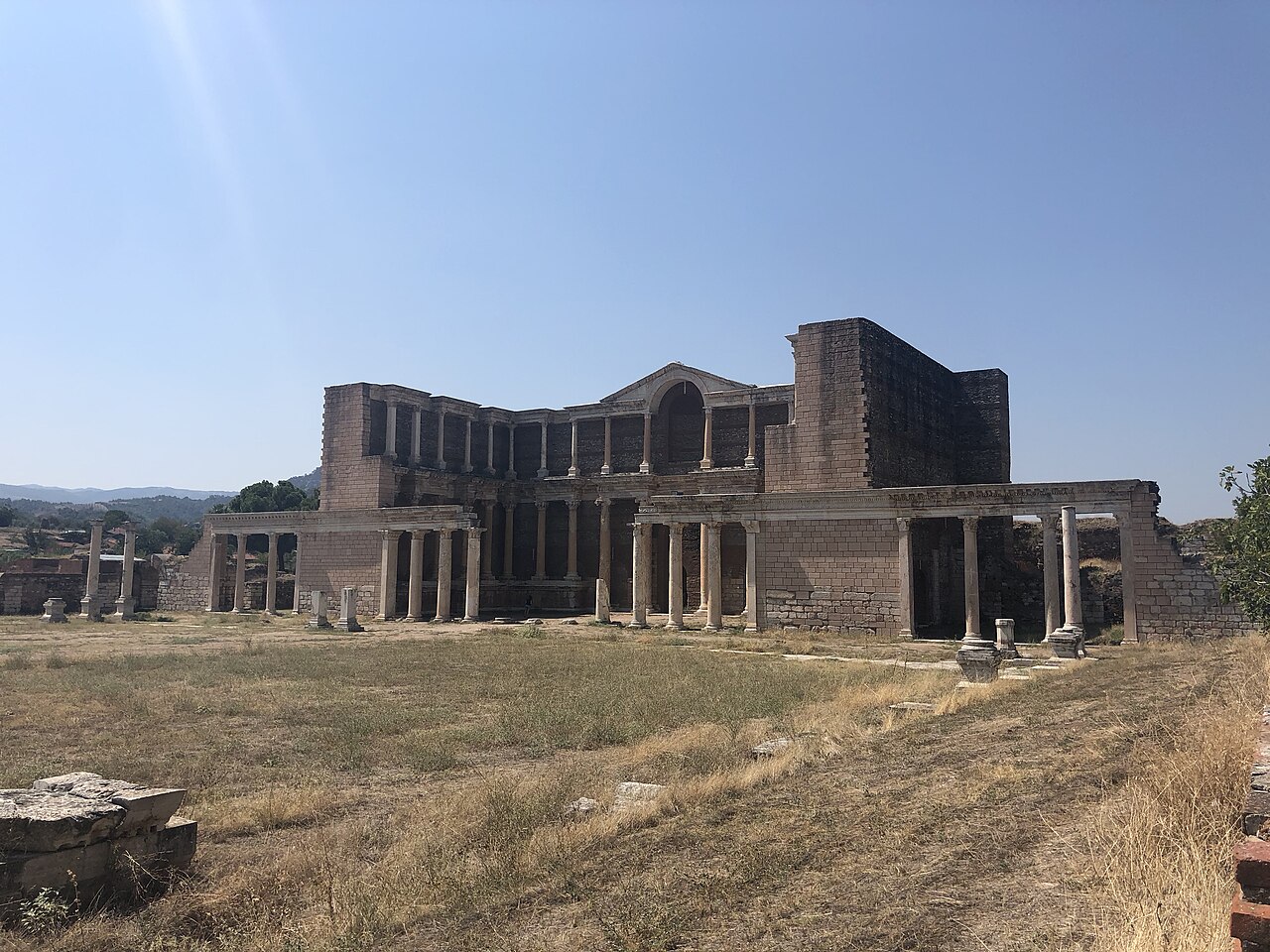
 The bath-gymnasium complex at Sardis in Asia Minor. Monumental complexes combining bathing and gymnasium functions became especially prominent in the eastern Roman world.
Image Credit:
Raicem, CC BY-SA 4.0, via Wikimedia Commons
The Changing Face of the Greek Gymnasium Under Rome
For centuries, the gymnasium stood at the heart of civic life in the Greek world. It was far more than a place for exercise. Young men trained there physically, received elements of military and intellectual education, participated in public ceremonies and learned what it meant to belong to their city.
But what happened to this deeply Greek institution after Rome took control?
A recent scholarly reassessment of a major study on gymnasia in Greece suggests that the answer was not simple disappearance. Instead, gymnasia adapted to Roman society, took on new social and political meanings and, in some cases, may have passed parts of their traditional role to other public buildings such as baths.
The study focuses on the Roman province of Achaea and brings together literary texts, inscriptions and archaeological evidence for 51 known gymnasia. The evidence, however, is uneven. Only a small number of these buildings have been excavated and published in enough detail to reconstruct their development securely. Others are known mainly from inscriptions or ancient written references, making their location and chronology difficult to establish.
Despite these limitations, the evidence shows that the gymnasium remained socially important after the Roman conquest. Roman elites became involved in Greek gymnasia, the imperial cult entered spaces traditionally associated with education and civic training, and sons of Roman and Italian families living in Achaea could participate in the ephebeia, the institution through which young men were educated and introduced to civic life.
The character of that education also changed, but not in a simple progression from military training to intellectual learning. Older interpretations often suggested that the military element gradually disappeared as Greek education became more academic. The evidence instead points to continued coexistence between physical, military and intellectual activities, with their relative importance varying from one city to another. Military training may have become more symbolic and civic in some places, but it did not simply vanish.
The buildings themselves underwent important changes as well. From the first century CE onward, heated bathing facilities increasingly appeared in gymnasium settings. In Asia Minor, this development produced large monumental complexes commonly described as bath-gymnasia. In Achaea, however, no equivalent architectural type appears to have developed on the same scale. Existing urban layouts and local traditions may have limited such transformations.
Yet the absence of enormous bath-gymnasium complexes does not necessarily mean that the institution’s functions disappeared. Baths were sometimes constructed beside or over earlier gymnasia, raising the possibility that activities once associated with the gymnasium gradually shifted into these new public spaces. At Sicyon, for example, baths contained altars dedicated to Hermes, Herakles and Apollo, while inscriptions connected with gymnasium officials have been found at Argos. Such evidence suggests a more complicated relationship than simple replacement.
This question becomes especially important because gymnasium buildings began to be abandoned at different times. In some places this process started as early as the middle of the first century CE, becoming more widespread by the second half of the second century. Yet inscriptions show that the ephebeia itself continued into at least the later third century. If the traditional buildings had stopped functioning, young men must have carried out at least some of their activities elsewhere. Baths or other civic complexes are one possible answer, although the evidence remains incomplete.
The Roman period was not simply an age of decline. There were also moments of renewed investment. One occurred under Augustus and his immediate successors, with examples at Messene and Corinth. Another came between the reign of Hadrian and the end of the second century, particularly visible at Mantinea and Athens. These projects suggest that gymnasia could still serve as powerful symbols of Greek cultural identity within the Roman Empire.
The overall picture is therefore one of adaptation rather than sudden disappearance. Greek gymnasia changed in architecture, social composition and educational role as cities adjusted to Roman rule. Traditional buildings eventually lost their original functions, but some of the practices and identities associated with them may have continued elsewhere. The gymnasium, in other words, did not simply vanish from the Roman Greek city. Its buildings changed, its users changed and its role evolved—offering a revealing example of how an old Greek institution could survive by becoming something different.
Published on: 31-10-2026
Edited by: Abdulmnam Samakie
Source: Journal of Roman Archaeology