- Archaeological News
-
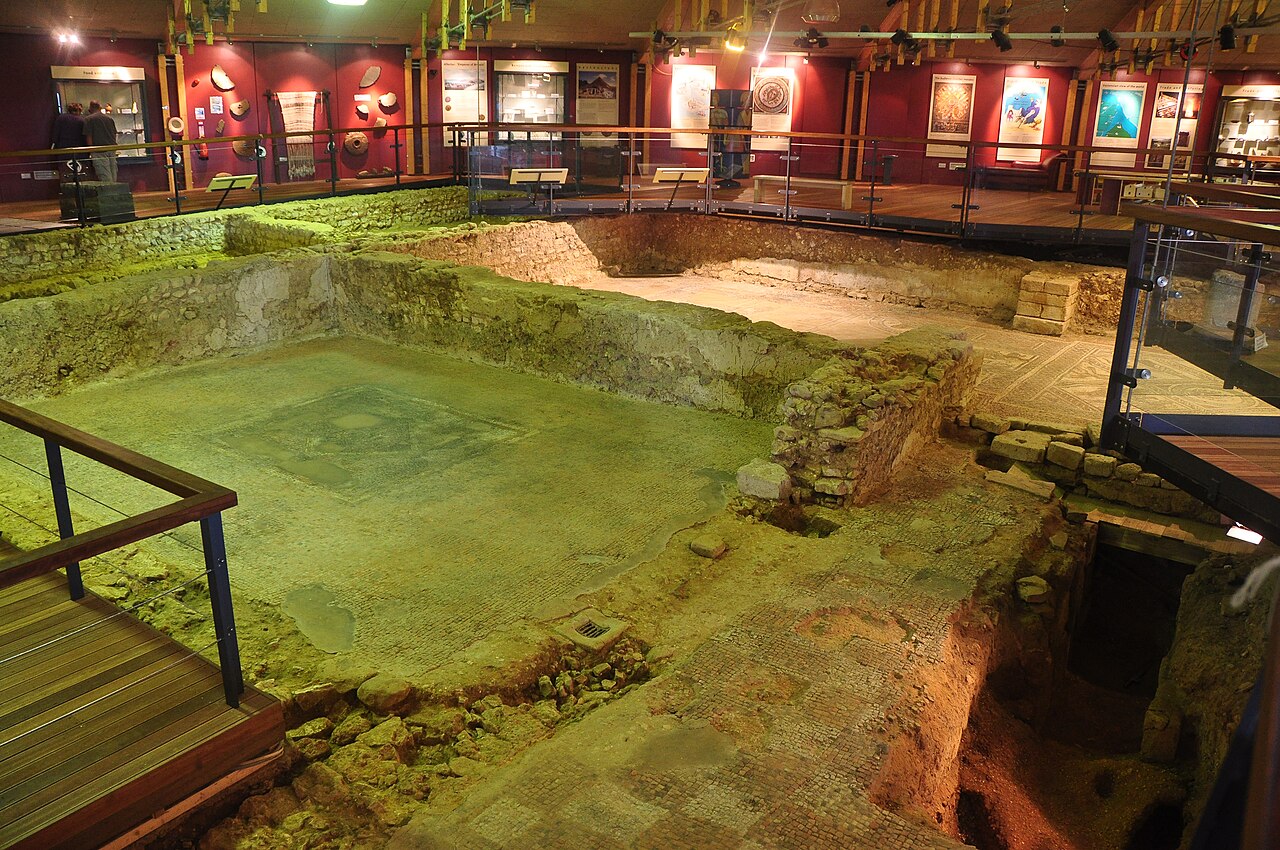
 Image Credit:
Nilfanion, CC BY-SA 3.0, via Wikimedia Commons
Image Credit:
Nilfanion, CC BY-SA 3.0, via Wikimedia Commons
What Happened at Brading Roman Villa?
A new study of human remains from Brading Roman Villa on the Isle of Wight suggests that the site may have witnessed a violent episode during the Late Roman period.
Brading Roman Villa is one of the best-known Roman villas in Britain, especially because of its decorated mosaic pavements. The villa was first excavated in the nineteenth century, and later investigations continued to reveal evidence for its long and complex occupation.
Among the most unusual finds from the site are scattered human bones. Some were discovered during the original excavations in 1880–81, while others were recovered during later work in the 1990s and early 2000s. The remains were not found as formal burials, but as disarticulated bones distributed in and around parts of the villa.
One of the most striking discoveries came from a well beneath the north range of the villa, where the remains of an adolescent were found along with the bones of three young dogs. Other adult bones were recovered from areas around the west range, the part of the villa famous for its mosaics.
The surviving human bone collection includes remains from at least four adults, as well as an adolescent and two neonatal bones. Some of the bones show signs of unusual treatment after death. One adult femur had evidence of animal gnawing, while fine cut marks were recorded on the neck of the same bone. A cut mark was also observed on one of the adolescent’s ribs.
Because most of the bones were not found in securely dated contexts, the researchers used radiocarbon dating to investigate when the remains were deposited. Four successful samples, including one from the adolescent in the well, produced dates that fall broadly between the third and fourth centuries AD.
Statistical comparison showed that the dated bones may belong to a single event, or to multiple events that occurred within a short period. The likely date falls within the Late Roman occupation of Britain, approximately between AD 250 and 400.
The authors then considered whether the date could be narrowed further. Coin evidence from the villa is unusual because it lacks the normal peak of coins from AD 330–348 that is commonly seen at Romano-British rural sites. This absence may point to a disruption or brief abandonment of the villa during or shortly after that period.
Several possible historical contexts are discussed. One is a crisis in Britain around AD 342–343, when the emperor Constans made a hurried visit to the province. Another possibility is the turmoil following the defeat of the usurper Magnentius in AD 353.
After Magnentius’ fall, the emperor Constantius II punished supporters of the defeated regime. Ancient sources report that his agent Paulus carried out severe reprisals in Britain, including torture, imprisonment, executions, and confiscations of property. The authors suggest that Brading Villa may have been affected by these events in the 350s.
This interpretation would fit with other changes at the villa. The west range, once a grand reception area with high-quality mosaics, appears to have undergone a significant reorganisation in the second half of the fourth century. The villa may have experienced a decline in status, possibly after its owner was killed or dispossessed.
The scattered condition of the human remains remains difficult to explain. The individuals may originally have been buried in shallow graves, later disturbed by scavenging animals such as dogs or foxes. Animal gnawing on one bone supports this possibility. The adolescent in the well may have been deliberately placed there, though the body was later disturbed or incomplete.
The researchers do not claim that the cause of death can be proven. Violence, sudden illness, or disease could all leave little or no trace on the skeleton. However, the unusual coin pattern, the cut marks, the scattered bones, and the wider political context make a violent episode a plausible explanation.
If the proposed mid-fourth-century event is correct, Brading Roman Villa may have been temporarily abandoned before being reoccupied in a different form. Coin loss later increased again, suggesting partial recovery in the later fourth century, although the villa’s social and architectural character may have changed.
Overall, the study provides a rare glimpse into insecurity and possible violence in the countryside of Late Roman Britain. It suggests that even wealthy villa communities were not isolated from political upheaval, military reprisals, or localised episodes of violence.
Published on: 10-07-2026
Edited by: Abdulmnam Samakie
Source: Britannia