- Archaeological News
-
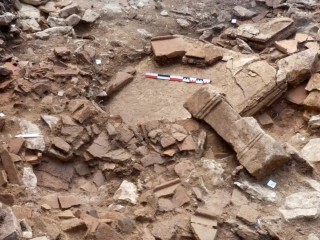 Image Credit:
Grégory Compagnon
Image Credit:
Grégory Compagnon
Gallo Roman Sanctuary with Temples Discovered in France
Archaeological excavations in Mancey, in the French department of Saône-et-Loire, have uncovered the remains of a large Gallo-Roman sanctuary that remained active for nearly five centuries, from the end of the Iron Age until the late fourth century AD. The site includes two temples, ritual areas, and evidence of ceremonial banquets likely attended by members of the local elite.
The 2025 excavation campaign, conducted over six weeks with a team of volunteers and professional archaeologists, documented in detail the architectural development and ritual use of the sanctuary. The sacred complex covers an area of roughly one hectare and includes circulation paths, food preparation spaces, and numerous votive deposits, confirming the site’s intensive ritual activity.
The sanctuary occupies a prominent position overlooking the surrounding landscape a few kilometers from Tournus. Earlier LiDAR surveys carried out in the forested area identified several large stone mounds that suggested the presence of a monumental complex rather than a rural settlement. Subsequent investigations identified six main structures and a possible boundary wall enclosing the sacred area.
Current excavations focus on two major buildings. The first is a rectangular temple with a sacred hall and vestibule, whose walls remain preserved up to 1.5 meters in height. The second structure follows the typical fanum plan, with a central cella surrounded by a peripheral gallery.
The rectangular temple shows several phases of reconstruction during the fourth century AD. Inside the building, archaeologists discovered benches and a central podium, indicating an organized ritual space. The floor deposits yielded nearly 10,000 archaeological remains, including animal bones, fragments of ceramic and glass vessels, coins, jewelry, and decorative items.
Many of the animal remains belong to young pigs, poultry, small birds, and fish species, suggesting that ritual meals or ceremonial banquets were regularly held within the sanctuary. The presence of valuable objects indicates that participation in these ceremonies may have been restricted to individuals of high social status.
Among the most remarkable discoveries are statue bases, a stone altar, and a masonry block decorated with painted imagery depicting the Gallic deity Sucellus, a rare artistic representation that could represent the only known painted depiction of this god if confirmed.
Even after the temple buildings were damaged and partially dismantled in the late fourth century, ritual activities appear to have continued among the ruins. Archaeologists found deposits of coins, pottery fragments, terracotta figurines of mother goddesses, and a ritual lamp placed in pits dug within the collapsed structures.
The second temple, the fanum, also revealed evidence of rich architectural decoration. Its floors were paved with terrazzo and decorative stonework, while the walls were originally covered with marble slabs and painted plaster. Hundreds of fragments of statues were recovered near the entrance, indicating that several sculptures once adorned the building before being intentionally destroyed.
Archaeological evidence suggests that the sanctuary’s origins may date back to the late La Tène period, while ritual activity continued for centuries afterward. Even after the structures had fallen into ruin, offerings continued to be placed on the site until the end of the fourth century AD.
The excavation employs a detailed recording method in which every artifact is precisely geolocated. This approach allows researchers to reconstruct not only the construction history of the sanctuary but also the ritual practices and daily activities that took place there over hundreds of years.
Published on: 14-03-2026
Edited by: Abdulmnam Samakie
Source: LBV Magazine