- Archaeological News
-
 Image Credit:
Haselburg-müller, CC BY-SA 3.0, via Wikimedia Commons
Image Credit:
Haselburg-müller, CC BY-SA 3.0, via Wikimedia Commons
X-rays Help Trace Roman Pottery Found on Britain’s Northern Frontier
A new study shows that portable X-ray fluorescence can help archaeologists identify the production origins of Roman samian pottery without damaging the artefacts.
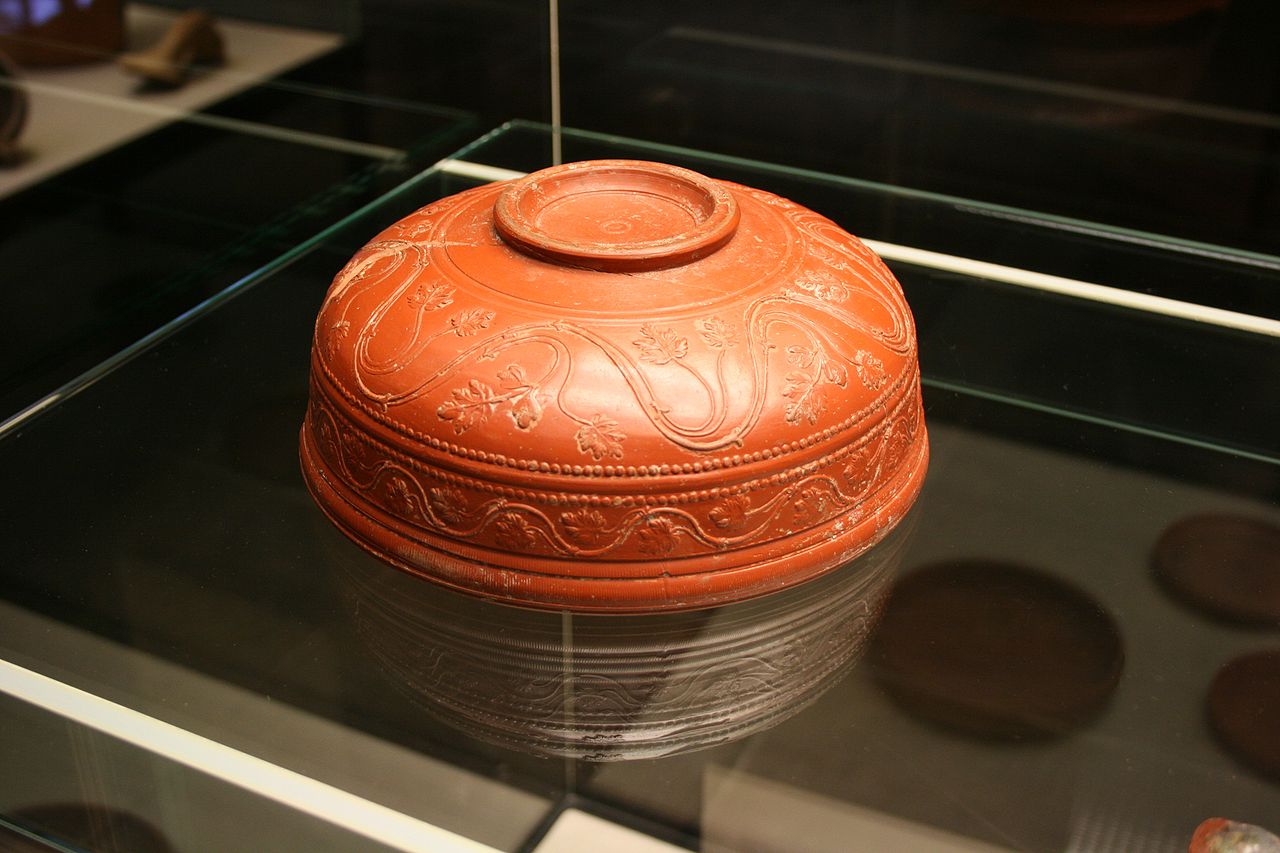
Samian ware, also known as terra sigillata, was one of the most recognizable and widely traded types of Roman pottery. Its glossy red surface, fine fabric, vessel forms, decoration, and potters’ stamps can often help specialists determine where it was made. In Britain, much of this pottery was imported from workshops in Gaul and reached both military and civilian sites.
However, many samian sherds are too fragmentary or lack clear diagnostic features. In such cases, identifying their source through visual study alone can be difficult, especially when different workshops produced vessels with similar fabrics and finishes. The new research explores whether portable X-ray fluorescence, or pXRF, can provide a useful non-invasive alternative.
The study analysed more than 300 samian sherds from Roman military sites in Scotland, including forts along and near the Antonine Wall, as well as material from South Shields Roman fort in northern England and Traprain Law, an Iron Age hillfort in East Lothian. The pottery mainly dates from the Flavian to Antonine periods, when Roman military activity shaped the northern frontier of Britain.
Using pXRF, the researchers measured the chemical composition of the pottery without taking destructive samples. The technique allowed them to compare elements in the ceramic fabric, especially trace elements useful for distinguishing production groups. These chemical patterns were then compared with established reference data from known samian workshops in Gaul.
The results suggest that pXRF can successfully assign many samian sherds to broad production regions. Central Gaul, especially the major production centre at Lezoux, was the most reliably identified. South Gaulish products, including material probably from La Graufesenque and Montans, could also be recognized in many cases. East Gaulish production, including Rheinzabern and other workshops, was less clearly represented and more difficult to separate.
The study also highlights the limitations of the method. Portable X-ray fluorescence is fast, relatively inexpensive, and non-invasive, but its results are semi-quantitative and affected by surface condition, sherd thickness, inclusions, and the small area analysed. For this reason, the researchers emphasize that pXRF should not be treated as a complete replacement for traditional expertise or laboratory-based destructive techniques, but rather as a practical complementary tool.
The findings are important because samian pottery plays a major role in dating Roman sites and understanding supply networks, military movement, trade, and consumption. A reliable non-invasive method is especially valuable for museum collections, where destructive sampling is often not possible.
Overall, the research shows that portable chemical analysis can expand the study of Roman pottery from frontier contexts while preserving the objects themselves. It also offers a useful framework for archaeologists and heritage professionals at a time when the number of specialists trained to identify samian pottery by traditional methods is declining.
Published on: 30-06-2026
Edited by: Abdulmnam Samakie