- Archaeological News
-
 Image Credit:
KARTY JazZ, CC BY-SA 4.0, via Wikimedia Commons
Image Credit:
KARTY JazZ, CC BY-SA 4.0, via Wikimedia Commons
New AI Method Makes Ancient Stone Inscriptions Easier to Read
A new image-processing framework may improve the digital preservation and interpretation of ancient stone inscriptions by automatically adapting to differences in lighting, surface texture, weathering and background noise.
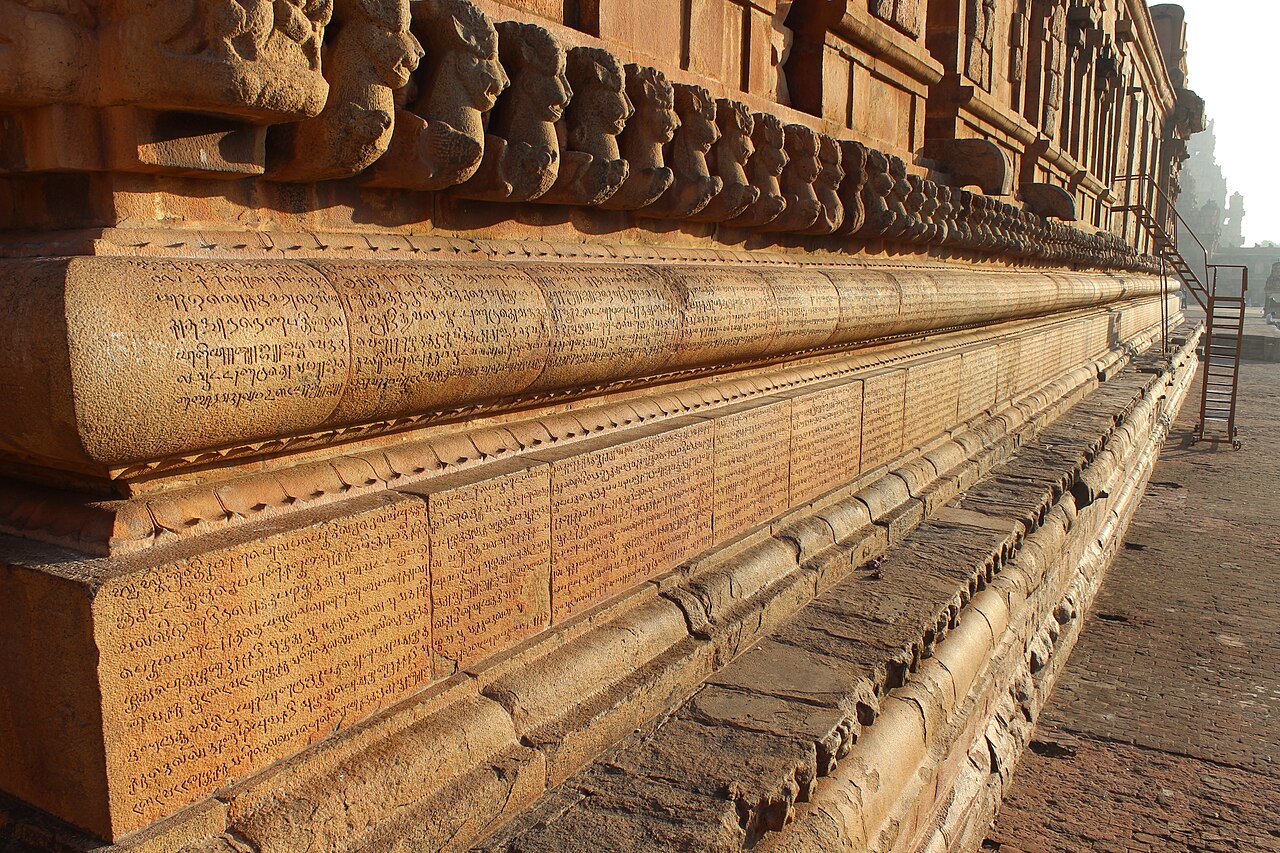
Stone inscriptions are important historical records, but their texts are often difficult to identify in photographs. Engraved characters may be faint, shallow or damaged, while cracks, rough stone surfaces, biological growth and uneven illumination can resemble written strokes. Traditional enhancement methods generally use fixed settings, which may work for one image but produce poor results when applied to inscriptions recorded under different conditions.
The new method was developed using photographs of 11th-century inscriptions at the Brihadeshwarar Temple in Thanjavur, India. The temple is a UNESCO World Heritage Site, and its inscriptions preserve significant historical and cultural information.
Researchers worked with a representative sample of 100 high-resolution photographs selected from a collection of more than 1,500 images taken at the temple. The sample included inscriptions with different levels of brightness, colour, sharpness, engraving depth and surface deterioration.
The proposed system operates in two main phases. First, it examines each photograph using measurable image characteristics, including sharpness, brightness, colour distribution and image quality. A clustering method then sorts the images into groups with similar visual conditions.
This automated classification divided the photographs into three general categories. One group contained darker images with relatively clear edges, another included images with moderate clarity and illumination, and the third represented brighter but more degraded or reflective stone surfaces.
The researchers compared the automated groupings with classifications made by an experienced heritage specialist. Thirteen of the 15 evaluated images were placed in the same category by both approaches, suggesting that the automated method can provide a consistent alternative to subjective visual assessment.
In the second phase, the system estimates the amount of noise in each image and automatically adjusts its processing settings. It combines wavelet-based filtering and non-local means filtering to reduce unwanted visual interference while attempting to preserve the edges of engraved characters.
The framework then enhances local contrast and converts the inscription into a simplified black-and-white image. Instead of using the same threshold for every photograph, it changes the sensitivity of the process according to the estimated noise level. Small visual fragments identified as background interference are subsequently removed.
Tests showed that this dynamic approach generally produced clearer separation between engraved text and stone surfaces than conventional methods using fixed parameters. It also preserved character shapes more effectively in images affected by uneven illumination or complex textures.
The system does not translate or interpret the inscriptions. Rather, it prepares images for later tasks such as character segmentation, digital tracing, recognition and epigraphic analysis.
Because the method does not require large collections of manually labelled images or extensive training of artificial-intelligence models, it may offer a relatively lightweight tool for heritage institutions working with limited technical resources.
The researchers present the framework as a scalable foundation for processing large and visually diverse archives of stone inscriptions. Further development could support more reliable documentation of endangered texts and improve access to inscriptions that have become increasingly difficult to read because of age, exposure and surface damage.
Published on: 31-07-2026
Edited by: Abdulmnam Samakie
Source: npj Heritage Science