- Archaeological News
-
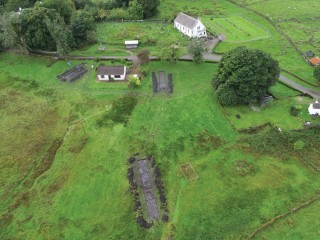 Aerial view of the 2019 archaeological excavations at Lismore, Scotland, with the oval building and metalworking area visible in the foreground.
Image Credit:
Ellis et al., Antiquity (2026)
Aerial view of the 2019 archaeological excavations at Lismore, Scotland, with the oval building and metalworking area visible in the foreground.
Image Credit:
Ellis et al., Antiquity (2026)
Lismore Finds Reveal a Major Early Medieval Monastic Centre
Archaeological investigations on the Scottish island of Lismore are reshaping the history of one of western Britain’s lesser-known early Christian centres, revealing an extensive cemetery, specialised craft workshops, early buildings and evidence for precious-metal working that together point to a wealthy and influential monastic community between the seventh and tenth centuries AD.
Known in Gaelic as Lios Mòr, Lismore lies at the mouth of Loch Linnhe in Argyll, western Scotland. Historical tradition associates the island with Saint Mo Luóc, or Moluag, whose monastery was established in the sixth century, while Irish chronicles record his death around AD 593–594. By the late seventh century, the island formed part of Dál Riata, the Gaelic-speaking kingdom whose religious and political networks stretched across western Scotland and northern Ireland.
For centuries, however, the monastery itself remained difficult to identify archaeologically. That began to change in 2016, when community-led investigations focused on the area around the present parish church and the ruins of Lismore Cathedral, long considered the most likely location of the early monastic settlement. Excavation and geophysical survey gradually revealed traces of buildings, possible enclosure boundaries and, most significantly, an early medieval cemetery.
One excavated area contained heavily intercut graves beneath later deposits, showing that the burial ground had been used repeatedly over a long period. Radiocarbon dating places the earliest tested burial between AD 650 and 780, while another dates to AD 900–1040. Further graves discovered nearby contained adults, adolescents and infants, some placed in stone-lined or stone-capped graves, alongside fragments of decorated early medieval cross-slabs that add another layer of evidence for the site’s religious importance.
The cemetery was only part of the picture. Nearby excavation uncovered an oval stone-built structure about eight metres across, with a limestone-paved interior and signs that it had been modified and reused over time. Deposits associated with the building date mainly from the eighth to tenth centuries, while adjacent craftworking layers extend from the seventh to ninth centuries, linking the structure to a wider zone of specialised production.
That activity was substantial. More than 1,000 fragments of non-ferrous metalworking debris were recovered from the workshop area, including crucibles, moulds and other manufacturing waste. The moulds indicate that craftspeople were producing penannular brooches and probably other fittings, while analysis shows that copper alloys were the main materials used. A smaller number of crucibles contained elevated levels of silver and gold, providing rare evidence for precious-metal casting at Lismore.
Other finds point to an equally sophisticated craft environment. Worked bone and antler included finely carved “motif pieces” decorated with interlaced designs, perhaps used to practise patterns or prepare ornament for metalwork. Waterlogged deposits preserved materials that rarely survive at comparable sites, among them worked yew associated with stave-built vessels and possibly a box, together with tools used for sharpening, polishing and manufacturing objects in wood, bone and metal.
Taken together, the scale and quality of this activity place Lismore among the more important ecclesiastical and elite centres of early medieval Britain and Ireland. Its assemblage of non-ferrous moulds and crucibles is among the largest yet found in Scotland after Dunadd, while some of the carved motif pieces have no close parallel elsewhere in the country. The evidence suggests that Lismore was not simply a religious retreat, but also a centre of skilled production, exchange and artistic activity.
The discoveries also invite a broader reconsideration of Lismore’s place within Dál Riata. The island’s fertile land, access to marine and freshwater resources and position near major routes through western Scotland would have given it considerable economic and strategic advantages. In this setting, Lismore may have played a greater role in early Christian networks than surviving written sources suggest, especially as the prominence of Iona has long dominated the historical picture of the region.
Direct archaeological evidence for the monastery’s sixth-century foundation has still not been identified, and the precise course of its enclosing boundary remains uncertain. Even so, the cemetery, buildings, sculpture and high-status craft production now provide strong evidence for a flourishing monastic community from at least the seventh century onward, giving Lismore a much clearer place in the religious and political landscape of early medieval Scotland.
Published on: 04-10-2026
Edited by: Abdulmnam Samakie
Source: Antiquity