- Archaeological News
-
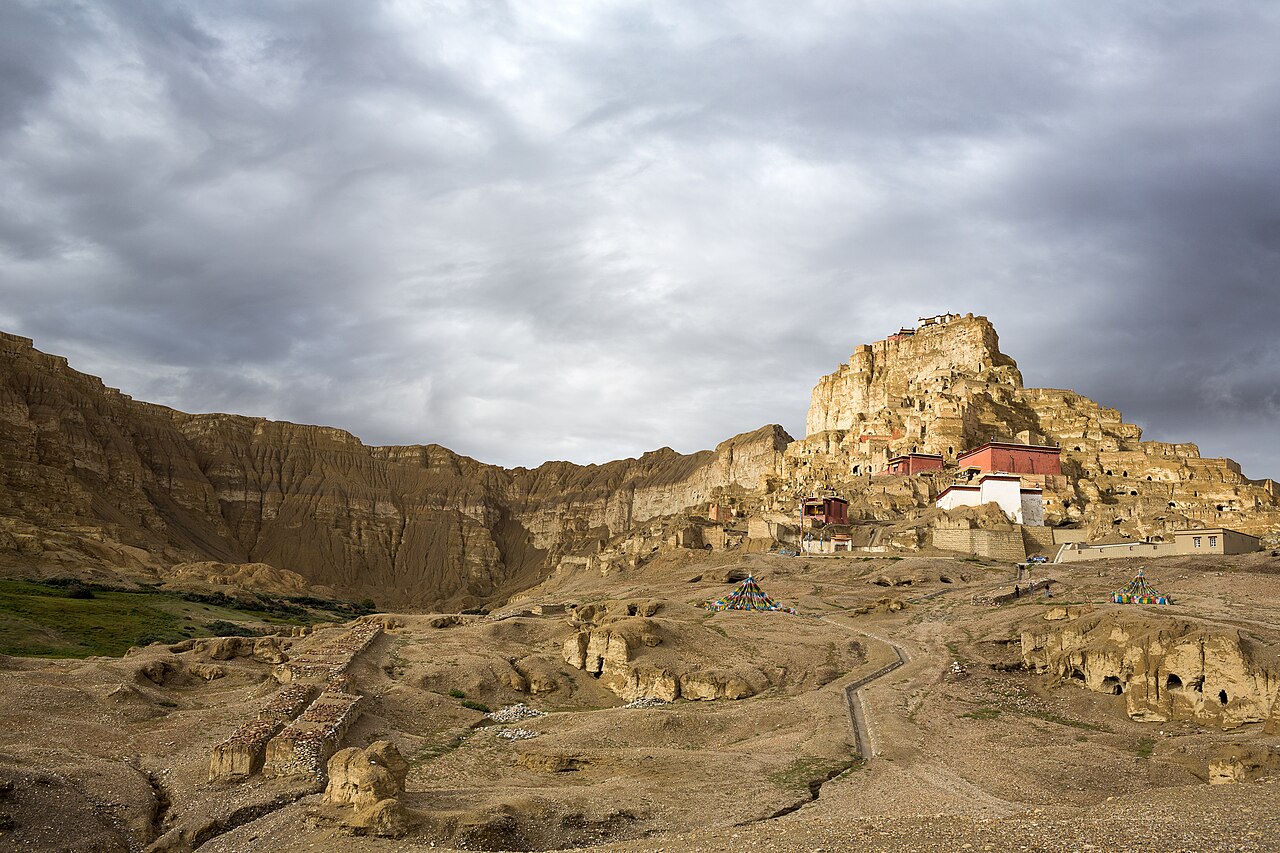
 Ruins of the ancient Guge capital at Tsaparang, western Tibet.
Image Credit:
squallgold, CC BY-SA 4.0, via Wikimedia Commons
Ruins of the ancient Guge capital at Tsaparang, western Tibet.
Image Credit:
squallgold, CC BY-SA 4.0, via Wikimedia Commons
Radiocarbon Dating Sharpens the Timeline of Tibet’s Guge Ancient City
A new scientific chronology is bringing several major structures at the ancient city of Guge in western Tibet into sharper historical focus, linking temple construction, Buddhist sculpture and later fortification to three distinct periods between the 15th and 18th centuries.
Guge emerged in the 10th century in Ngari, western Tibet, and Tsaparang later became one of its principal political and cultural centres. The archaeological complex is vast: more than 1,400 structures survive across the site, including palaces, caves, temples and ceremonial buildings. Yet dating those remains precisely has long been difficult because contemporary written records are scarce and earlier chronologies relied heavily on architectural form and mural style.
The new study combines accelerator mass spectrometry radiocarbon dating with Bayesian statistical modelling and evidence from Tibetan texts and inscriptions. Researchers analysed 12 plant samples—10 pieces of structural timber and two short-lived herbaceous remains—taken from four architectural contexts. They deliberately selected outer growth layers and small-diameter wood where possible, while the annual plants offered an especially useful way to reduce the “old-wood effect,” in which timber can predate the building where it was eventually used.
The earliest phase centres on the VIF27 complex and the nearby Mandala Hall. Three timber samples from VIF27 produced a Bayesian construction range of 1457–1471 AD after historical information from the Mandala Hall murals was incorporated into the model. The result closely matches the independently estimated date of the hall itself, placing both within a concentrated period of religious building activity during the mid-to-late 15th century.
A Buddha sculpture from another structure, IVF262, points broadly to the same phase, but its date is less secure. Radiocarbon calibration produced a much stronger probability for 1442–1501 AD and a smaller alternative range of 1599–1616 AD. The study considers the 15th-century attribution more consistent with the combined archaeological and historical evidence, while stressing that the later possibility can’t be eliminated statistically.
The White Temple provides the clearest mid-16th-century picture. Six samples came from the original structural cores and debris associated with damaged Buddha statues, including two herbaceous stalk samples with almost no old-wood offset. When those dates were modelled alongside historical evidence connected with the temple’s royal patronage, the end of the statue-production event narrowed to 1556–1560 AD.
That precision matters. Radiocarbon dates from the 16th century can fall across several possible calendar ranges because of irregularities in the calibration curve, but the short-lived plants helped anchor the sequence more closely to the actual period when the statues were made.
The final phase concerns Watchtower VIII D2, where two small twigs embedded in the original masonry were dated. The results point to construction or major reinforcement between the mid-17th and late 18th centuries, with two principal ranges: 1661–1695 and 1725–1813 AD. This doesn’t produce one neat answer. The radiocarbon evidence can’t distinguish between the two periods, although both coincide with episodes of conflict, political change and pressure along western Tibet’s frontier.
The internal consistency of the samples also supports the interpretation that the dated contexts represent discrete construction or production events rather than multiple major rebuilding episodes. Still, the sample set covers only four areas of an enormous site. Minor repairs may have escaped detection, so the proposed sequence is a framework to refine—not a final date for every part of Guge.
Taken together, the results establish a more detailed sequence for Guge: a major religious construction phase in the 15th century, renewed monumental Buddhist activity in the 16th, and later defensive works after the kingdom itself had disappeared as an independent power. Some uncertainty remains, especially where only a single sample was available, and wider sampling and regional tree-ring studies could refine the picture further.
Published on: 03-10-2026
Edited by: Abdulmnam Samakie
Source: PLOS One