- Archaeological News
-
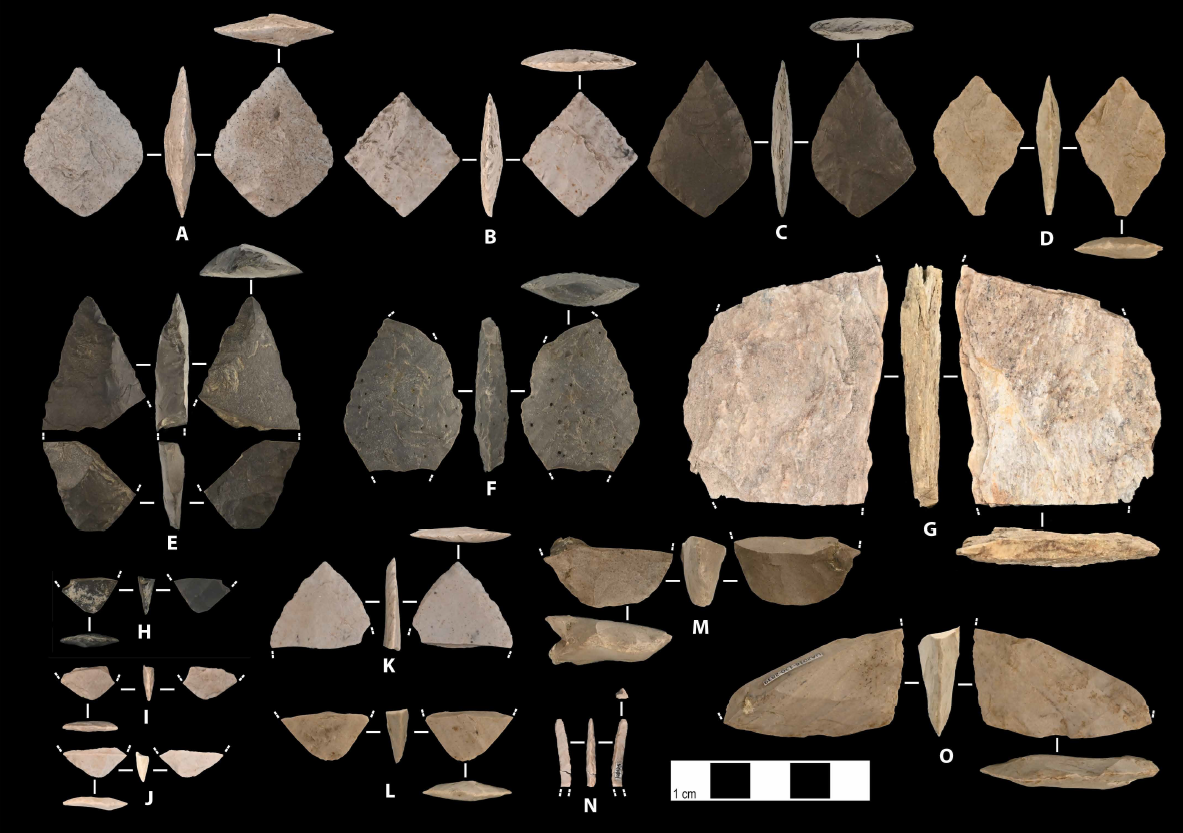
 Bifacial stone tools from the 13,800-year-old occupation at Shég’ Xdaltth’í’ in Alaska, including distinctive diamond-shaped forms that resemble artifacts found at contemporary sites in western Beringia.
Image Credit:
B. Potter / University of Kansas, in Graf et al., Science Advances (2026)
13,800-Year-Old Alaska Camp Reveals a Life Already Rooted in Beringia
A remarkably well-preserved archaeological site in interior Alaska is offering an unusually detailed glimpse of how people lived 13,800 years ago, revealing a camp with hearths, a possible shelter, an earth oven, specialized stone and bone tools and remains from a surprisingly broad range of animals.
The site, known as Shég’ Xdaltth’í’, meaning “They were there” in Alaska Native Athabascan, lies about 55 kilometres south-southeast of Fairbanks on traditional lands of Tanana Athabaskan communities. It overlooks the Tanana River from a high bluff, a position that provided shelter from north-westerly winds while giving its occupants a broad view across the surrounding floodplain.
Excavations have identified several periods of occupation, but the oldest layer is the most significant. Radiocarbon modelling places it mainly between about 13,850 and 13,500 years ago, with evidence that people may have arrived as early as around 14,000 years ago. This earliest occupation contains tens of thousands of artifacts, bones and other archaeological remains, making it one of the richest sites of its age in Beringia—the vast region that once connected Siberia and Alaska across the Bering Land Bridge.
This wasn’t simply a brief hunting stop. Within a 25-square-metre excavation area, researchers identified a large charcoal-stained zone interpreted as a possible dwelling or partially covered shelter. A hearth lay inside it, along with a shallow pit, a possible posthole and an anvil stone apparently used to break animal bones. Nearby was a pile of discarded bones and a large earth oven that may have been used repeatedly to slow-cook meat. The investment required to build and reuse these features suggests longer stays or repeated returns rather than a short-lived hunting camp.
The animal remains reinforce that picture. Nearly 7,000 bones were recovered from the earliest layer, including bison, caribou, mammoth, horse, hare, wolf, fox and lynx, as well as waterfowl and other birds. Some bones were burned, while heavily degraded deposits may reflect the processing of bone grease or the use of bone as fuel. A single fish vertebra was also identified.
Tools reveal another side of life at the camp. Eighteen worked bone or antler objects have been identified, including eight needle fragments, an awl, polished rods and a pierced pendant. Such sewing equipment points toward activities extending beyond hunting itself—repairing clothing, preparing equipment and carrying out everyday tasks within the camp.
Stone artifacts provide one of the study’s most important clues. Among them are distinctive double-pointed, diamond-shaped bifaces with ground edges suggesting that they were mounted in handles or shafts. Comparable forms have been found at roughly contemporary sites west of the former Bering Land Bridge in Arctic Siberia, while they are unusual in central Alaska. The resemblance gives researchers a rare material connection between communities on opposite sides of Beringia.
Long-distance movement is visible in the raw materials too. Obsidian found at the site came from a source around 370 kilometres to the west-northwest, showing that the inhabitants either travelled widely or participated in networks capable of moving valuable stone across considerable distances. Other tools were repeatedly sharpened and repaired, suggesting detailed knowledge of the regional landscape and careful management of useful materials.
Together, the evidence leads the researchers to describe Shég’ Xdaltth’í’ as something closer to a base camp used across multiple seasons than a temporary hunting station. It lacks the storage pits and substantial houses expected at a permanent settlement, but the density of artifacts, domestic features, animal diversity and repeated use all indicate a community already well adapted to interior Alaska.
The site is also the earliest known expression of the Nenana Complex east of the Bering Land Bridge. Its technology differs from another early Alaskan tradition based on microblades, raising the possibility that Late Pleistocene Beringia contained culturally distinct groups rather than a single uniform population. Exactly how those archaeological traditions relate to the populations identified by ancient DNA remains unresolved.
Shég’ Xdaltth’í’ therefore doesn’t mark the earliest known human presence in Beringia. What it offers instead is something just as valuable: a rare picture of people no longer simply passing through a northern landscape, but learning it, returning to it and making it home.
Published on: 20-10-2026
Edited by: Abdulmnam Samakie
Source: Science Advances