- Archaeological News
-
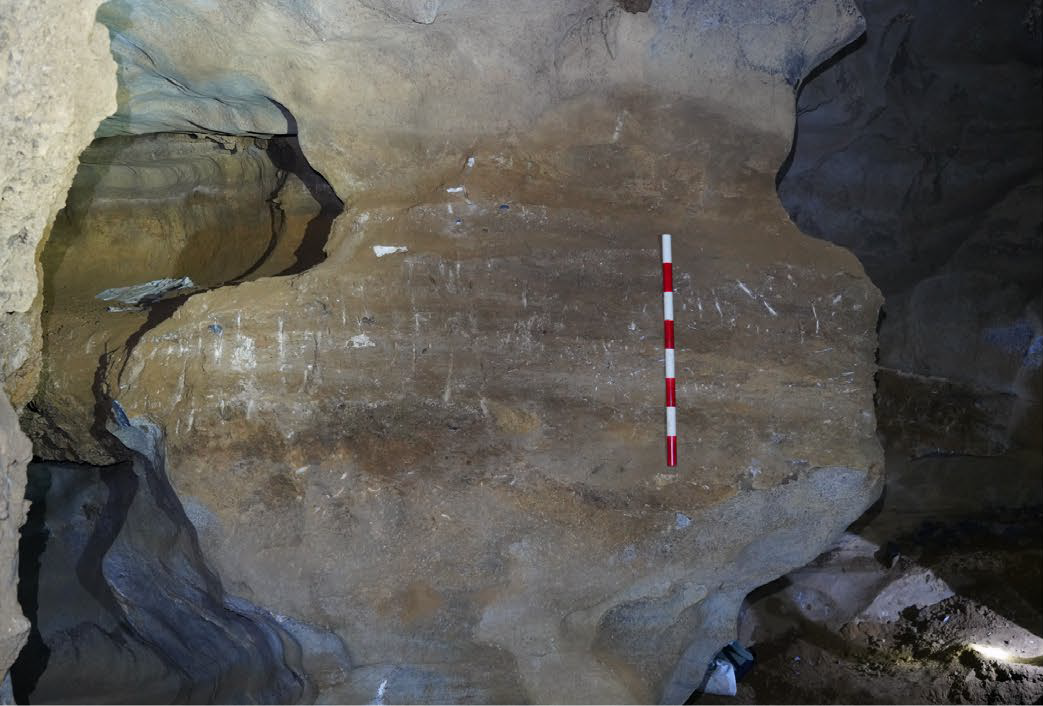
 Sedimentary deposits inside Chuanshandong Cave in southern China, where two ancient human teeth were discovered. Analysis suggests that the remains may belong to a distinct archaic human lineage with evolutionary links to Homo erectus.
Image Credit:
Xing et al., Nature (2026)
Ancient Teeth Reveal Denisovans and a Mysterious Human Lineage in Southern China
Four ancient human teeth discovered in southern China are providing new evidence that the region was once home to several distinct human populations. A new study in identifies remains belonging to a population closely related to the Denisovans, alongside another archaic human lineage whose evolutionary identity remains unresolved.
The fossils were recovered from Chuanshandong Cave in Long’an County and Longchuandong Cave in Luzhai County, both located within the limestone landscapes of Guangxi. The discoveries form part of archaeological investigations that began in 2016 across a region extending more than 500 kilometres through southern China.
Two teeth were recovered from each cave, together with numerous animal fossils. Dating analyses indicate a minimum age of approximately 100,800 years for the Chuanshandong human remains, while the two Longchuandong teeth yielded age estimates of around 104,500 and 42,600 years. No stone tools or other cultural remains were found in direct association with the human fossils.
To determine which ancient human populations the teeth belonged to, researchers combined detailed examinations of their external and internal structures with analyses of ancient proteins preserved in tooth enamel. This molecular approach, known as palaeoproteomics, is particularly valuable in warm and humid environments, where ancient DNA rarely survives over long periods.
The two teeth from Longchuandong displayed characteristics closely resembling those of previously identified Denisovans. One molar was particularly similar in shape and internal structure to a Denisovan tooth discovered in Denisova Cave in the Altai Mountains of Siberia.
Protein analysis provided further support for this identification. Both Longchuandong teeth carried a variation in ameloblastin, a protein involved in the formation of tooth enamel, that has also been identified in Denisovan remains from Siberia, Harbin in northeastern China, the Penghu Channel near Taiwan and Bianfu Cave in southwestern China.
Together, the morphological and molecular evidence strongly supports the presence of a Denisovan-related population in subtropical southern China. The findings further expand the known geographical distribution of these ancient humans, who appear to have occupied remarkably diverse environments, ranging from cold Siberian landscapes and high-altitude plateaus to warm and humid regions of Asia.
The teeth from Chuanshandong, however, presented a more complicated picture. They retained several characteristics associated with Homo erectus, including complex root structures, while also displaying more derived features found in later human populations. Their combination of characteristics did not clearly match any established ancient human group.
Protein analysis reinforced this distinction. One of the recovered proteins carried a variation previously identified in Middle Pleistocene Homo erectus from East Asia. Another retained an ancestral variation known from the much older species Homo antecessor. The sample also lacked the protein variation identified in the two Longchuandong teeth.
These findings suggest that the Chuanshandong remains may represent a distinct archaic human lineage with evolutionary connections to Homo erectus. One possibility is that an older human population survived in southern China for much longer than previously recognized. Another is that interactions and interbreeding between different archaic populations contributed to its unusual combination of characteristics.
However, the researchers caution that the available protein evidence is limited and does not yet establish whether the Chuanshandong fossils belong to a previously unidentified species or a population shaped by a more complex evolutionary history.
The discoveries challenge the idea that Denisovans alone accounted for the diversity of archaic human populations across East Asia during the Middle and Late Pleistocene. Instead, southern China may have supported several distinct human lineages, some of which remain poorly understood. Further fossil discoveries and molecular analyses will be essential to clarify their relationships and reconstruct the complex history of human evolution in the region.
Published on: 28-11-2026
Edited by: Abdulmnam Samakie
Source: Nature