- Archaeological News
-
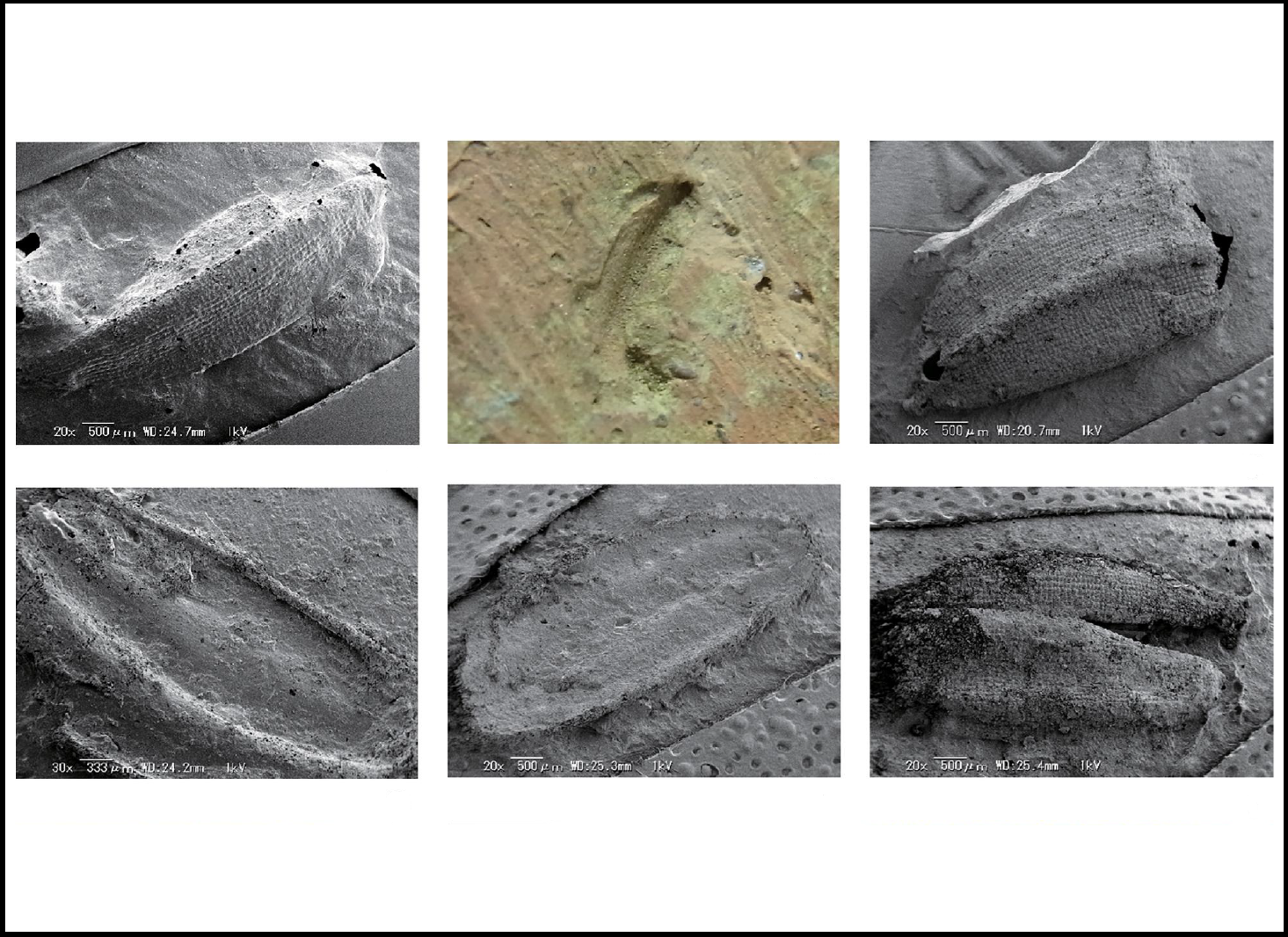
 Microscopic images and a photograph of rice impressions preserved in ancient pottery, including a rice grain and rice husks.
Image Credit:
Endo et al., Frontiers in Environmental Archaeology (2026)
Microscopic images and a photograph of rice impressions preserved in ancient pottery, including a rice grain and rice husks.
Image Credit:
Endo et al., Frontiers in Environmental Archaeology (2026)
Ancient Pottery Impressions Reveal Farming Across Kazakhstan’s Steppe
New archaeological research from southern Kazakhstan is challenging the long-standing image of ancient Central Asian steppe communities as societies dependent almost entirely on mobile pastoralism. Impressions of grains preserved in pottery show that farming was incorporated into local economies over more than two millennia, from the Bronze Age through the Iron Age, alongside herding and other forms of subsistence.
The study examined ceramic fragments from 24 archaeological sites across southern Kazakhstan, 15 of which had not previously been included in this type of analysis. The sites range in date from about 1700 BC to AD 400 and extend across a broad zone between the pastoral steppe to the north and more intensively agricultural regions to the south. Researchers identified impressions left by hulled and naked barley, broomcorn millet, foxtail millet, and rice.
Plant remains are often difficult to recover from open-air archaeological sites on the steppe because erosion and wind deflation can destroy or disturb deposits. The researchers therefore turned to pottery itself. Seeds and plant material could accidentally become pressed into wet clay while vessels were being made. Once fired, the ceramic preserved the shape of the grain even when the original plant material disappeared.
To study these traces, the team examined pottery surfaces and cavities and produced silicone replicas of selected impressions. These casts were then studied with scanning electron microscopy, allowing details of grain shape, husks, grooves, and surface structures to be compared with known cereals. The method can provide a short snapshot of plant use around the time a vessel was manufactured.
The results show that domesticated grains were represented at all six Bronze Age sites examined. Grain impressions were also found at eight of nine Iron Age sites associated with the Saka, populations traditionally described primarily as nomadic, as well as at most of the more sedentary Iron Age sites included in the study. The researchers caution that pottery impressions cannot show how much grain people consumed or prove that every crop was cultivated locally. However, the widespread occurrence of grains suggests that agriculture formed part of economic life across much of the region.
The evidence also points to changes in crop choices through time. Barley appears to have been more prominent during the second millennium BC, while broomcorn millet became increasingly widespread during the first millennium BC. Millet was identified at 15 of 19 Iron Age sites in the dataset. Its short growing season and ability to grow in relatively dry conditions would have made it suitable for small plots near rivers and seasonal camps, potentially allowing farming to complement pastoral mobility.
Several impressions also indicate that millet grains had been processed for human consumption rather than simply used as animal feed. The presence of chaff and other plant parts further supports the possibility that at least some crops were grown locally, although the researchers stress that this cannot yet be demonstrated conclusively.
Among the most notable discoveries were five rice impressions from the Myntobe and Kultobe sites along the Syrdarya River: one grain and four husks. Their archaeological contexts fall within the first centuries AD, and the study describes them as among the oldest rice remains known outside East Asia. The surviving husk impressions also suggest that rice processing may have taken place close to domestic pottery-making areas.
The rice finds are especially important because they add a north-south dimension to discussions of ancient crop movement across Central Asia. The researchers suggest that rice probably reached the region from the south, while other crops followed different routes across Eurasia. Southern Kazakhstan may therefore have functioned not simply as a boundary between farmers and pastoralists, but as a cultural crossroads where different crops, technologies, and economic traditions met.
Overall, the study presents ancient steppe economies as flexible rather than sharply divided between farming and herding. The pottery evidence indicates that communities adapted agriculture to dry environments and combined cultivation with pastoral strategies in different ways through time. The findings add to a growing archaeological picture of Central Asia as an interconnected and economically diverse region rather than a landscape occupied exclusively by specialized nomads.
Published on: 01-09-2026
Edited by: Abdulmnam Samakie