- Archaeological News
-
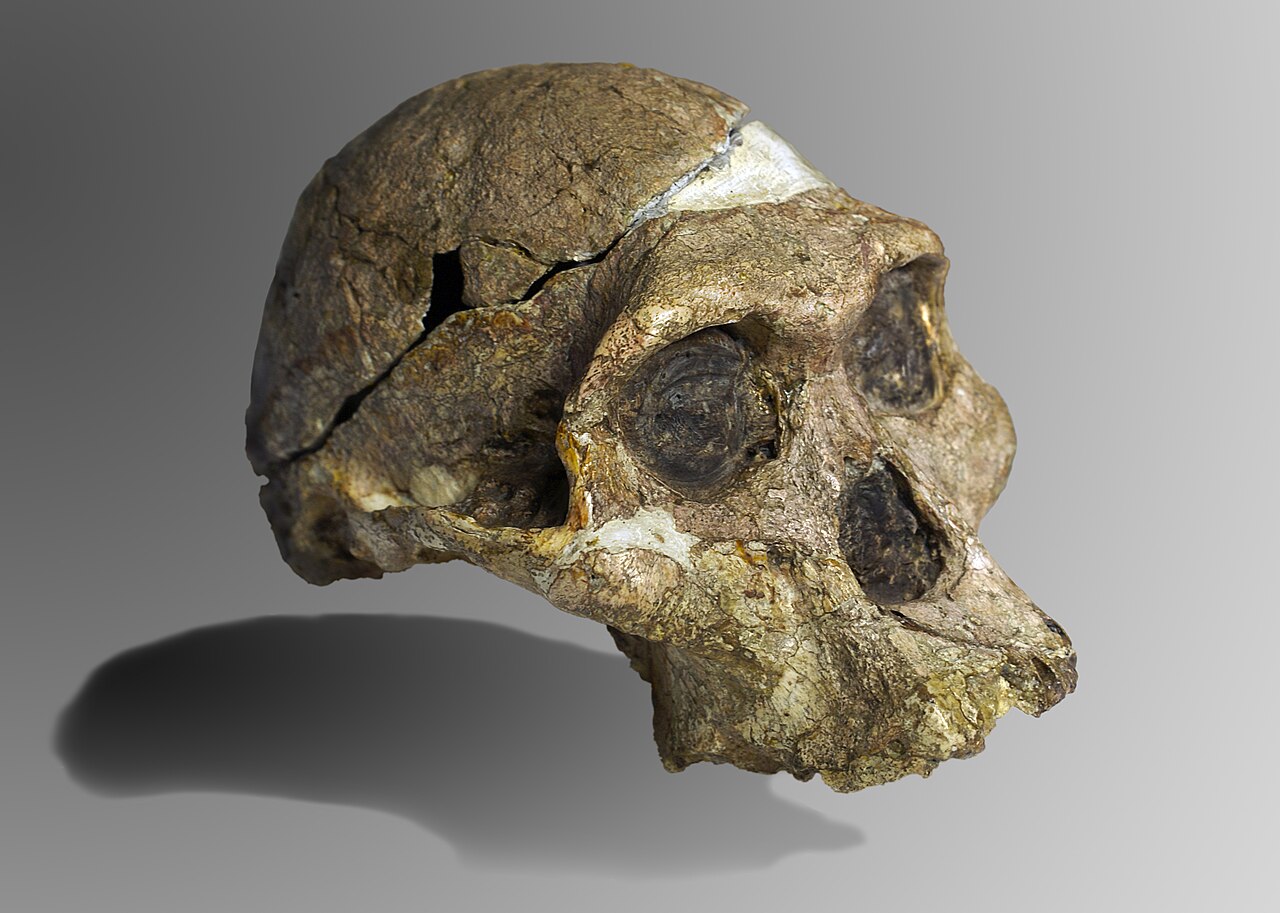
 The Sts 5 skull, known as "Mrs. Ples," an approximately 2.1-million-year-old Australopithecus africanus specimen from Sterkfontein, South Africa.
Image Credit:
Ditsong National Museum of Natural History, CC BY-SA 4.0, via Wikimedia Commons
Fossil Skulls Reveal a Different Story of Early Human Brain Evolution
A new computational study of fossil skulls suggests that the transition from Australopithecus to early members of the genus Homo involved important changes in specific parts of the brain rather than a simple enlargement of the frontal lobes, offering a more detailed view of how early human’s brain organization may have evolved nearly two million years ago.
Because brain tissue doesn’t fossilize, researchers usually rely on endocasts—the internal shape of the skull—to estimate the form of ancient brains. But the faint impressions left by folds and grooves on fossil skulls can be difficult to identify and sometimes misleading. To move beyond these limitations, the new study combined CT scans of fossil crania with comparative brain data from modern humans, chimpanzees and macaques, using a mathematical model to estimate the regional anatomy that could have occupied each fossil skull.
The analysis included seven fossils: two Australopithecus africanus specimens dating to roughly 2.0–2.6 million years ago, two Homo habilis specimens around 1.76–1.78 million years old, and three Homo ergaster fossils dating between about 1.50 and 1.65 million years ago. The researchers reconstructed 39 brain regions for each specimen and compared both their absolute and relative volumes.
The clearest difference appeared in the posterior cerebellum. Although overall brain size increased from Australopithecus through Homo habilis to Homo ergaster, the posterior portion of the cerebellum showed a particularly marked expansion. In some reconstructed Homo ergaster specimens, its absolute size was roughly twice that estimated for Homo habilis. Its relative contribution to total brain volume also increased, indicating that the change wasn’t simply a consequence of a larger brain overall.
The cerebellum is traditionally associated with movement, coordination and precise motor control, so the authors raise the possibility that its expansion may have supported increasingly refined hand movements and more complex tool-related behaviour. Modern research also links the cerebellum to working memory, language and other cognitive processes. Still, the study is careful here: brain shape alone can’t demonstrate what extinct hominins were thinking or doing, and any behavioral connection remains hypothetical.
Another change appeared in the temporoparietal region, which expanded relatively from Homo habilis to Homo ergaster. In modern humans, areas in this broader region participate in functions that include social communication and aspects of tool use, but the researchers again avoid treating the fossil reconstruction as direct evidence for any particular ability.
Perhaps the most surprising result concerns the frontal lobe. Rather than showing a major proportional expansion from Australopithecus into early Homo, its total relative volume remained broadly similar across the sampled fossils. Some localized differences appeared, including changes in parts of the inferior frontal region, but the study found no simple trend toward a progressively larger frontal lobe during this interval.
That finding doesn’t mean the frontal cortex remained unchanged in every respect. Features such as neural connections, cell organization and neurotransmitter systems can’t be recovered from fossil skulls, and major frontal reorganization may have occurred later in human evolution. The results concern broad regional proportions only.
The method itself also has limits. Only seven fossils could be included, preservation varies between specimens, and the reconstruction model is constrained by brain variation observed in living humans, chimpanzees and macaques. The resulting models should therefore be viewed as biologically plausible estimates, not digital recoveries of the actual brains of extinct individuals.
Even with those cautions, the study points toward a more complex picture of early human brain evolution. The emergence of Homo may not have involved every region expanding together. Instead, different parts of the brain appear to have changed at different rates, with the cerebellum and temporoparietal areas becoming particularly important in the process of gradual regional reorganization.
Published on: 26-10-2026
Edited by: Abdulmnam Samakie
Source: Communications Biology