- Archaeological News
-
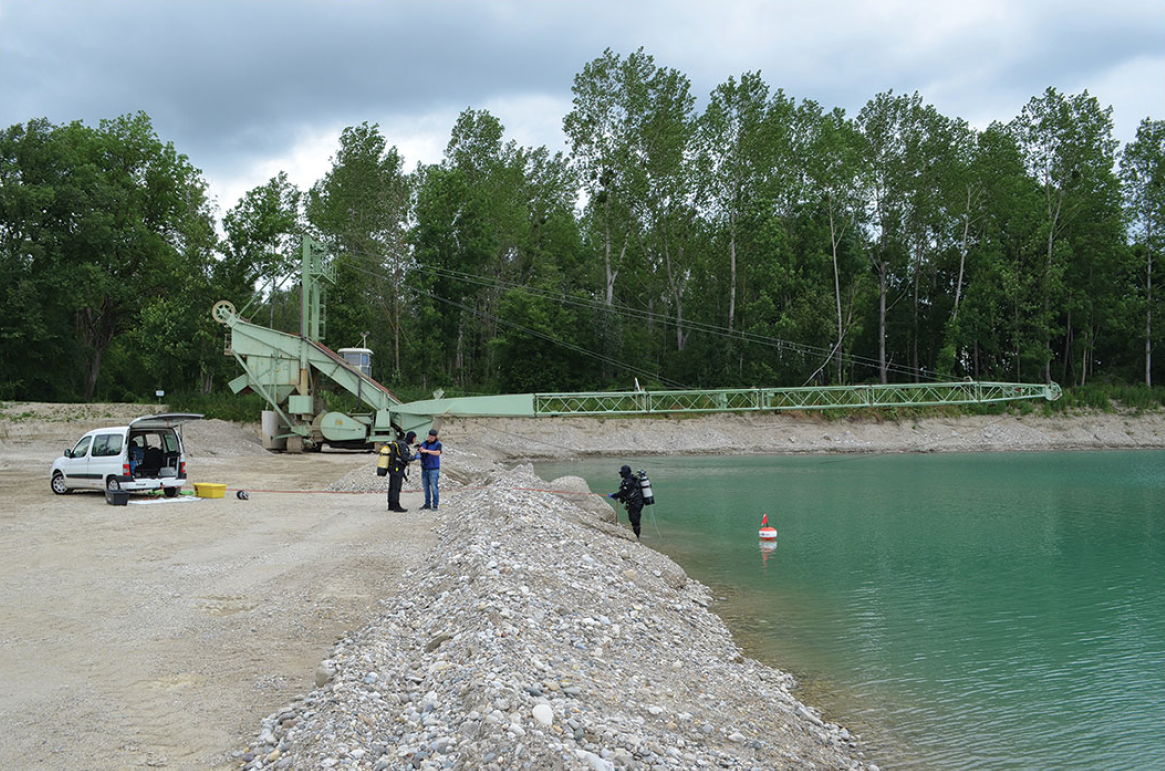
 The Deinham gravel pit in Upper Austria, where archaeological divers investigated the find spot of the large Iron Age iron-bar assemblage.
Image Credit:
Trebsche & Berranger, Antiquity (2026)
One-Tonne Iron Cargo from the Danube Reveals the Scale of Iron Age Trade
An extraordinary concentration of at least 500 iron bars recovered from an old branch of the Danube in Upper Austria is offering new evidence for the scale of iron production and long-distance trade in Central Europe during the Late Iron Age. Weighing more than one tonne in total, the assemblage is the largest known collection of Iron Age iron bars yet identified in Europe and may represent the cargo of a vessel lost while travelling along the river.
The objects were discovered in 2019 during gravel extraction at Deinham, near the right bank of the Danube. Workers noticed numerous pointed iron objects being lifted from beneath the water and reported the discovery to archaeological authorities. Subsequent collection from the gravel produced 540 fragments. By matching broken pieces and examining the surviving portions, researchers established a minimum of exactly 500 individual bars, including 193 that remain complete.
The bars are heavily corroded, and many still carry gravel and sand attached to their surfaces. Complete examples average around 28.5 centimetres in length and weigh about 2.1 kilograms, although individual weights vary considerably. The original weight of the entire iron assemblage, excluding gravel and allowing for missing fragments, is estimated at approximately 1,035 kilograms.
Their unusual form is especially important. Each bar is pointed at both ends or has a generally double-pointed, elongated shape, often resembling a willow leaf. These objects were not finished tools and should not strictly be described as cast ingots. Instead, they were forged semi-finished products that could later be transformed by blacksmiths into weapons, tools, nails or other iron objects. Researchers identify the Deinham examples as a newly recognized variant of a broader class of long bipyramidal iron bars known from Iron Age Europe.
Similar objects had often been associated with earlier Iron Age contexts, but direct radiocarbon dating of carbon trapped inside three Deinham bars produced significantly later dates. The calibrated ranges extend broadly between the fourth and first centuries BC, with probability concentrations in the later fourth century and again between the late third and second centuries BC. Comparisons with related finds from dated settlements suggest that the latter interval, particularly the second century BC, is the more likely archaeological context for the cargo.
The find location adds another dimension to the discovery. Historical maps show that the objects came from an area once occupied by braided channels of the Danube, where shifting currents, sandbanks and other obstacles would have complicated navigation. No remains of a boat were recovered, partly because industrial excavation had already disturbed the original context. Nevertheless, the concentration of more than a tonne of uniform semi-finished iron in a river channel makes accidental loss during transport a strong possibility. Ritual deposition cannot be completely excluded, but the homogeneous nature of the assemblage differs from the more varied objects usually found in ritual river deposits.
The sheer quantity of iron provides a rare indication of the productive capacity of Late Iron Age communities. The assemblage is much larger than other known deposits of bipyramidal bars, which generally contain only several dozen examples. Its size supports broader archaeological evidence that iron production expanded considerably during the third and second centuries BC.
To illustrate the scale involved, approximately one tonne of iron could theoretically have provided enough material for around 500 swords weighing 1.5–2 kilograms each, even allowing for losses during forging. Alternatively, it could have produced as many as 8,000 large iron nails. These comparisons do not reveal what the bars were actually intended to become, but they demonstrate the exceptional economic value represented by the shipment.
Where the iron originated remains unresolved. Because heavy cargo was most efficiently transported downstream, possible production areas are being sought upstream along the Danube and its tributaries. Iron-producing districts in Bavaria, including areas near Kelheim, Manching and the Upper Palatinate, are considered plausible candidates, particularly because similar bars have been found there. Chemical and metallographic analyses are still underway to determine whether the bars came from a single production center or several workshops.
The Deinham assemblage therefore offers an unusually tangible picture of Iron Age commerce: not isolated tools or weapons, but more than a tonne of iron prepared for transport and further manufacture. Whether the cargo sank in a shipwreck or was lost under other circumstances, it demonstrates that large quantities of metal were already moving along the Danube within organized production and exchange networks more than two thousand years ago.
Published on: 25-09-2026
Edited by: Abdulmnam Samakie
Source: Antiquity