- Archaeological News
-
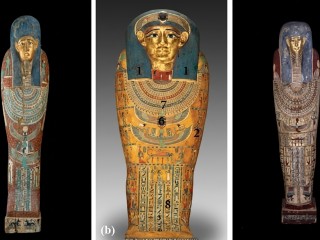 Ptolemaic cartonnage examples used for stylistic comparison and dating.
Image Credit:
Al-Gaoudi & Rehan, npj Heritage Science (2026)
Ptolemaic cartonnage examples used for stylistic comparison and dating.
Image Credit:
Al-Gaoudi & Rehan, npj Heritage Science (2026)
Science Reveals the Materials Behind a Ptolemaic Egyptian Mummy Mask
A previously unpublished Egyptian mummy mask preserved in the Egyptian Museum in Cairo has been scientifically examined for the first time, revealing details about its construction, pigments, gilding and preservation and supporting its attribution to the Ptolemaic period.
The polychrome cartonnage mask, catalogued as Object No. 1032, has no documented archaeological provenance, excavation context or acquisition history and has never been publicly exhibited. Researchers therefore combined stylistic analysis with several scientific techniques to reconstruct its chronology and manufacturing technology.
The mask consists of an integrated head and upper body with a tripartite wig, gilded facial features, almond-shaped eyes, a broad decorative collar and a gilded hieroglyphic inscription. Its continuous frontal form and other stylistic characteristics closely resemble securely dated Ptolemaic examples.
These comparisons, supported by the scientific evidence, allowed researchers to attribute the mask to the Ptolemaic period, more specifically the second to first centuries BCE.
Microscopic examination revealed the characteristic layered structure of Egyptian cartonnage. A plain-woven textile support formed the base, followed by a white mineral preparation layer and finally the painted and gilded surface.
Analysis of the textile showed plant-based cellulosic fibres consistent with linen, a material widely used in ancient Egyptian funerary objects. The white preparatory layer was dominated by calcite, with smaller amounts of gypsum and siliceous impurities.
The pigment analysis revealed a sophisticated palette of traditional Egyptian materials.
The vivid blue areas, particularly the tripartite wig, contained Egyptian blue, or cuprorivaite, a synthetic calcium-copper silicate pigment widely associated with ancient Egyptian painting.
Red decoration included vermilion, made from mercury sulfide, as well as hematite. The presence of both materials may indicate deliberate pigment mixing to alter colour, opacity or surface coverage. Green areas contained malachite, while the black pigment was identified as an iron oxide rather than carbon-based black.
Researchers also identified thin sheets of high-purity gold leaf on the face and decorative elements. The use of gold had both visual and religious significance in Egyptian funerary art, where it was closely associated with divine and eternal qualities.
Analysis of the binding materials revealed another aspect of the artisans’ technical knowledge. Protein-based adhesive, probably of animal origin, was used between structural layers, while gum Arabic served as the binder for painted and gilded surfaces.
This layer-specific use of different adhesives indicates careful selection of materials according to their function.
The investigation also documented significant deterioration. The linen fibres show brittleness, tearing and abrasion, while painted surfaces exhibit cracking, flaking and localized detachment.
Particularly notable is deterioration affecting the Egyptian blue. Some originally blue areas have become gray and powdery, a process sometimes described as “blue decay” or “blue cancer.” Researchers associate this alteration with chloride-related reactions affecting copper-bearing compounds in the pigment.
Despite these problems, the mask preserves valuable evidence of Ptolemaic craftsmanship. Its combination of linen, calcite-based preparation, mineral pigments, gold leaf and carefully selected organic binders demonstrates the technical complexity behind Egyptian cartonnage production.
The study also highlights the value of scientific analysis for museum objects lacking archaeological context. By examining their materials and manufacturing techniques without extensive destructive sampling, researchers can recover information about their date, workshop practices and preservation needs even when their original archaeological histories have been lost.
Published on: 14-08-2026
Edited by: Abdulmnam Samakie
Source: npj Heritage Science