- Archaeological News
-
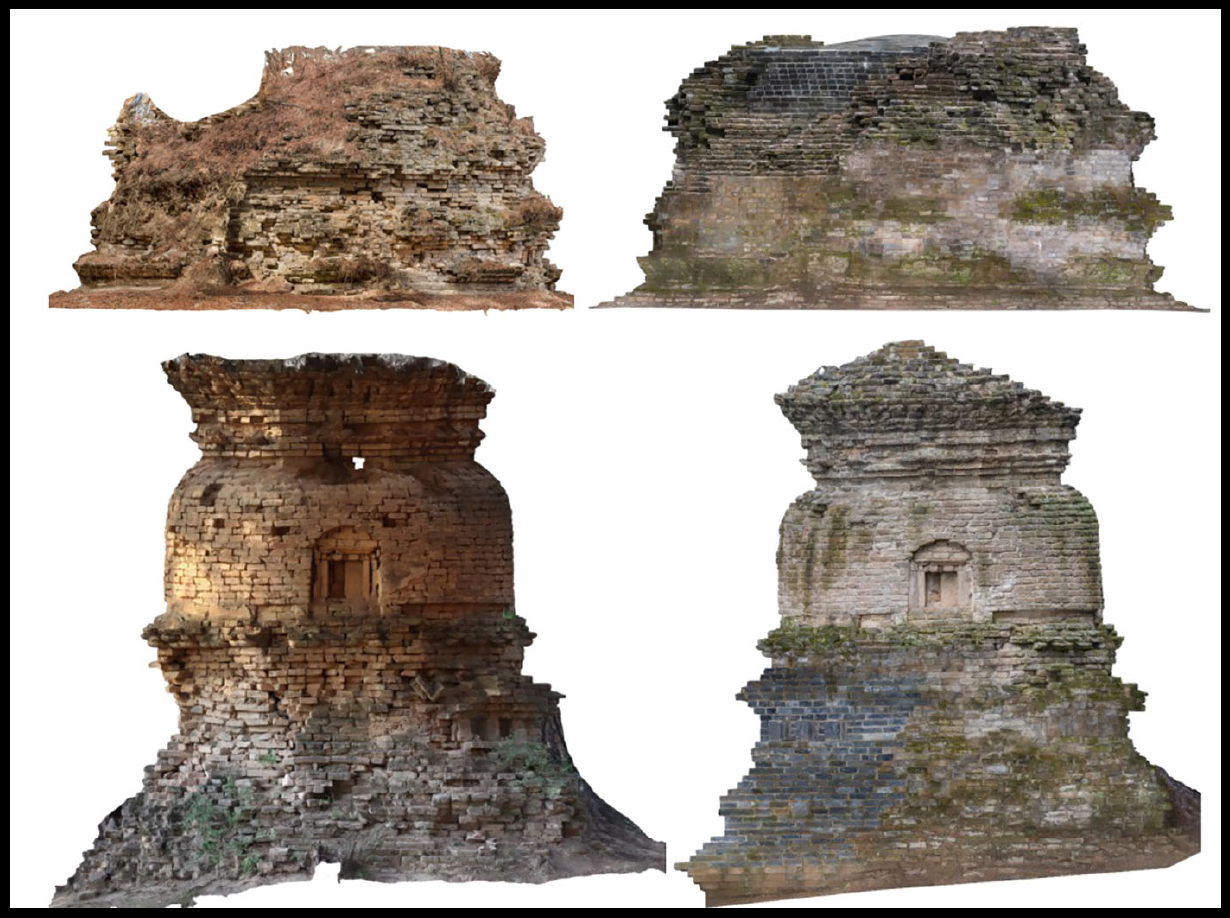
 Before-and-after conservation views of two masonry pagodas at Foguang Temple: the unnamed inverted-bowl-shaped pagoda above and the Wugou Jingguang Pagoda below.
Image Credit:
Lyu et al., npj Heritage Science (2026)
Leaning Tang Pagodas Reveal a New Approach to Heritage Conservation
A long-term assessment of three ancient masonry pagodas at Foguang Temple in China’s Shanxi Province has shown how digital surveying, material analysis and environmental monitoring can guide conservation without unnecessary structural intervention. The work followed the monuments through four survey stages in 2011, 2020, 2024 and 2025, covering conditions before conservation, work in progress and the period immediately after completion.
Foguang Temple, on the southern foothills of Mount Wutai, preserves important Buddhist architecture from the Tang Dynasty and forms part of a World Heritage property. Although the temple’s timber buildings have received extensive attention, several masonry pagodas outside the main enclosure have been studied far less. Three of these structures were examined in detail: the Pagoda of Master Fangbian, built in AD 795; the Wugou Jingguang Pagoda, built in AD 752; and an unnamed inverted-bowl-shaped pagoda generally attributed to the late Tang or early Five Dynasties period.
High-resolution 3D laser scanning and photogrammetry revealed that two of the monuments lean noticeably. The Pagoda of Master Fangbian has an overall inclination of about 2 degrees toward the southwest, while the unnamed pagoda tilts by roughly 3 degrees toward the southeast. Comparison with earlier records, however, showed no significant increase in either inclination. The two structures were therefore interpreted as being in a long-term “metastable” condition: not perfectly stable, but currently maintaining an overall equilibrium rather than undergoing rapid structural movement.
The more immediate threats were found on the surfaces and within the masonry itself. Between 2011 and 2020, brick loss increased on several elevations of the Fangbian Pagoda, and new cracks appeared around openings and inscriptions. The Wugou Jingguang Pagoda displayed loose bricks, cracks, deterioration of murals, vegetation growth and partial collapse near its upper section. The unnamed pagoda also showed widespread brick loss, cracking, salt deposits, weathered interior masonry and traces of water seepage.
Material tests helped explain these problems. Exposed brick surfaces generally absorbed more water and showed greater deterioration than protected inner layers. Analysis of white deposits also identified salts associated with moisture movement through the masonry. Environmental monitoring showed strong seasonal changes in temperature and humidity, with cold winters, humid periods and concentrated rainfall creating conditions for repeated freezing and thawing, wetting and drying, and continued salt movement.
These findings changed the conservation priorities. Because the leaning had not increased significantly, the project did not attempt to straighten the pagodas through large-scale dismantling and rebuilding. Instead, work concentrated on the active causes of deterioration: improving drainage, reducing water infiltration, removing accumulated soil and damaging vegetation, repairing cracks and loose masonry, repointing joints and improving waterproofing.
Compatibility with the historic fabric was also emphasized. Original displaced bricks were reused wherever possible, while replacement bricks were selected to match the physical properties of the older masonry rather than simply being stronger. Traditional lime-based mortars were preferred for repairs and joint filling because analyses showed that earlier mortars were predominantly lime-based, sometimes with plant fibers.
The conservation plan was also adjusted as work progressed. When soil and vegetation were removed from the top of one pagoda in 2024, previously hidden structural details and displaced bricks were exposed. Instead of following the original waterproofing proposal unchanged, the bricks were documented, cleaned and repositioned, allowing more of the historic arrangement to be retained.
Post-conservation observations in 2025 found no visible expansion of major structural cracks, while repaired joints remained bonded and surface salt deposits and biological growth were reduced. These results indicate that the interventions controlled active deterioration in the short term. However, the monitoring period after completion remains brief. Continued observation will be needed to determine how the pagodas respond over the longer term to moisture, salts, freeze-thaw cycles and changes in their foundations. The findings therefore support an approach to heritage conservation based on repeated diagnosis, minimal intervention and long-term monitoring rather than automatically correcting every visible deformation.
Published on: 04-09-2026
Edited by: Abdulmnam Samakie
Source: npj Heritage Science