- Archaeological News
-
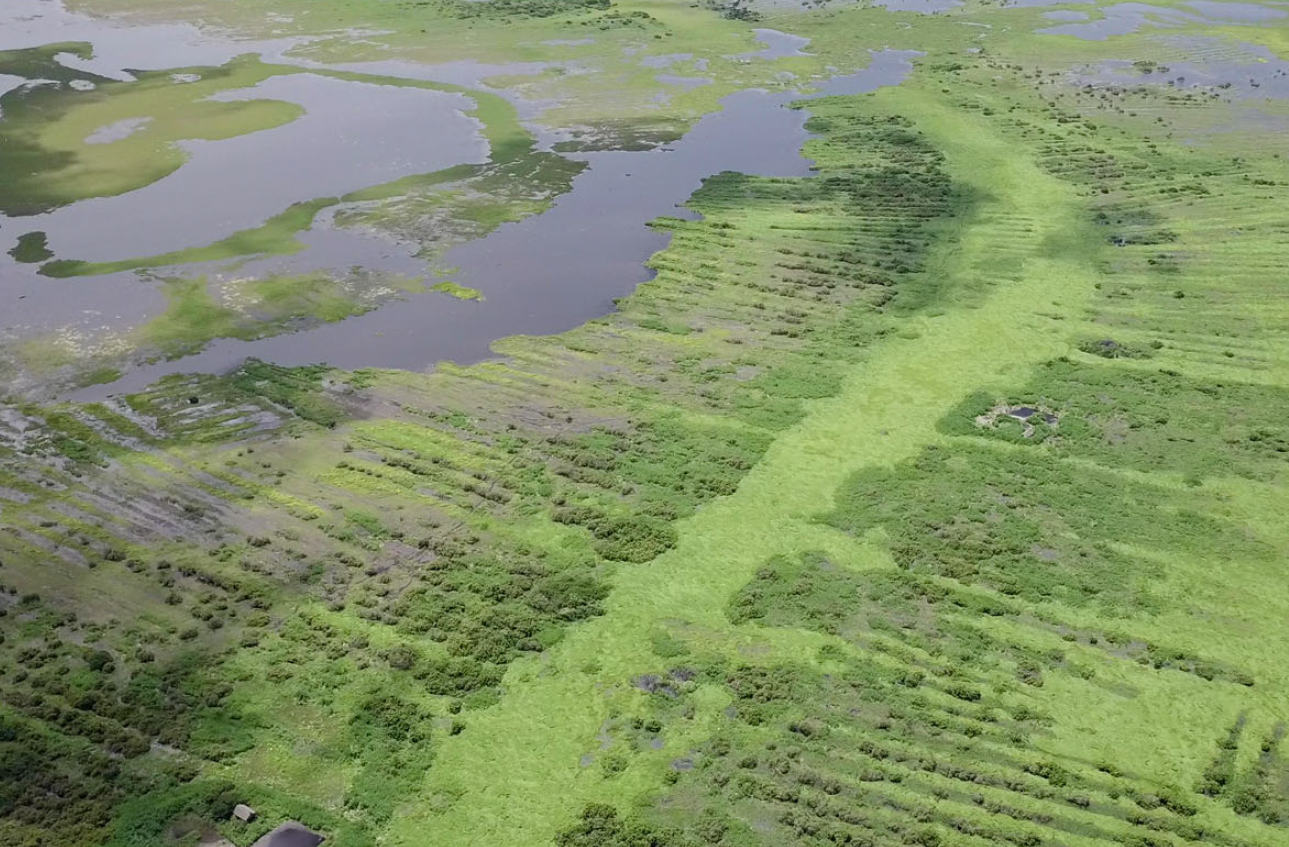
 Aerial view of the ancient canal-and-ridge hydraulic system in La Mojana, Colombia.
Image Credit:
Nicolás Jiménez, Vieri et al., Communications Sustainability (2026)
Aerial view of the ancient canal-and-ridge hydraulic system in La Mojana, Colombia.
Image Credit:
Nicolás Jiménez, Vieri et al., Communications Sustainability (2026)
Ancient Zenú Waterworks Show the Power of Collective Labour
A new archaeological study of pre-Hispanic raised-field systems in northern Colombia suggests that one of the region’s largest ancient hydraulic landscapes could have been built and maintained by local communities without centralized state control.
Across La Mojana, a seasonally flooded lowland in the Colombian Caribbean, pre-Hispanic societies constructed vast networks of canals and elevated agricultural ridges known as camellones. These systems extend across more than 500,000 hectares and are commonly associated with the Zenú archaeological tradition. They were used from the final centuries BC until around the 10th or 11th century AD.
The networks performed several functions simultaneously. Canals helped redistribute floodwater and fertile sediments, while raised ridges allowed crops to grow above water during wet seasons. The waterways may also have helped move fish from permanent wetlands toward settlements.
Because of their enormous scale and regular layout, the systems were traditionally interpreted as evidence of centrally organized engineering projects requiring powerful authorities to coordinate large labour forces.
The new study challenges that assumption.
Researchers examined approximately 500 hectares in San Marcos, Sucre, producing detailed digital maps of 1,601 raised ridges and 63 elevated housing platforms. By combining satellite imagery, high-resolution elevation data, spatial analysis and archaeological information, they estimated the amount of earth that would have been moved during construction.
The ridges were divided into four main types according to their length and orientation. Longer formations appear to have played a major role in directing water between settlements and permanent or ancient water bodies, while many shorter ridges were probably more closely associated with cultivation and local water distribution.
Population estimates based on the housing platforms suggest that approximately 1,600 people may have lived within the study area. Researchers conservatively assumed that only half—around 800 people—would have participated in construction.
The resulting labour calculations were striking.
The complete 500-hectare canal-and-ridge system could have been constructed by 800 workers in approximately 0.7 to 1.5 months. This represents less than half of the region’s typical three- to four-month dry season.
Some of the largest individual structures would have been difficult for a single household to build. One formation containing about 1,951 cubic metres of earth would have required a family of five to work between 78 and 156 days. A community workforce of 800, however, could have completed the same work in less than half a day.
By contrast, many shorter ridges could have been constructed by individual households within only a few days.
This pattern suggests a flexible form of labour organization. Larger water-management structures probably required several households to cooperate, while smaller agricultural features could be built or modified independently. Once established, the whole system could potentially have been fully renewed once every generation with only a few days of collective maintenance each year.
The findings therefore weaken the argument that monumental landscapes automatically indicate centralized political authority. Instead, the La Mojana networks could have emerged through coordinated community labour operating at several social scales.
The ancient technology may also have modern significance. La Mojana continues to experience severe cycles of flooding and drought, while modern attempts to control water through dikes have sometimes failed.
Raised fields operate differently: rather than attempting to block seasonal flooding, they redistribute and accommodate water. Such systems can create cultivable surfaces during floods, retain water for dry periods and potentially support agriculture, fishing and wetland restoration.
Small-scale projects in the region have already revived elements of this ancestral technology. The new labour estimates suggest that expansion to larger areas may also be technically feasible.
The researchers propose that government involvement could focus on providing technical, legal and financial support while allowing communities themselves to organize construction and maintenance.
The study thus presents the ancient Zenú landscape not only as an archaeological achievement, but as evidence that large and sustainable infrastructure can emerge through relatively low-cost collective action—and may still offer lessons for managing water in the Colombian Caribbean today.
Published on: 11-08-2026
Edited by: Abdulmnam Samakie
Source: Communications Sustainability