- Archaeological News
-
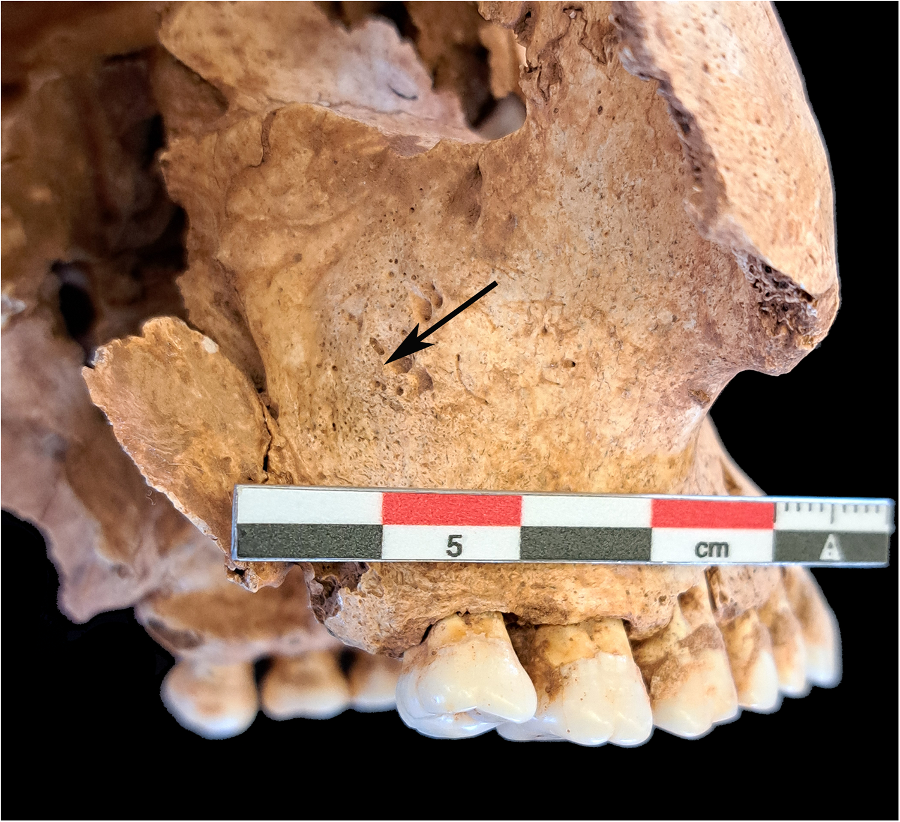
 Posterior view of the right upper jaw of an individual buried in early medieval Barcelona, showing abnormal bone formation and porosity associated with possible scurvy.
Image Credit:
Merino & Rissech, International Journal of Paleopathology (2026)
Scurvy in Medieval Barcelona Reveals the Hidden Toll of War and Food Shortages
Skeletal remains from an early medieval cemetery in Barcelona are revealing how prolonged warfare and disrupted food supplies may have affected everyday health, with a new study identifying evidence of scurvy—a disease caused by severe vitamin C deficiency—in adults and children who lived in the city during the 9th and 10th centuries AD.
The remains come from the Antics Jutjats Municipals cemetery, discovered in what is now Barcelona’s historic urban area. At the time, the burial ground lay outside the old Roman walls, away from the city centre, and appears to have had no direct connection with a church or monastery. Archaeologists uncovered 123 individual graves, 115 of which were fully excavated, although researchers estimate that the entire cemetery may contain more than 460 burials. The graves were carefully arranged east–west, with the dead placed on their backs according to Christian funerary customs and without grave goods.
These people lived during a turbulent period. Barcelona occupied a frontier zone between the Christian powers to the north and al-Andalus to the south, and the city experienced repeated military confrontations during the 9th and 10th centuries. Major episodes included fighting in 826–827, a temporary Muslim occupation between 850 and 852, and the devastating siege and capture of Barcelona in 985. Warfare and attacks on surrounding agricultural areas could interrupt farming, trade and the movement of food into the city, creating periods of scarcity even in a Mediterranean environment capable of producing fruits and vegetables rich in vitamin C.
Researchers examined 115 skeletons—71 individuals younger than 21 and 44 adults—but preservation allowed 87 to be assessed reliably for signs associated with scurvy. Among them, 12 individuals, or 13.8%, showed skeletal changes potentially linked to the disease. Four met the strongest diagnostic criteria, three were classified as highly consistent or typical of scurvy, and five showed changes considered consistent with it.
Children were particularly prominent among the affected individuals. Nine of the 12 possible cases occurred in people younger than adulthood, and eight were children between approximately 1.5 and seven years old. The study suggests that weaning may have increased vulnerability: as children shifted away from breast milk and became more dependent on available foods, restricted dietary diversity could have reduced their intake of vitamin C. Adults were affected too, although less frequently.
The diagnosis comes from distinctive changes in the bones rather than from a single lesion. Vitamin C deficiency weakens collagen and blood vessels, allowing repeated haemorrhaging around muscles and bone surfaces. Over time, this can leave abnormal porosity and new bone formation in characteristic locations, including parts of the skull, jaw, shoulder blades, pelvis and long bones. The researchers also considered other conditions capable of producing similar changes, including rickets, anaemia and pellagra, but concluded that scurvy best matched the overall pattern observed in the affected skeletons.
Interestingly, the bone changes may point to repeated episodes of deprivation rather than uninterrupted starvation. Some individuals showed both active and healed lesions, suggesting periods when vitamin C intake fell sharply followed by intervals when fresh foods became available again. The researchers propose that such fluctuations could fit a city repeatedly affected by sieges, damaged farmland and unstable supply routes.
The cemetery itself doesn’t appear to represent a single wartime catastrophe. Instead, the graves accumulated gradually through ordinary community deaths over an extended period. That distinction matters: the evidence suggests that the effects of conflict weren’t limited to people killed directly in battle. Political instability and recurring shortages may also have weakened health over years, leaving traces in the bones of civilians, especially young children.
Scurvy may seem surprising in Mediterranean Barcelona, where fresh produce was potentially available, but access matters as much as geography. When warfare interrupts cultivation and distribution, diets can shift toward storable staples such as cereals while fresh fruits and vegetables become harder to obtain. The study therefore argues that scurvy may have been more common in medieval Mediterranean populations during periods of political and economic disruption than previously assumed.
The findings remain preliminary for the cemetery as a whole. Only 115 individuals have been excavated from an estimated population of around 460 burials, and not every recovered skeleton preserved the bones needed for a confident diagnosis. Further skeletal, isotopic and dietary studies could refine the picture.
Even so, the evidence gives Barcelona’s medieval conflicts a distinctly human dimension. Beyond sieges and territorial struggles recorded in historical sources, the bones suggest that instability also reached the dinner table—and, for some of the city’s most vulnerable inhabitants, left lasting marks on the skeleton.
Published on: 10-10-2026
Edited by: Abdulmnam Samakie