- Archaeological News
-
 Image Credit:
Maria Koutsoumpou, Margariti et al., npj Heritage Science (2026)
Image Credit:
Maria Koutsoumpou, Margariti et al., npj Heritage Science (2026)
Rare Nautical Equipment Found on Greek Island Dates to Late Antiquity
A rare collection of carbonized nautical equipment discovered on the Greek island of Amorgos has provided new evidence for Mediterranean sailing, fishing and ship maintenance between the sixth and eighth centuries CE.
The assemblage was uncovered during a 2013 rescue excavation at Katapola, the island’s natural harbour. Archaeologists found it beneath the collapsed remains of a Late Roman or Early Byzantine residential building occupied between the fifth and seventh centuries.
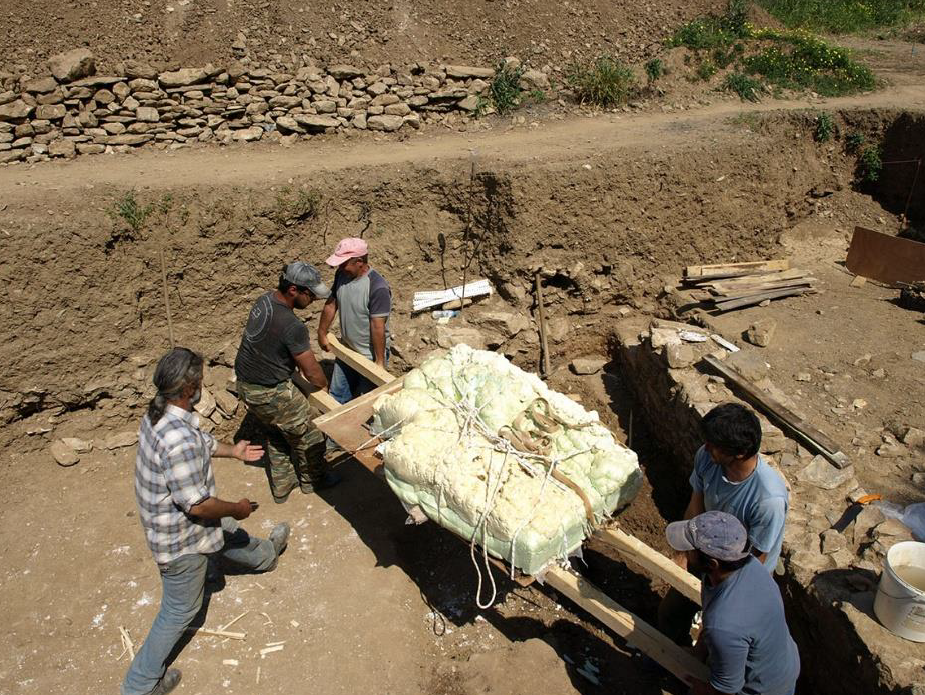
Because the organic remains were extremely fragile, the entire deposit was removed inside a block of surrounding soil and transported to a conservation laboratory. Careful micro-excavation revealed folded textiles, woven tapes, cords, ropes, wooden fragments and a large perforated stone object.
Scientific analysis indicates that these materials probably formed a collection of nautical equipment that included sailcloth, rigging, caulking material, wooden vessel components and a heavy fishing weight or ballast.
The textile fragments came from the same type of thick basket-weave fabric made from flax fibres. CT scans showed that the larger pieces consisted of continuously folded layers rather than separate fragments. One examined section contained about 20 layers, while the surviving material was estimated to represent approximately 1.4 square metres of fabric.
The fabric’s strength, flexibility, air permeability and water resistance support its interpretation as sailcloth. Narrow woven tapes made from similar fibres may have reinforced the sail or served another practical function aboard a vessel.
Two kinds of cord and two types of rope were also identified. One flax cord appears to have been stitched to the textile and may have served as a bolt rope that strengthened the sail’s edge. A flatter braided cord could have been used in reefing, the process of reducing a sail’s exposed area.
One heavy six-strand rope was probably associated with rigging. Another thick two-strand rope, possibly made from flax, hemp or a mixture of both, may have been used to seal gaps between a vessel’s wooden planks and prevent water from entering.
The wooden remains included elm, chestnut, pine and other coniferous and deciduous species. Researchers interpret the largest surviving wooden element and nearby fragments as probable parts of a vessel or related maritime equipment.
The stone object measured about 47 centimetres in diameter, weighed nearly 13 kilograms and had a central perforation. Scientific examination identified it as a porous siliceous rock belonging to the flint or chert group.
Lead discovered around the broken stone and inside repaired areas showed that it had been carefully restored in antiquity. Its shape, weight and central opening suggest that it functioned as a large fishing-net sinker or possibly as ballast. Its unusually heavy construction would have suited deep water, strong currents or the rocky coastal environment around Amorgos.
Radiocarbon analysis dated the wood to approximately the mid-sixth through mid-seventh centuries, while the textile most probably dated from the late seventh to late eighth centuries. The difference could reflect the reuse of older wooden material or the long service life of the equipment.
The finds had been exposed to fire at temperatures probably between 300 and 350 degrees Celsius, causing the organic materials to carbonize rather than disappear completely.
Nautical textiles, ropes and wooden equipment rarely survive in Mediterranean archaeological sites. The Amorgos assemblage is therefore important for reconstructing the materials, construction methods and everyday maritime activities of the Late Antique and Early Byzantine Aegean.
Published on: 03-08-2026
Edited by: Abdulmnam Samakie
Source: npj Heritage Science