- Archaeological News
-
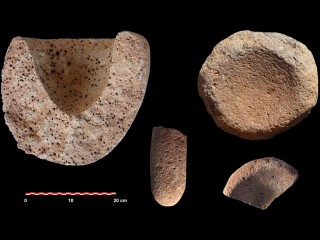 Ground-stone tools from the Early Natufian site of Jeftelik in western Syria, including a mortar, pestle and grinding slabs. The finds provide evidence for plant processing at the site around 14,000 years ago.
Image Credit:
Abdo et al., PLOS ONE (2026)
14,000-Year-Old Sickle Blades Reveal How People Harvested Wild Cereals in Syria
About 14,000 years ago, Natufian communities at Jeftelik in western Syria were harvesting wild cereals with composite sickles, sometimes using the same stone inserts for more than 20 hours. A new study shows that cereal gathering was important to subsistence at the site, but sickles were only one tool within a broader and flexible harvesting system.
The research focuses on Jeftelik, an Early Natufian settlement west of Homs near the northern edge of the Bouqaia Basin. The site lies in the Homs Gap, a corridor linking the Mediterranean coast with inland Syria. Excavations between 2008 and 2010 uncovered several stone structures, including a circular building about six metres in diameter, while radiocarbon dating places the Natufian occupation around 14,000 years ago.
The Natufian period, roughly 14,600 to 11,500 years ago, preceded large-scale plant-food production in the Levant. Archaeobotanical evidence shows that Natufian communities exploited many plant species, including the wild ancestors of cereals later domesticated during the Neolithic. Yet how intensively these plants were harvested, and how often sickles were used, remains less clear.
Researchers examined twelve glossed flint tools recovered from secure Natufian layers at Jeftelik. The shiny polish along their cutting edges forms when stone repeatedly contacts silica-rich plants. But such gloss is not unique to cereals; cutting reeds and grasses can create similar traces.
The team used confocal microscopy and three-dimensional surface-texture analysis to compare microscopic wear on the archaeological pieces with experimental tools used to harvest wild cereals, reeds and grasses. Their statistical model distinguished cereal cutting from other plant processing with an overall classification accuracy of about 85 percent.
Five of the twelve tools were used predominantly to harvest wild cereals. One was mainly associated with cutting reeds or grasses, while six showed mixed signals, suggesting use on more than one type of plant. Across all measured surfaces, roughly 62 percent were classified as cereal-related and 38 percent as other plant cutting.
The researchers also estimated use duration by comparing microscopic wear with an experimental sequence in which wheat was harvested for 36 hours. Two archaeological tools produced estimates between 10 and 20 hours, while three exceeded 20 hours. The authors stress that these durations are approximate because the experimental wheat was domesticated and fully ripe, whereas the Natufian tools probably cut wild cereals before full ripening.
At first glance, this intensive use might suggest systematic cereal reaping. Yet glossed sickle blades make up only about one percent of Jeftelik’s retouched stone-tool assemblage. The researchers therefore argue that harvesting wild cereals with sickles was real and could sometimes be intensive, but it was not necessarily the dominant way cereals were collected.
Other evidence supports a broader role for plants at the site. Jeftelik yielded grinding slabs, handstones, mortars and pestles, tools consistent with processing plant foods. Similar patterns occur at other Natufian sites where cereal-processing equipment is common even though sickle blades remain relatively rare.
The authors suggest that people may have gathered wild cereals in several ways, including plucking ears by hand, uprooting plants, beating seed heads into containers and cutting stems with sickles. Sickle harvesting may have been especially useful when cereal stands were abundant and had to be gathered rapidly during a short period of peak ripeness.
The findings do not show that Jeftelik’s inhabitants were farmers or that they cultivated domesticated crops. No domesticated cereals are documented in Natufian contexts, and the study treats the plants as wild cereals growing naturally. Instead, the evidence captures an important stage before agriculture, when communities had already developed sophisticated tools and flexible strategies for obtaining and processing cereal resources.
Jeftelik adds a northern Levantine example to the long history of increasingly intensive plant exploitation. Fourteen millennia ago, its inhabitants were selecting, cutting, processing and sometimes intensively harvesting wild cereals—behaviours that formed part of the long transition toward the food-producing economies that later transformed Southwest Asia.
Published on: 11-11-2026
Edited by: Abdulmnam Samakie
Source: PLOS One