- Archaeological News
-
 Image Credit:
Wang et al., Antiquity (2026)
Image Credit:
Wang et al., Antiquity (2026)
Zhaigou Reveals an Independent Bronze Age Power in Northern China
Archaeological discoveries at Zhaigou in northern Shaanxi are reshaping understanding of the Loess Highland during China’s Yinxu period, between about 1300 and 1050 BC. Monumental architecture, elite tombs, bronze casting remains and imported prestige goods indicate that the settlement belonged to a socially stratified and politically organized community.
The Loess Highland was traditionally viewed as a marginal zone between the agricultural societies of the Central Plain and pastoral regions farther north. New research, however, shows that complex societies developed there independently and maintained extensive connections with neighbouring regions.
Zhaigou covers approximately 300 hectares near the confluence of the Yellow and Wuding rivers. Unlike the dense, walled cities of the Central Plain, its activity areas were distributed across several hills. Cemeteries, residential zones, workshops and monumental buildings formed a dispersed settlement adapted to the rugged terrain.
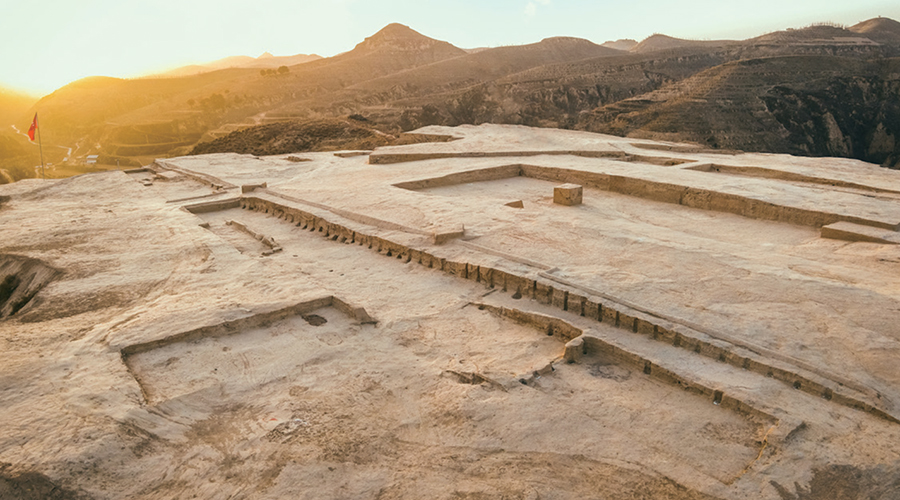
The most prominent feature is the Zhaiyuangai architectural complex, built on a large elevated platform. Excavations revealed substantial rammed-earth structures, a sunken courtyard and a long building divided into rooms. Thousands of pottery fragments and objects made of stone, bone and jade were recovered, together with oracle bones, ceremonial stone axes, disks and chimes.
The complex contained little domestic refuse, suggesting that it was not an ordinary residential area. Its elevated position, monumental construction and ritual objects indicate that it may have served as a ceremonial, administrative or communal centre, possibly also used by local elites.
Clear evidence of social inequality comes from the contrast between two cemeteries. At Houliujiata, archaeologists excavated four large elite tombs containing chariots, bronze fittings, weapons, jade ornaments, shell objects, gold earrings and ritual materials. The largest tomb extended about 39 metres and reached a depth of 12 metres.
Many objects display decorative styles associated with Anyang, the Shang capital. However, the burial practices remained distinctly local. The tombs lacked several characteristic Shang features, including human sacrifice and special pits beneath the deceased. Chariots were placed directly above the coffins rather than in separate pits.
This combination suggests that the occupants were Indigenous regional leaders who selectively adopted Shang prestige goods without becoming subjects of direct Shang rule.
A second cemetery at Yutaliang contained smaller graves with modest offerings, probably belonging to non-elite residents. Nearby fragments of clay moulds used for bronze casting show that local craftspeople produced objects decorated in Anyang styles. The scale of production appears limited, suggesting manufacture controlled by local elites rather than a centralized state industry.
Researchers argue that Zhaigou was probably one of several small, independent polities distributed across the Loess Highland. These communities maintained their own political authority while participating in exchange networks connecting the Shang heartland with northern pastoral regions.
Local elites may have gained influence by controlling river crossings, trade routes and access to prestige goods. Horses, livestock, wool and other northern resources could have been exchanged for bronzes, luxury objects and specialized knowledge from the Central Plain.
The discoveries challenge the idea that Shang-style objects automatically indicate Shang political control. Instead, Zhaigou presents a society that adopted selected technologies and symbols from a powerful neighbour while preserving its own traditions and autonomy.
The site therefore reveals an alternative pathway toward social complexity—one based not on territorial expansion by a centralized state, but on trade, ritual authority and the control of regional exchange.
Published on: 29-07-2026
Edited by: Abdulmnam Samakie
Source: Antiquity