- Archaeological News
-
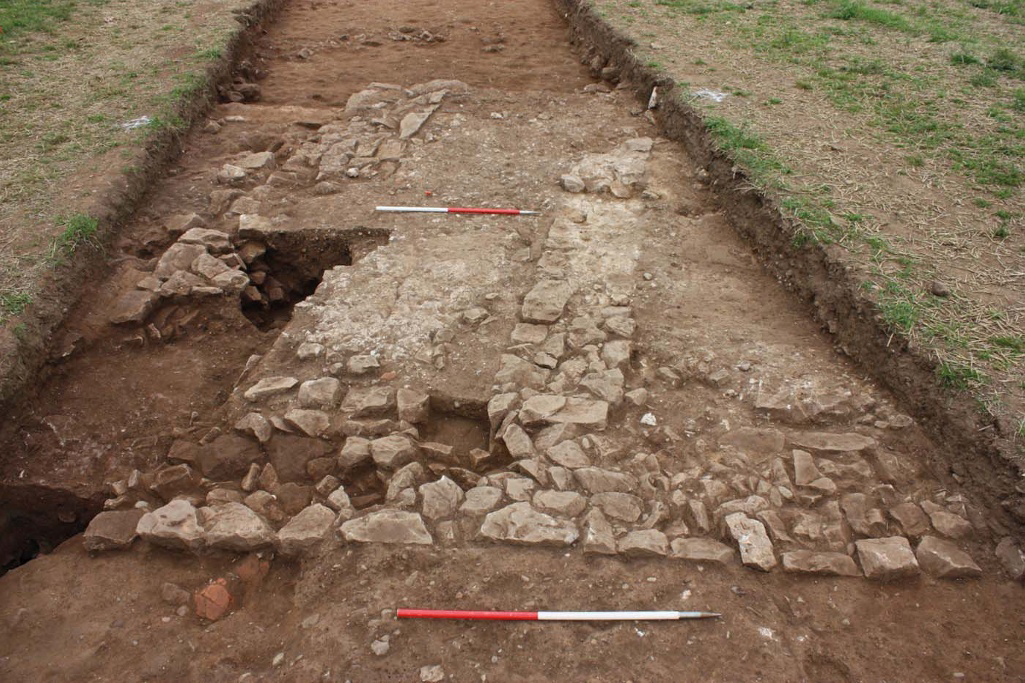
 Excavated stone walls and surviving floor of the Rossett Roman villa in north Wales, providing direct evidence for the substantial Roman residence uncovered at the site.
Image Credit:
Pudney & Grenter, Britannia (2026)
A Lost Roman Villa Emerges in North Wales
The discovery of a Roman villa near Wrexham is challenging a long-standing picture of north Wales as a landscape dominated almost entirely by forts, mines and industrial settlements, revealing instead a substantial rural residence whose occupants enjoyed heated rooms, painted walls and connections to the wider Roman economy.
The investigation began unexpectedly in 2019, when a Roman lead ingot was discovered in a field at Cobblers Lane near Wrexham. Archaeologists initially searched its surroundings for evidence of mining, processing or transport, but excavations found no associated Roman activity. The ingot may simply have been lost while being moved through the landscape. Attention then turned to another field about 1.7 kilometres away at Stringer’s Lane, where Roman coins and brooches had previously been found.
Geophysical survey changed everything. Beneath the field appeared the outline of a large «winged-corridor Roman villa», the first structurally confirmed villa of its kind identified in north Wales. Subsequent fieldwalking recovered more than 25 kilograms of Roman building material, around 70 pottery fragments, pieces of wall plaster and opus signinum flooring, while the survey revealed possible enclosures, tracks, ancillary buildings and surrounding field systems.
Excavations in 2021 confirmed that substantial Roman structures survived below ground despite centuries of ploughing. One trench revealed limestone walls and an intact section of opus signinum floor. Another exposed the eastern part of the main residence, where surviving walls, internal divisions and traces of alteration suggest that the house changed during its occupation rather than being built and used in a single unchanging phase.
Fragments of painted wall plaster, decorated Samian pottery and other imported and regional ceramics point to a relatively comfortable household. More strikingly, box-flue tiles, possible brick supports and a surviving furnace and flue demonstrate that at least part of the villa had a «hypocaust underfloor heating system». The flue showed clear signs of burning, proving that the installation had actually operated. Ceramics suggest activity from the second to fourth centuries AD, while several identifiable coins belong to the fourth century.
The precise date of the villa’s construction remains uncertain, although a second-century beginning appears likely. Its eventual abandonment is equally unclear because later disturbance destroyed parts of the archaeological sequence. Evidence also shows changes late in the building’s life, including the deliberate removal of an internal wall sometime after AD 306–307.
What supported the household economically is still one of the largest unanswered questions. Quern-stone fragments indicate grain processing, while spindle whorls point to wool working, and the surrounding survey suggests possible fields and ancillary structures. Yet archaeologists haven’t found enough evidence to determine whether agriculture formed the villa’s principal economic base. Further excavations from 2026 onward are intended to clarify that question.
That uncertainty is part of what makes the discovery important. Roman north-east Wales has traditionally been understood through its military installations, lead and silver extraction, pottery production and settlements associated with Chester’s legionary fortress. Farms and villas appear surprisingly scarce in the archaeological record, despite fertile land and a substantial military and civilian population that had to be supplied with food.
The Rossett villa raises the possibility that this apparent absence reflects how archaeologists have searched for settlements rather than how few settlements actually existed. Unlike many villas elsewhere in Britain, this site wasn’t first recognized through crop marks visible from the air. Its discovery grew from recorded metal finds, fieldwalking and geophysical survey—a combination that may be particularly valuable in landscapes where soil conditions conceal buried structures.
The villa therefore fills more than an empty space on a map. It suggests that rural life along Britannia’s western frontier may have been more varied than the surviving archaeological record once implied, and that other farms and high-status residences could still lie hidden beneath the fields of north Wales.
Published on: 25-10-2026
Edited by: Abdulmnam Samakie
Source: Britannia