- Archaeological News
-
 Image Credit:
Jason Quinn, CC BY-SA 3.0, via Wikimedia Commons
Image Credit:
Jason Quinn, CC BY-SA 3.0, via Wikimedia Commons
Science Reconstructs the Last Months of Inca Child Sacrifices
A new study provides fresh evidence about the Inca Capacocha ritual, one of the most powerful and politically charged ceremonies of the Inca Empire.
Capacocha was a state ritual that combined pilgrimage, offering, and sacrifice. Children and young people were selected, moved across the imperial landscape, and ultimately offered at sacred mountain shrines known as apus. In Inca belief, these mountains were not simply natural features, but sacred beings, ancestors, and powerful forces within the landscape.
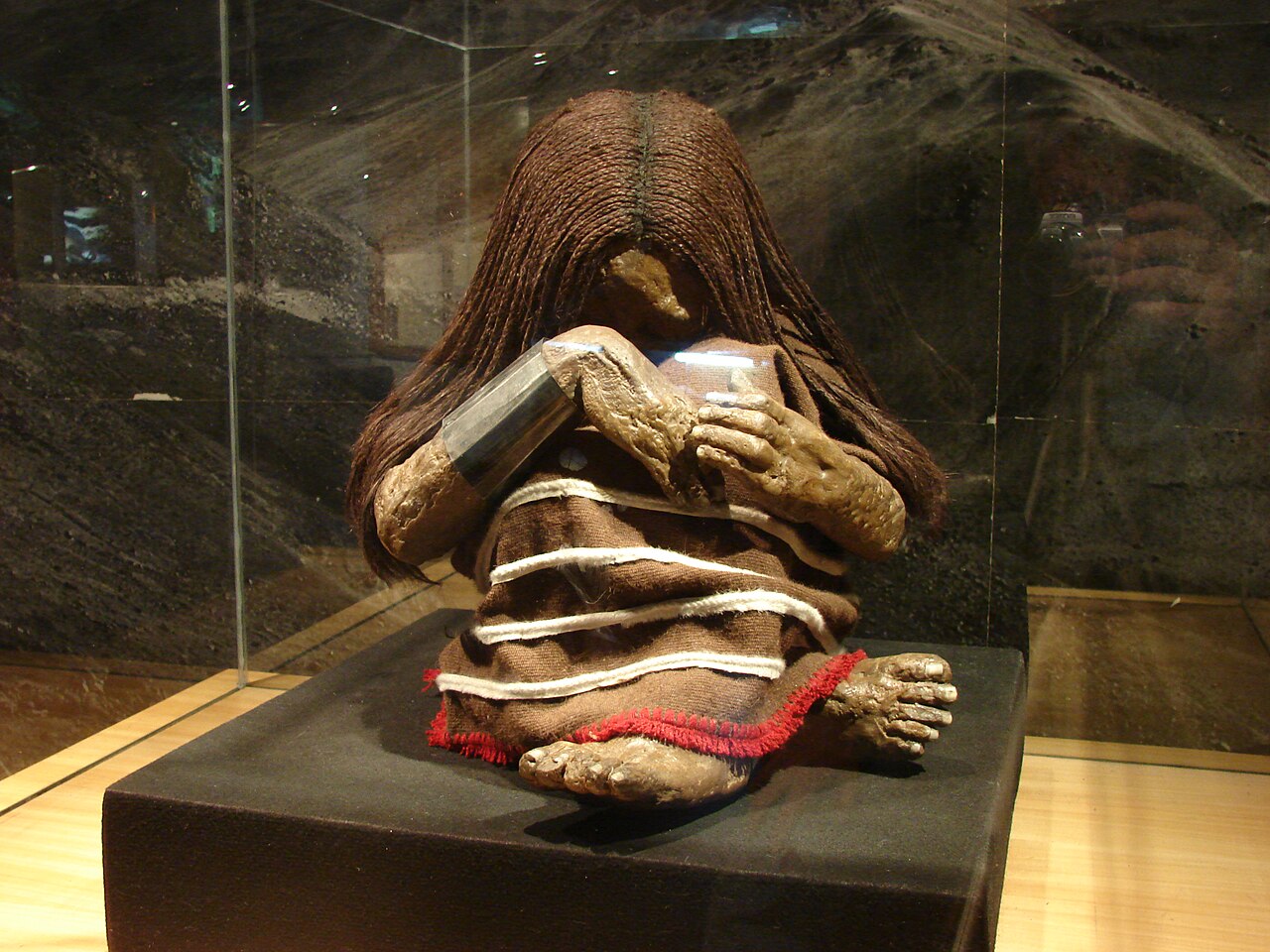
The study examines three individuals from two Capacocha contexts in Chile. Two are female individuals from Cerro Esmeralda in the coastal Atacama Desert of northern Chile: a girl around 9 years old and a young woman around 18 years old. The third is the well-known Niño de El Plomo, an approximately 8-year-old boy discovered at high altitude on Cerro El Plomo in central Chile.
The researchers used a wide range of methods, including stable isotope analysis of hair, computed tomography, dermatoscopy, skin histology, biomechanical modelling, and radiocarbon dating. These methods allowed them to reconstruct aspects of the individuals’ final months of life, their movement across different environments, and the possible mechanisms of death.
Sequential isotope analysis of hair provided important evidence for pilgrimage. Because hair grows gradually, its chemical composition can preserve a month-by-month record of diet and environment before death. In all three individuals, the isotopic values changed during the final months of life, indicating sustained movement through different ecological zones.
The two Cerro Esmeralda individuals followed different life-history paths but appear to have converged during the final stage of the ritual. Their isotopic values suggest changes in diet and movement, including increased consumption of maize or other foods supplied through Inca networks. In the final period before death, their dietary signals became more similar, suggesting shared provisioning during the last phase of the ceremony.
The El Plomo child showed a different but equally significant pattern. His isotopic record suggests prolonged movement across multiple regions, probably including a southward trajectory from the Atacama Desert toward central Chile. Physical evidence also supports this interpretation: the soles of his feet showed marked thickening consistent with repeated mechanical stress, suggesting long-distance walking.
Together, these findings provide direct evidence that pilgrimage was not only a symbolic idea in Capacocha ritual, but an embodied process. The selected individuals were physically moved through the empire, passing through landscapes, communities, and ritual routes before reaching their final mountain shrines.
The study also reassesses earlier interpretations of how the individuals died. For the two Cerro Esmeralda females, earlier research had suggested possible strangulation based on marks on the neck. However, new CT scans and external examination found no fracture or displacement of the hyoid bones, and the marks appear more consistent with compression from textiles or clothing. Because the bodies were altered after recovery and during later autopsies, the exact causes of death remain uncertain.
The case of the El Plomo child is different. Earlier interpretations proposed that he may have died from hypothermia or exposure at high altitude. The new study challenges this view. Skin and tissue analyses found no evidence of freezing injury or cold-induced tissue damage.
Instead, CT scans revealed a perimortem fracture in the left frontal bone, aligned with an external skin lesion. The injury was associated with traumatic separation along cranial sutures. Biomechanical modelling showed that a strong blunt-force impact could plausibly have produced this pattern of damage.
The researchers suggest that the injury is compatible with a close-range blow from a compact blunt implement, possibly a star-shaped Inca mace head. This does not mean every Capacocha death occurred in the same way, but it shows that deliberate violence formed part of at least some sacrifices.
Additional evidence suggests that the El Plomo child had eaten shortly before death. CT imaging showed food in the stomach and a dilated esophagus, while food residues were observed on clothing. The researchers interpret this as evidence for ritual feeding followed by vomiting around the time of death, possibly triggered by cranial trauma and rapid physiological collapse.
Radiocarbon dating places the Cerro Esmeralda and El Plomo sacrifices broadly in the mid-fifteenth century. This situates them within the period of Inca expansion and consolidation in Collasuyu, the southern region of the empire. The dates also overlap with other known Capacocha contexts in the south-central Andes.
The findings show that Capacocha was not a single uniform practice. It involved movement, staged feeding, local participation, imperial provisioning, and different possible mechanisms of death. The ritual connected children, communities, sacred mountains, and state power within a vast imperial landscape.
Overall, the study reveals Capacocha as both a religious ceremony and a form of imperial statecraft. Through pilgrimage and sacrifice, the Inca state incorporated distant communities into its political and sacred order, transforming human bodies into powerful offerings within the landscape of Tawantinsuyu.
Published on: 17-07-2026
Edited by: Abdulmnam Samakie
Source: Science Advances