- Archaeological News
-
 Image Credit:
Wadley et al., African Archaeological Review (2026)
Image Credit:
Wadley et al., African Archaeological Review (2026)
Stone Discs in South Africa May Have Been Used in Rain Rituals
Fragments of perforated stone discs discovered at two rock shelters in South Africa’s Limpopo Province may have been connected to rituals intended to influence rainfall, according to a new archaeological study.
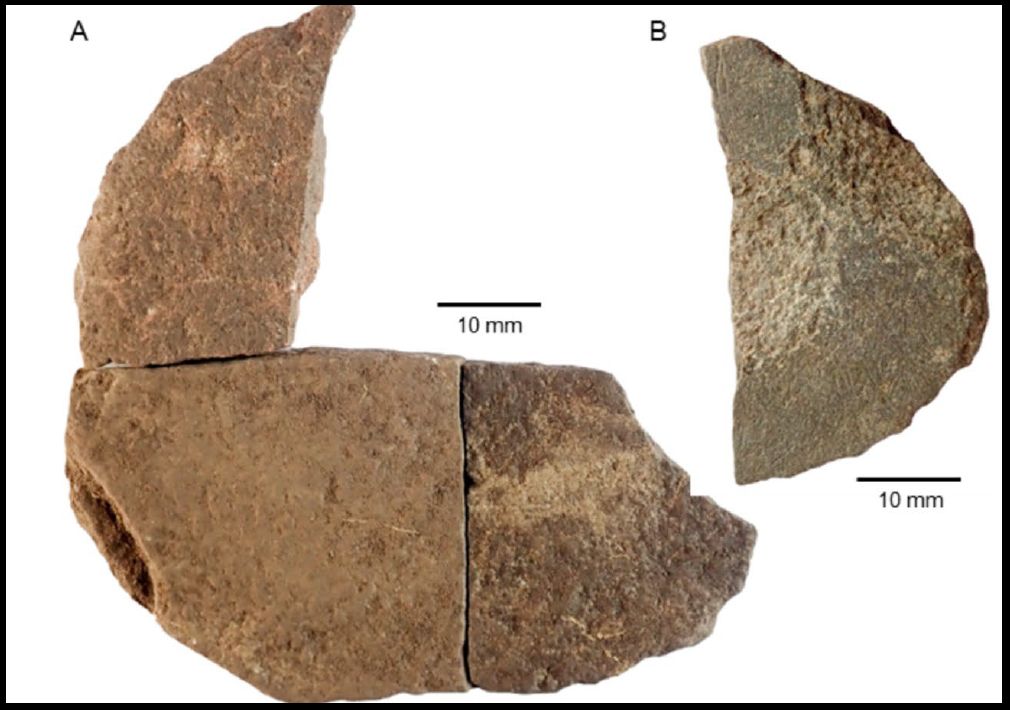
The objects were found at Welgevonden and Dwaalhoek 11 rock shelters in the Kaingo Game Reserve, part of the Waterberg region. Researchers examined fragments representing different stages of manufacture, breakage and occasional reuse.
The discs were made from naturally flat slabs of quartzitic sandstone available in the surrounding landscape. Their edges were shaped by removing stone flakes, sometimes from both faces to create a sharp perimeter.
Craftspeople then pecked shallow circular depressions into the centre of each face, thinning the stone and producing an hourglass-shaped profile. A central hole was completed through further pecking or by striking a short, pointed stone tool through the weakened area.
The discovery of incomplete examples, perforated fragments and possible stone punches suggests that at least some discs were manufactured at the shelters. Broken pieces were occasionally reused as grinding tools, as shown by wear marks on their surfaces and fractured edges.
The objects may not all have served the same purpose. Larger examples with sharp edges could possibly have been mounted on handles and used as circular axes or chopping tools. Smaller discs resemble stone spindle whorls used by Iron Age farming communities to spin thread.
However, the researchers suggest that some of the small discs may have been symbolic imitations rather than ordinary textile tools.
At Welgevonden, the discs were recovered alongside pottery associated with the Eiland cultural tradition, generally dated to around 1000–1300 CE. Because Iron Age farmers usually established settlements in open areas rather than occupying rock shelters, their presence at the site may indicate that it was used for specialized activities.
The landscape surrounding Welgevonden includes natural rock cisterns, seasonal water sources and rock-art locations. A nearby painting depicts a person playing a single-stringed musical bow, an instrument associated in some Bushman traditions with calling rain.
Ethnographic accounts from southern Africa also connect perforated stones with water, ancestors and rainmaking. In some farming communities, ritual specialists poured grain, medicines or beer through stone openings during ceremonies related to rainfall, harvests and crop fertility.
Threads also carry symbolic importance in both Iron Age farming and Bushman traditions. Spindle whorls were used to produce thread for fine cotton garments associated with elite status. Chiefs wearing such textiles were sometimes considered responsible for securing rainfall for their communities.
In Bushman beliefs, rain specialists entering trance were described as climbing threads into the sky or using them to guide supernatural rain animals. These traditions may help explain why the performance of making or drilling spindle-like stone discs could itself have carried ritual meaning.
The researchers do not claim that every perforated disc was ceremonial. The variation in size, edge shape and wear suggests that some objects probably had practical uses. Nevertheless, the combination of manufacturing remains, pottery, rock art and the water-rich ritual landscape supports the possibility that disc production formed part of activities concerned with controlling rain.
The findings highlight the difficulty of separating practical and symbolic functions in archaeological objects. At the Kaingo shelters, stone discs may have served as tools, ritual objects or both, reflecting interaction between farming and hunter-gatherer traditions in the Waterberg.
Published on: 04-08-2026
Edited by: Abdulmnam Samakie
Source: African Archaeological Review