- Archaeological News
-
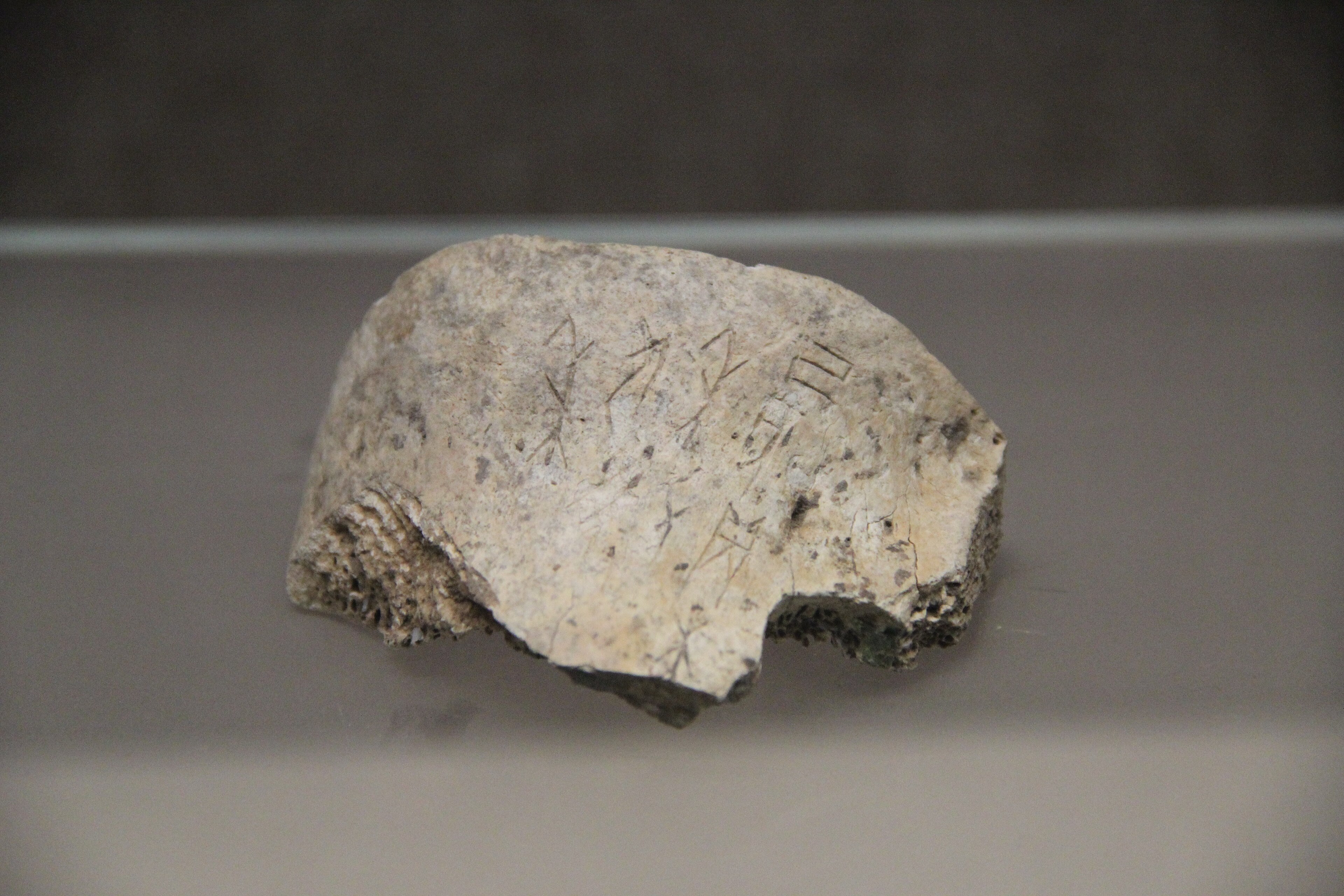
 Oracle bone fragment bearing ancient Chinese inscriptions from the Shang Dynasty.
Image Credit:
Gary Todd, CC0, via Wikimedia Commons
Oracle bone fragment bearing ancient Chinese inscriptions from the Shang Dynasty.
Image Credit:
Gary Todd, CC0, via Wikimedia Commons
Stroke and Structure Analysis Improves AI Recognition of Oracle Bone Inscriptions
A new artificial-intelligence approach has improved the recognition of Oracle Bone Inscriptions by focusing on the physical features that define ancient Chinese characters: their strokes, edges, overall layout, and the spatial relationships between their components. The results show that models designed around the morphology of the inscriptions can perform better than systems that rely mainly on broader forms of transferred visual knowledge.
Oracle Bone Inscriptions are regarded as the earliest systematic form of Chinese writing and are closely associated with divination records of the late Shang period. Thousands of digitized rubbings, facsimiles, and inscription images have created new opportunities for computational cataloguing and comparison, but automatic recognition remains difficult. Individual characters may differ by only a short stroke or the position of one component, while surviving examples can also be affected by abrasion, broken surfaces, poor rubbing quality, missing traces, and historical variations in writing.
Another challenge is the uneven amount of surviving material. Some character classes have many known examples, while others are represented by only a small number of labelled images. This makes “few-shot” learning particularly relevant. Instead of requiring large quantities of examples for every character, few-shot systems attempt to identify unfamiliar classes using only a limited set of labelled samples.
The new approach was tested using the OBC306 dataset, a large collection developed for Oracle Bone Inscription recognition. The researchers evaluated a model that first extracts visual information from inscription images and then adapts that information to distinguish between character classes. Two additional modules were introduced specifically for the ancient script. One emphasizes local strokes, edges, and fine line structures. The other examines the broader arrangement of the glyph, including the placement and relationships of its components.
These features were compared with a system using a separate “Teacher” model, in which previously stored visual information provides additional supervision. The tests showed that this broader Teacher supervision did not consistently improve recognition under the main OBC306 conditions. By contrast, adding the stroke and structure features produced improvements across every tested setting.
When only one labelled example per character class was available, the morphology-aware model achieved an average accuracy of 77.56 percent, compared with 75.44 percent for the same system without the added glyph features and 74.31 percent for the original Teacher-based configuration. With 50 labelled examples per class, accuracy reached 91.67 percent, compared with 89.88 percent without the glyph modules and 88.99 percent with the original Teacher. Across the different tests, the stroke-and-structure additions improved the model without the Teacher by about 1.79 to 2.15 percentage points.
The findings do not mean that transferred supervision is inherently unsuitable for studying ancient inscriptions. Its effectiveness changed depending on factors such as the balance of the dataset, the reliability of the transferred information, and the number of available reference images. On a specially balanced subset, the Teacher-based approach performed better than the equivalent model without it. This indicates that the usefulness of general visual knowledge depends heavily on how closely it matches the archaeological material being analyzed.
A second dataset produced much smaller gains because recognition accuracy was already above 99.7 percent for all tested configurations. The researchers therefore caution against treating the improvements as universal. The main evaluation was also restricted to 42 sufficiently represented test classes, and several additional experiments were conducted under more limited conditions.
For heritage research, the work highlights the value of designing computational tools around the characteristics of the material itself. Oracle Bone Inscriptions are not ordinary image-recognition objects: tiny differences in carving and structure may carry the information needed to distinguish one character from another. By giving these features greater importance, artificial intelligence may become more effective for cataloguing, retrieving, and comparing large digital collections of inscriptions. The system addresses character recognition rather than decipherment, however, and does not replace the linguistic and archaeological expertise required to interpret the meaning and historical context of the texts.
Published on: 02-09-2026
Edited by: Abdulmnam Samakie
Source: npj Heritage Science