- Archaeological News
-
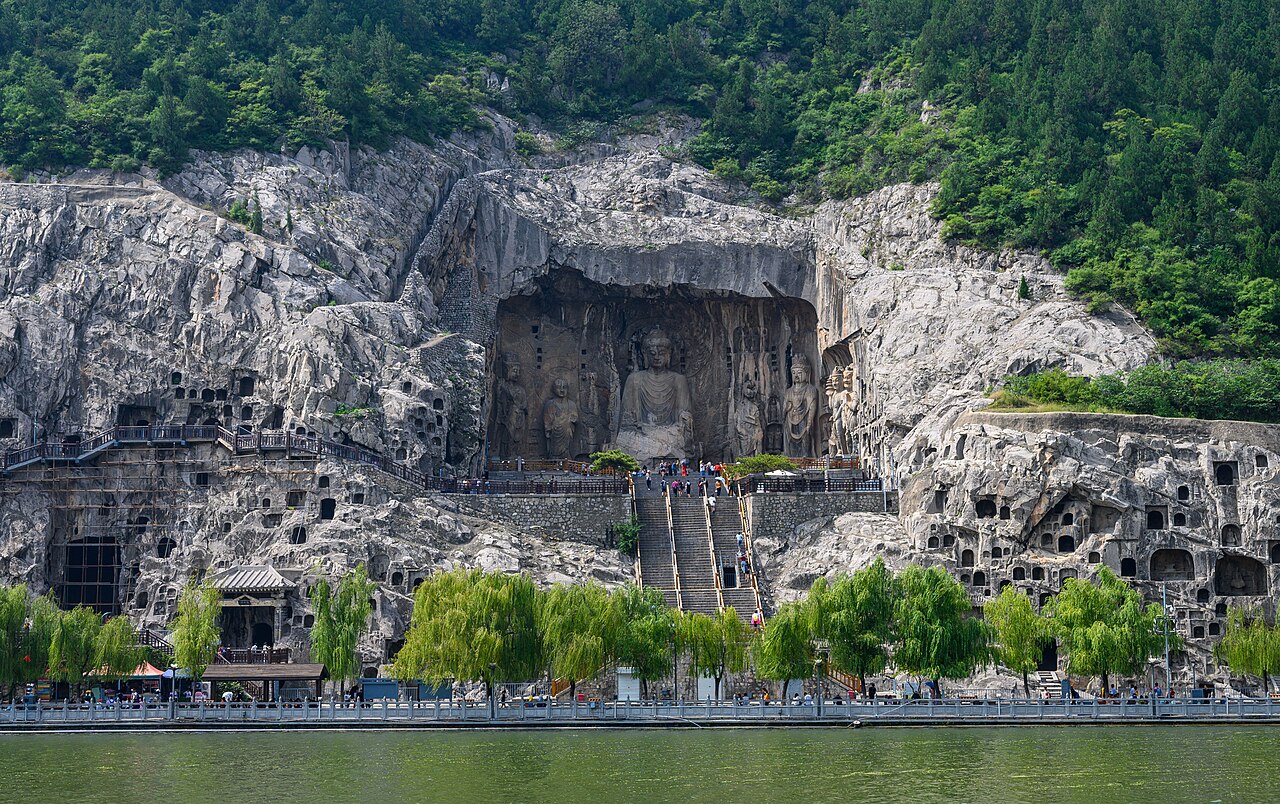
 The Longmen Grottoes on the banks of the Yi River in Luoyang, China, with the monumental Vairocana Buddha at Fengxian Temple visible at the center.
Image Credit:
xiquinhosilva, CC BY 2.0, via Wikimedia Commons
The Longmen Grottoes on the banks of the Yi River in Luoyang, China, with the monumental Vairocana Buddha at Fengxian Temple visible at the center.
Image Credit:
xiquinhosilva, CC BY 2.0, via Wikimedia Commons
At Longmen Grottoes, More Shelter Doesn’t Always Mean Better Protection
A new study at China’s Longmen Grottoes suggests that rebuilding lost protective architecture around ancient cave temples could help shield stone sculptures from sunlight and climatic fluctuations—but enclosing them too tightly may create another problem: trapped moisture.
The research focuses on Cave 1280, a large semi-open space carved into the limestone cliffs beside the Yi River near Luoyang in Henan Province. The cave contains the Great Vairocana statue and other sculptures whose surviving surfaces show weathering, flaking, corrosion and extensive loss of their original pigments. Holes once used for beams and columns remain visible in the rock, indicating that protective structures stood in front of the cave at different times in the past.
Those structures have largely disappeared, leaving the sculptures more exposed to changing temperatures, humidity, wind, rainfall and direct sunlight. Such environmental forces don’t act independently: moisture can encourage salt movement and biological growth, while repeated heating and cooling create stresses that contribute to cracking and surface deterioration. Protective architecture can moderate these effects, but it can also change ventilation and humidity inside a cave.
To explore that balance, the researchers reconstructed two historically plausible timber shelters and compared them with the cave’s current open condition. One resembles a relatively open gallery with projecting eaves, while the other takes the form of a more enclosed hall. Historical records, architectural traces, traditional construction texts and measurements from the site helped shape the digital reconstructions, although the study notes that no surviving record establishes the original façade with certainty. The team then combined environmental monitoring with computer simulations of temperature, relative humidity, airflow and solar radiation. Outdoor conditions were monitored for a year, while measurements inside the cave helped test whether the digital model reproduced the actual environment with reasonable accuracy.
The two shelter designs behaved very differently. The enclosed hall provided the strongest protection from external climatic changes and dramatically reduced solar exposure, cutting radiation by roughly 82% to 97% in important areas. Around the large Vairocana statue, reductions reached 90% to 97% across some of the most exposed middle and upper sections. That could reduce thermal stress on the stone and create a more stable temperature environment.
But the stronger barrier came with a trade-off. By restricting air exchange, the hall expanded areas with very slow airflow and increased the tendency for moisture to remain inside the cave. During summer, simulations showed higher relative humidity in upper areas, bringing conditions closer to saturation and potentially increasing sensitivity to condensation, salt movement and biological deterioration. The study doesn’t claim that condensation would necessarily occur; rather, it identifies conditions in which the risk could become greater.
The more open gallery-eave design offered less thermal buffering and weaker shading, particularly around lower portions of the sculptures, but maintained better natural ventilation. Around the middle and upper zones of the large Buddha, it still reduced solar radiation by about 70% to 96%, while allowing more daylight to reach lower areas. Its open form also produced smoother airflow and fewer zones where moisture might linger.
When environmental performance was considered alongside reversibility, visual impact and compatibility with the historic landscape, the overall assessment favored the gallery-eave approach. The result highlights a wider conservation principle: placing a stronger physical barrier around vulnerable heritage doesn’t automatically provide better protection.
There are important limits. The proposed structures remain digital scenarios rather than engineering plans, and the simulations simplify factors such as cracks, surface roughness, liquid-water movement and short-term weather changes. Conditions would also differ from one grotto to another depending on scale, orientation, hydrology and local climate.
For Longmen, the study therefore argues for balance rather than maximum enclosure—enough shelter to reduce sunlight and climatic stress, but enough openness to keep air moving and moisture under control. In rock-cut heritage, sometimes less protection can protect more.
Published on: 08-10-2026
Edited by: Abdulmnam Samakie
Source: npj Heritage Science