- Archaeological News
-
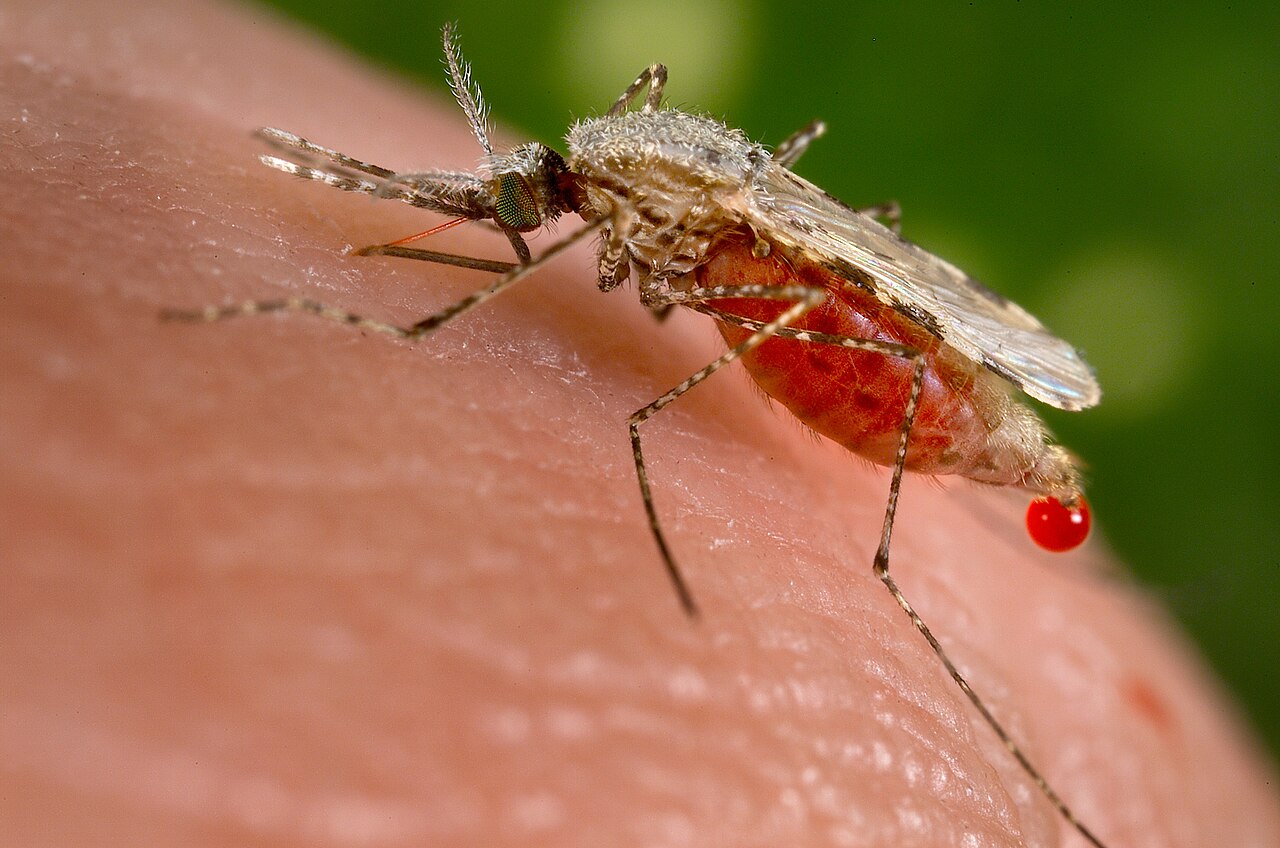
 A female Anopheles stephensi mosquito feeding on a human. The species is a malaria vector and was historically documented in Bahrain, particularly around irrigated gardens and water-management systems.
Image Credit:
Jim Gathany, via Wikimedia Commons
Ancient Mass Graves in Bahrain Raise a 1,500-Year-Old Malaria Question
A cluster of unusual mass graves in Bahrain may preserve evidence of a severe disease outbreak around 1,500 years ago. A new study has tested whether epidemic malaria could help explain the sudden mortality, combining human remains with evidence from climate, irrigation, agriculture and the ecology of mosquitoes.
The graves come from the DS3 cemetery and date to the Late Tylos, or Sassanian, period. Two of the mass burials appear to have been created within a relatively short period, probably less than a decade, close to the beginning of the Justinianic plague era in the mid-sixth century CE. Their unusually large number of individuals, disturbed burial arrangements and distinctive age profile have previously led researchers to argue that the community experienced a short-lived catastrophe.
Although the timing overlaps with the outbreak of plague caused by Yersinia pestis around 541 CE, the researchers do not consider plague the most convincing explanation for the Bahrain graves. Earlier work had proposed alternatives including cholera and epidemic malaria. The new study focuses specifically on malaria and asks a more cautious question: does the archaeological evidence fit what might be expected from an epidemic outbreak?
To investigate this, the researchers first reconstructed the long-term ecology of malaria in Bahrain. The island is hot and arid, with very little rainfall, but historically possessed abundant freshwater springs that supported extensive agriculture. Water was channelled through gardens, especially date-palm plantations, creating pools, drains, shallow wells and irrigated soils that could provide breeding places for mosquitoes. Historical records from the twentieth century show that malaria was particularly associated with garden areas and irrigation systems.
This relationship may stretch far back into Bahrain’s past. Archaeological evidence indicates that freshwater springs were used to irrigate date palms from at least the Bronze Age. Flooding gardens helped crops survive heat and salinity, but standing or slowly moving water could also favour mosquito larvae. The researchers therefore argue that human modification of the landscape was an important part of Bahrain’s malaria ecology.
Climate alone, however, does not provide a simple explanation for a sixth-century epidemic. Palaeoclimate modelling indicates that malaria transmission was possible during this period, but the climatic changes associated with the Late Antique Little Ice Age appear relatively modest in Bahrain. The authors conclude that climate could have altered the seasonal timing of transmission, especially around the margins of the freshwater spring zone, but was unlikely by itself to have triggered a major epidemic.
Changes in agriculture and water management may have mattered more. Declining spring levels and increasing salinity could have encouraged greater irrigation, the use of wells or the abandonment of some water systems. Historical evidence shows that neglected wells, drainage problems and flooded gardens can create highly favourable mosquito habitats. The authors therefore suggest that relatively small environmental changes may have increased local malaria risk even without a dramatic regional climatic shift.
The human remains provide some support for the hypothesis. The mass graves contain an unusually high proportion of infants and young children, especially babies under six months old. Such a pattern could be compatible with epidemic malaria, particularly if pregnant women were affected and more infants were born prematurely or with low birth weight. The graves also contained a significantly higher proportion of very small newborns than the ordinary burials used for comparison.
Some skeletal patterns also fit an acute mortality event. Signs associated with prolonged bone-marrow response were less frequent among children in the mass graves, potentially indicating that death occurred before chronic skeletal changes had time to develop. But these lesions are not specific to malaria and can have several causes.
Other evidence is less convincing. An epidemic affecting pregnant women might be expected to produce a stronger increase in young female mortality, yet that pattern is not clearly visible. The number of adults is also small, while the graves are heavily commingled, making it difficult to connect particular skeletal changes with individual age and sex. The researchers therefore stop well short of identifying malaria as the cause of the deaths. Their conclusion is that the hypothesis cannot currently be rejected, but important anomalies remain, particularly in the adult mortality pattern.
Malnutrition or interactions between malaria and other stresses could also have contributed. Ancient DNA may eventually establish whether the malaria parasite was present, but even that would demonstrate infection rather than prove that malaria caused the mass deaths.
More broadly, the study shows how disease in the past cannot be understood from bones or pathogens alone. Climate, irrigation, agriculture, mosquitoes, human movement and biological adaptation all interacted to shape risk.
For Bahrain, the mass graves remain evidence of a dramatic episode whose precise cause is unresolved. But by reconstructing the environment in which disease operated, researchers are narrowing the possibilities—and showing how even modest changes to water and landscape could have profound consequences for communities living in the Gulf centuries ago.
Published on: 01-11-2026
Edited by: Abdulmnam Samakie