- Archaeological News
-
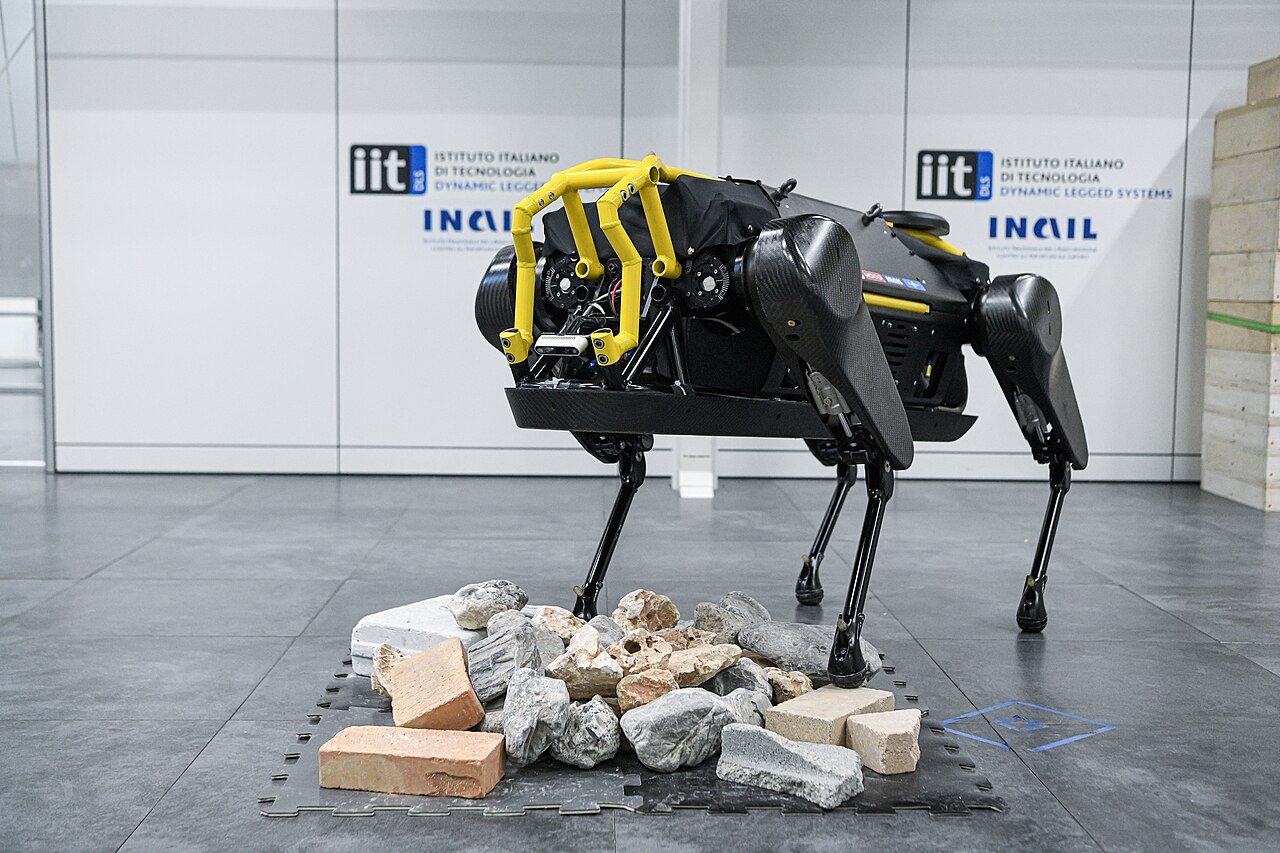
 A quadruped robot demonstrating its ability to negotiate uneven terrain and obstacles, illustrating the type of legged platform considered for surveys in complex environments.
Image Credit:
European Union, 2026, CC BY 4.0, via Wikimedia Commons
A quadruped robot demonstrating its ability to negotiate uneven terrain and obstacles, illustrating the type of legged platform considered for surveys in complex environments.
Image Credit:
European Union, 2026, CC BY 4.0, via Wikimedia Commons
Can Robots Protect the Past Without Harming It?
Robots are increasingly being used to document historic buildings, archaeological sites, underground tombs and other cultural heritage places that are difficult or dangerous for people to access. Yet a new review warns that a robot capable of navigating a complex space is not necessarily suitable for working around fragile heritage. Airflow, vibration, contact with the ground, cables and even the consequences of a mechanical failure can threaten the very remains that the technology is intended to protect.
The researchers examined 156 studies covering aerial robots, ground-based platforms, cable-driven systems, robotic arms and combinations of multiple robots. Rather than comparing them only by navigation accuracy or scanning performance, the review evaluated three broader questions: whether the systems are safe for heritage materials, whether they can actually collect the required data, and how mature they are for deployment at real sites.
Drones remain among the most established options. Their ability to fly makes them valuable for documenting façades, roofs, tall architectural elements and large archaeological landscapes. Cameras, laser scanners and other sensors can produce detailed three-dimensional records without requiring scaffolding or putting people in dangerous locations.
Their greatest strength, however, can also create a serious limitation. Multirotor drones generate downward airflow, or rotor downwash. Near delicate murals, painted surfaces, crumbling stone or loose archaeological deposits, this air movement could disturb fragile material. Flying indoors introduces additional problems, including narrow spaces, structural obstacles, poor lighting and the absence of satellite navigation signals. Even when a drone can calculate a collision-free route, it may still be unable to position its camera at the correct distance and angle without approaching a vulnerable surface too closely.
Ground robots avoid rotor downwash and can carry comparatively heavy equipment for long periods. Wheeled and tracked machines are particularly effective on level floors and in lower parts of historic buildings, where they can transport laser scanners, multispectral cameras and other instruments. Tracked systems can also negotiate loose stones and moderate slopes at archaeological sites. But their access to high architectural spaces is inherently limited.
Legged and wheel-legged robots offer greater mobility over rubble, steps and damaged terrain, yet they introduce a different conservation concern. Each footstep produces impacts and shear forces against the ground. On robust industrial floors this may be insignificant, but on fragile archaeological layers or loose earthen remains repeated loading could potentially cause damage. The review notes that these effects have not yet been sufficiently measured in heritage environments.
For very large interiors, another possibility is the cable-driven robot. Several cables suspended from fixed points can move a sensor platform through a broad three-dimensional space without producing rotor airflow. Such systems could therefore be useful in high halls or large grotto temples and can carry relatively heavy instruments. Their disadvantages include the need for anchors, careful cable routing and calibration, as well as the possibility of cables interfering with structures or obstructing the sensors. Evidence from complete heritage-site deployments remains limited.
Robotic arms solve a different problem. They can position cameras, spectroscopic instruments and other sensors very precisely for detailed examination of a localized surface. Their weakness is range: a robotic arm can inspect only what it can reach from its base. Heavy, rigid arms may also increase the consequences of accidental contact, while lighter and more flexible designs can introduce vibration that reduces measurement quality.
Combining technologies may overcome some of these limitations. A cable system, for example, can move a platform across a large space while a robotic arm mounted on it adjusts a sensor for detailed inspection. Multiple robots can similarly divide mapping, lighting, communication and close-range survey tasks. But greater complexity also brings more demanding calibration, communication, energy management and emergency planning, and many such systems remain at prototype or controlled-validation stages rather than routine heritage use.
The review therefore argues against searching for a single “best” heritage robot. The appropriate platform depends on the site itself. Drones may suit broad documentation of open or semi-open spaces, ground robots can cover lower and obstructed areas, robotic arms can perform localized high-resolution inspection, and cable-driven systems may be useful in large high-clearance interiors. Particularly fragile surfaces require approaches specifically demonstrated to operate with minimal disturbance.
More fundamentally, the researchers propose changing how heritage robots are designed. Instead of starting with an existing machine and relying on increasingly sophisticated software to overcome its physical limitations, designers should begin with the conservation requirements: how fragile the material is, where sensors must reach, what level of disturbance is acceptable and what would happen if the robot failed.
In this view, successful heritage robotics is not simply about making machines smarter. It is about designing machines whose physical form, movement and deployment methods are compatible with the archaeological and architectural remains they are intended to document.
Published on: 29-09-2026
Edited by: Abdulmnam Samakie
Source: npj Heritage Science