- Archaeological News
-
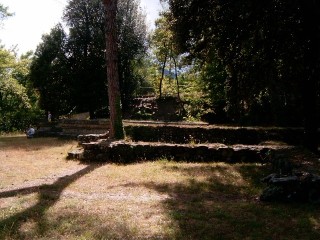 The acropolis of Kainua (Marzabotto), an important Etruscan city in northern Italy where organised craft-production areas developed during the Iron Age.
Image Credit:
Iijjccoo (assumed), CC BY-SA 3.0, via Wikimedia Commons
Beyond the Ancient City: Pottery Workshops Redraw Iron Age Northern Italy
A new archaeological study of pottery production in northern Italy is challenging the idea that the rise of major cities automatically pulled craft manufacture into a handful of urban centres. Instead, evidence from Emilia-Romagna suggests that increasingly sophisticated city workshops developed alongside a surprisingly broad network of pottery production in smaller settlements and rural areas during the sixth and fifth centuries BC.
The study examines the southern Po Plain, a region where settlements, agriculture and communication networks changed dramatically during the Iron Age. Centres such as Bologna expanded and became increasingly urban, while Marzabotto developed a carefully planned layout with distinct residential, religious and productive areas. At the same time, rivers and routes crossing the plain connected these centres with farms, smaller settlements and the Apennine valleys.
To understand how pottery production fitted into these changes, the research assembled 48 documented production contexts from 23 archaeological sites, ranging from the ninth century to the fourth century BC. The evidence included complete workshops, individual kilns and less certain production areas identified through objects such as kiln supports, firing-floor fragments and misfired pottery.
The clearest shift appears between the earlier Iron Age and the sixth–fifth centuries BC. Among the securely dated earlier evidence, seven of eight production contexts occurred in urban settings. During the sixth and fifth centuries, however, the pattern changed sharply: 15 of 23 contexts, or about 65 per cent, were located outside major urban settlements, while only eight were urban. The earlier evidence came from just two sites, whereas the later group was spread across 17.
That doesn’t mean the cities lost their importance. Bologna remained a major centre of production, while Marzabotto contained some of the region’s most organised workshops, where kilns formed part of carefully structured spaces associated with water management, work surfaces, waste areas and repeated modifications. Urbanisation clearly encouraged more elaborate and spatially organised craft production. But it didn’t eliminate manufacture elsewhere.
Some non-urban sites were substantial in their own right. San Pancrazio, for example, contained eight kilns, making it difficult to interpret its pottery manufacture as a small household activity intended only for local use. Other kilns and production traces appeared across agricultural and rural settlements throughout the region.
This combination changes the larger picture. Instead of pottery production moving steadily from households and villages into centralized city workshops, two developments seem to have occurred together: production inside major centres became increasingly organized, while manufacture also appeared across a wider range of locations beyond them.
The researchers tested whether this broader distribution could simply result from differences in excavation intensity, uncertain dating or poorly documented sites. Even after lower-quality evidence was removed, and when only securely identified workshops and kilns were considered, the sixth–fifth-century pattern remained much more geographically dispersed.
There are limits. Major cities have generally been excavated more intensively than smaller settlements, some sites are known only from old or incomplete reports, and several kilns at one location may have operated at different times rather than simultaneously. The number of archaeological contexts therefore can’t be converted directly into estimates of pottery output or workshop size.
The evidence nevertheless points away from a simple story of centralisation. By the sixth and fifth centuries BC, Emilia-Romagna appears to have supported a more varied productive landscape in which highly organised urban workshops coexisted with pottery manufacture scattered across smaller communities, river corridors and rural settlements. The growth of cities didn’t replace regional production. It reshaped the network around it.
Published on: 27-10-2026
Edited by: Abdulmnam Samakie