- Archaeological News
-
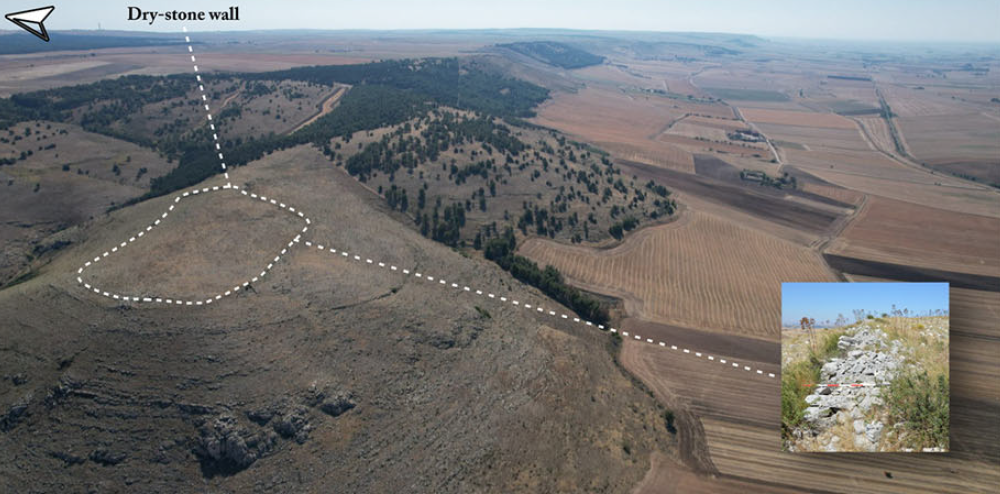
 Edge of the Murgia plateau in survey area B1, showing the enclosed hilltop and the adjacent plain.
Image Credit:
Recchia et al., Antiquity (2026)
New Surveys Trace a Prehistoric Shift from Valleys to Hilltops in Southern Italy
New archaeological surveys along the edge of the Murgia plateau in south-eastern Italy are revealing how prehistoric communities changed the way they used the landscape over thousands of years. Evidence ranging from the Neolithic to the Iron Age shows repeated occupation of valleys, lower slopes and elevated positions, with a gradual shift toward hilltop settlement becoming particularly visible from the middle of the second millennium BC.
The research focused on the northern Murge uplands within Alta Murgia National Park, a karstic plateau overlooking the Fossa Bradanica plain. Until recently, archaeological knowledge of this landscape depended largely on isolated excavations. Surveys carried out in 2023 and 2024 instead examined the plateau edge on a broader scale, concentrating on areas where upland and lowland environments meet.
Two valleys were selected because they form natural corridors linking the plateau with the surrounding plain. Together, the two surveyed zones covered about 1.5 square kilometres. Their position offered an opportunity to examine how prehistoric communities used different elevations and ecological settings and whether settlement preferences changed over time.
Archaeologists divided the landscape into smaller topographic units according to elevation, slope and ground visibility. This was particularly important in the rugged karstic terrain, where vegetation, erosion and steep slopes can strongly affect how easily archaeological remains can be detected.
The surveys recorded numerous concentrations of pottery, accompanied by chipped stone tools and larger stone implements such as grindstones. Most of the ceramics were handmade and smoothed or burnished, allowing researchers to identify several phases of prehistoric activity.
In one of the surveyed valleys, clusters of pottery found on the valley floor and lower slopes were identified as Early Bronze Age material. These finds were accompanied by flint artifacts and trachyte grindstones, strengthening the evidence for settlement-related activity in the area. Previous excavations nearby had already identified Early Bronze Age domestic structures, and the new survey demonstrates that occupation extended more widely through the valley system.
The pattern appears to change during the Middle Bronze Age, around the middle of the second millennium BC. Pottery and stone tools discovered higher on the Garagnone spur suggest that people increasingly began using elevated locations. Such positions offered broader views of the surrounding landscape and were naturally easier to defend, a pattern also seen at other nearby prehistoric hilltop sites.
A similar sequence emerged in the second surveyed valley. Concentrations of coarse handmade pottery and finer ceramics on the valley floor indicate occupation during the Iron Age, with some evidence possibly extending back into the Bronze Age. Fragments of grindstones and pieces from large vessels, perhaps used for storage, further suggest that this was not simply an area of temporary passage but supported settlement-related activities.
An elevated area overlooking this valley is enclosed by a poorly preserved dry-stone wall whose date remains uncertain. Erosion has exposed additional structural remains, while pottery from the hilltop is mainly associated with the Iron Age. A smaller number of fragments may date to the Middle Bronze Age, once again suggesting that elevated positions began attracting activity before hilltop settlement became widespread.
The surveys also identified evidence of much earlier human presence. One decorated pottery fragment bearing fingernail impressions belongs to Early Neolithic Impressed Ware of the sixth millennium BC. Flint artifacts from several parts of the landscape provide additional signs of intermittent activity stretching across different periods of later prehistory.
Taken together, the results suggest a long-term transformation in settlement choices. Earlier communities made substantial use of valley floors and lower slopes, while elevated sites became increasingly important from the middle of the second millennium BC. By the first millennium BC, hilltop occupation had become much more widespread across the region.
The findings show that the edge of the Murgia plateau was not merely a boundary between uplands and plains. Instead, it was a dynamic landscape repeatedly used for settlement, movement and resource exploitation. Future geophysical surveys, targeted excavations and archaeobotanical studies are expected to clarify how these communities adapted to local environments and why elevated places became increasingly important during the later phases of prehistory.
Published on: 13-09-2026
Edited by: Abdulmnam Samakie
Source: Antiquity