- Archaeological News
-
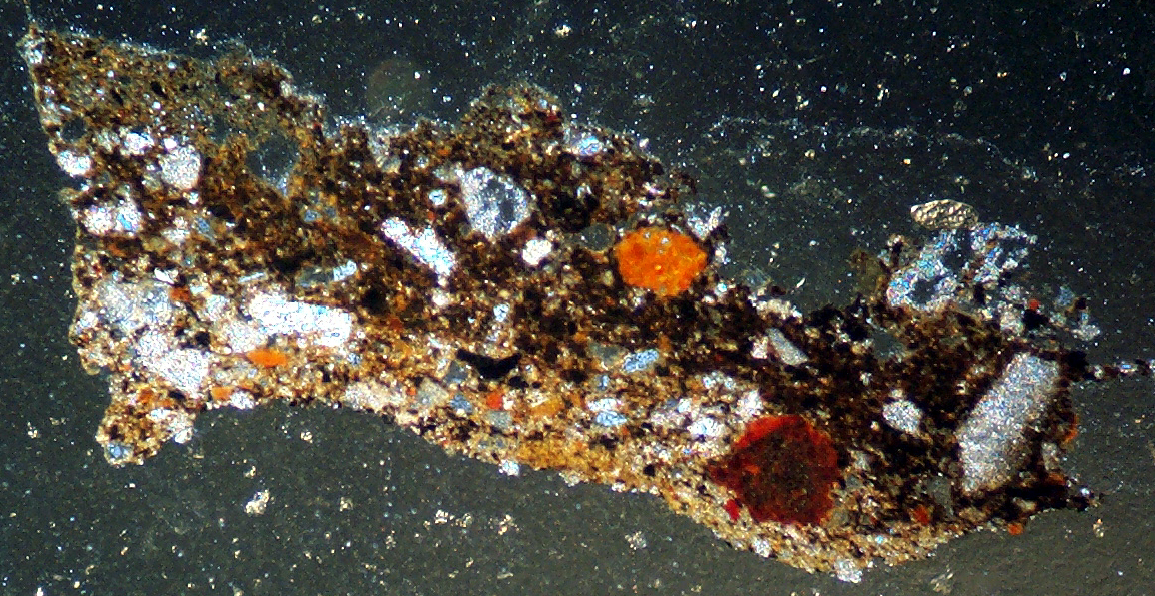
 Archaeological soil aggregate observed in a micromorphological thin section under polarized light.
Image Credit:
Hg.naton assumed, CC BY-SA 3.0, via Wikimedia Commons
Archaeological soil aggregate observed in a micromorphological thin section under polarized light.
Image Credit:
Hg.naton assumed, CC BY-SA 3.0, via Wikimedia Commons
Under the Microscope, Latin America’s Soils Are Rewriting Archaeological Stories
A technique that studies archaeological soils and sediments at microscopic scale has moved from the margins of research in Latin America to become an increasingly important tool for reconstructing how people built, farmed, cooked, burned, buried and reshaped landscapes. A new review of 166 scientific publications traces that transformation from the first regional applications in the 1990s to a rapidly expanding field stretching from Mexico to Tierra del Fuego.
Archaeological micromorphology works by examining thin sections of intact soils and sediments under a microscope, revealing structures and materials that excavation alone may not detect. Tiny fragments of charcoal, bone, ash, clay, plaster and other components can distinguish human activity from natural soil formation, while microscopic layering can preserve events that appear as a single homogeneous deposit to the naked eye.
The review shows how quickly the approach has grown. Since the early 2000s, annual publication numbers have increased substantially, reaching peaks of 15 studies in both 2019 and 2022. Mexico accounts for about 34% of the reviewed research and Brazil for roughly 25%, making the two countries the strongest regional centers for archaeological micromorphology. Peru, Argentina, Chile, Bolivia, Colombia and several other countries contribute smaller but growing bodies of research.
Its applications are remarkably broad. Researchers have used microscopic soil evidence to reconstruct ancient environments and agriculture, identify the construction methods behind earthen buildings, investigate caves and rockshelters, explain the formation of shell middens, and study human-made dark earths. Three themes alone—earthen architecture and construction materials, human-environment interaction and past agriculture—account for nearly 60% of the reviewed literature.
In Maya sites, for example, microscopic analyses have revealed differences in plaster recipes and manufacturing techniques, including finer materials used for some wall coatings and sculptural stucco. Elsewhere, studies of Amazonian Dark Earth have identified dispersed charcoal, pottery, bone fragments, phytoliths and traces of repeated trampling and reworking, helping researchers reconstruct how long-term occupation and land management gradually transformed natural soils into fertile anthropogenic deposits.
The review also highlights a major shift in who is conducting this work. More than 60% of the surveyed studies involved Latin American specialists working at institutions within the region, while another roughly 10% involved Latin American researchers based abroad. This growing local capacity means that the field is becoming less dependent on laboratories and specialists elsewhere.
Entire areas—including much of Central America south of Guatemala, Venezuela, Paraguay and parts of the Amazon—remain poorly represented or absent from the published record. Some archaeological subjects are similarly overlooked: earthworks and mounds account for less than 2% of the reviewed publications, living floors and activity areas only around 3%, while colonial, plantation, mining and other historical-period contexts have received very little attention. That gap may be especially important because almost 70% of Latin America lies within the tropics. Many standard microscopic reference criteria were developed in temperate, Mediterranean or arid environments, yet tropical soils can be intensely weathered and disturbed by roots, termites, ants and earthworms. Applying outside models without adjustment may therefore erase or misread subtle signs of past human activity.
The review calls for more regional laboratories and training, locally built reference collections, planned micromorphological sampling during excavations rather than afterthought sampling, and greater integration with techniques such as spectroscopy, micro-CT and chemical analysis. It also encourages open access to high-resolution thin-section imagery and analytical data.
The microscope, in other words, is no longer just confirming what archaeologists see in the trench. Increasingly, it is revealing what the trench cannot.
Published on: 02-10-2026
Edited by: Abdulmnam Samakie