- Archaeological News
-
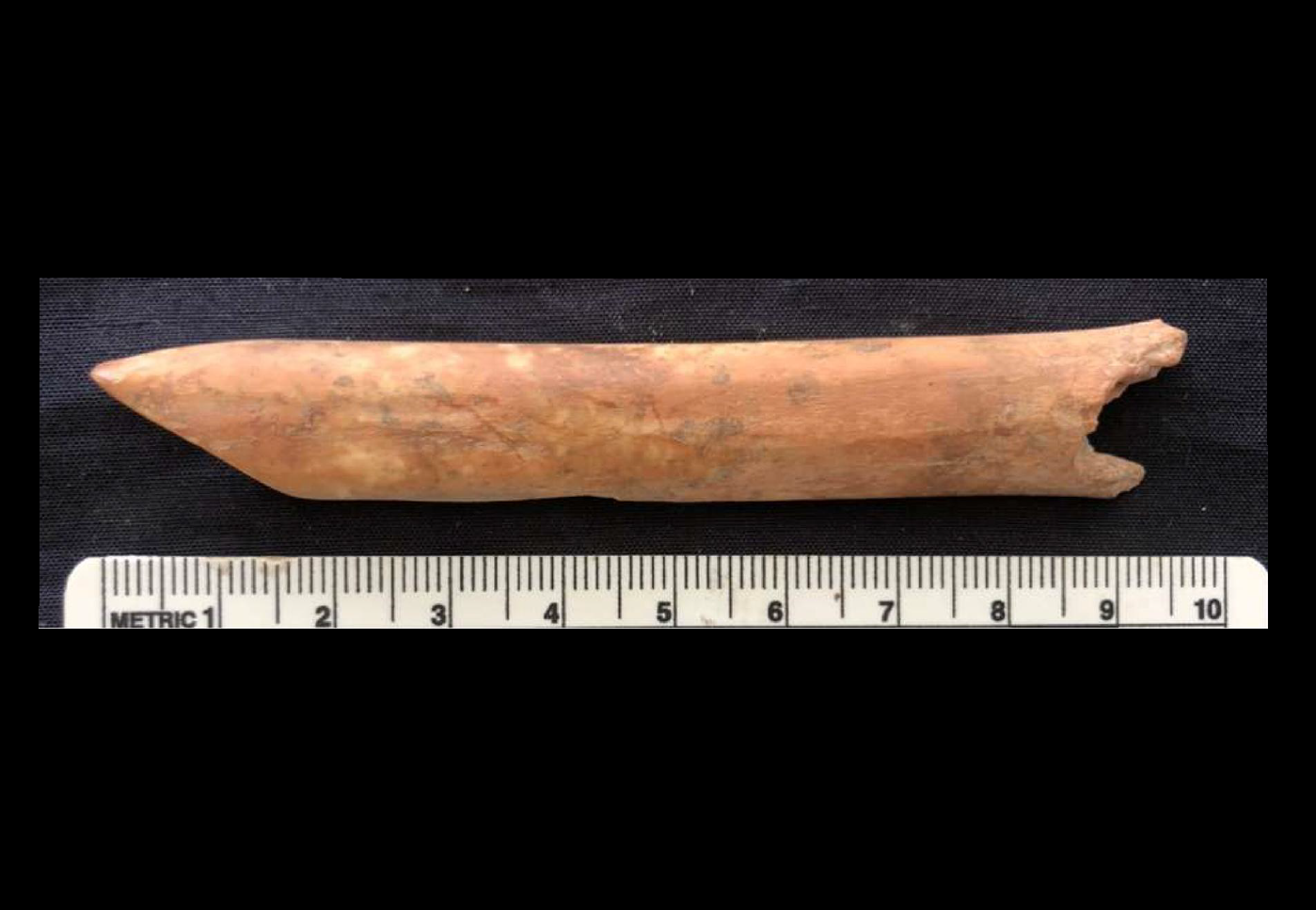
 Modified sheep or goat tibia from Abu Salabikh, showing a smooth, worked edge.
Image Credit:
Greenfield et al., Frontiers in Environmental Archaeology (2026)
Modified sheep or goat tibia from Abu Salabikh, showing a smooth, worked edge.
Image Credit:
Greenfield et al., Frontiers in Environmental Archaeology (2026)
Animal Bones Reveal Stone Blades Still Dominated Butchery in Early Dynastic Iraq
Microscopic traces preserved on animal bones from Abu Salabikh in southern Iraq are revealing that stone blades remained central to everyday food preparation even in a society already familiar with metalworking. The analysis of butchery marks from an Early Dynastic household shows that animals were processed with chipped-stone tools rather than metal knives, offering a detailed glimpse into how technological change unfolded in daily life during the third millennium BC.
Abu Salabikh lies on the southern Mesopotamian alluvial plain, on a tributary of the Euphrates. The settlement was occupied during several phases from the Late Uruk period onward and reached its greatest extent during the Early Dynastic III period before being abandoned later in the third millennium BC. The study focused on House 6H, an affluent but non-elite residence dating to about 2600–2350 BC.
The house contained numerous rooms, courtyards, work areas, a kitchen annex, reception spaces, nearby lanes and burials within the domestic complex. These different contexts preserve evidence of household activities, including food preparation and animal processing. The faunal assemblage was dominated by domestic animals, especially sheep and goats, followed by pigs, while cattle and several wild species were present in smaller numbers.
Researchers recorded 54 animal-bone specimens with signs of butchery, including slicing, chopping, scraping and impact marks. Sixteen specimens with particularly clear, non-overlapping slice marks were selected for closer examination. Silicone moulds of the marks were studied using light microscopy and scanning electron microscopy, allowing the shape of individual grooves and tiny secondary striations to be compared with marks typically produced by stone and metal edges.
The distinction is visible at microscopic scale. Metal knives generally produce cleaner, more symmetrical V-shaped grooves with smoother sides and more regular striations. Chipped-stone tools tend to leave shallower, more irregular grooves because their cutting edges are naturally uneven. They can also produce small lateral striations beside the main groove.
All 16 analysed specimens displayed features consistent with chipped-stone blades or flakes. Fifteen showed marks attributed to unretouched, unifacially produced stone edges, while one may have been made with a retouched tool. None displayed diagnostic traces of a metal knife. The result therefore indicates that chipped stone was the primary cutting technology used for animal butchery in the examined household.
This is significant because metallurgy was already present in Mesopotamia. Metal objects are known from Early Dynastic contexts, but copper and bronze were not automatically adopted for every task. At Abu Salabikh, copper objects from domestic contexts were scarce and consisted mainly of small items rather than butchering knives. Stone blades, by contrast, were readily available, sharp, relatively inexpensive and easy to replace or resharpen.
The findings therefore challenge a simple picture in which metal rapidly replaced stone once metallurgy appeared. Technological change seems instead to have been selective. New materials could acquire importance in weapons, ornaments, ritual objects or high-status settings while older technologies continued to perform everyday tasks efficiently.
The spatial distribution of butchered bones within House 6H also suggests that animal processing took place in several parts of the household complex. Butchery evidence occurred in courtyards, work areas, the kitchen zone, graves and exterior spaces, indicating that carcass processing was integrated into a range of domestic activities rather than confined to a single specialized room.
More broadly, the evidence fits a pattern documented elsewhere in the ancient Near East, where chipped-stone tools continued to be used for butchery long after metal technology had appeared. Metal knives became more common in everyday carcass processing only during later Bronze Age periods.
By reading microscopic traces that survived on discarded animal bones, the analysis provides a different way of measuring technological adoption. Rather than relying only on surviving tools—which could be recycled, curated or deposited selectively—the cut marks record what people actually used. At Abu Salabikh, those traces show that technological innovation did not erase established practices overnight: in the kitchen and courtyard, stone remained an effective and trusted tool.
Published on: 12-09-2026
Edited by: Abdulmnam Samakie