- Archaeological News
-
 Image Credit:
Totsuka et al., Nature Communications (2026)
Image Credit:
Totsuka et al., Nature Communications (2026)
Population Growth May Have Sparked Cultural Complexity in Paleolithic Japan
A new study suggests that population expansion among early Upper Paleolithic hunter-gatherers helped trigger cultural complexity on Paleo-Honshu Island, the landmass that once connected Honshu, Shikoku, and Kyushu in Japan.
Modern humans are thought to have reached the Japanese islands around 38,000 years ago. This early dispersal is represented by archaeological sites on Paleo-Honshu, where distinctive stone-tool traditions appeared soon after the arrival of Homo sapiens.
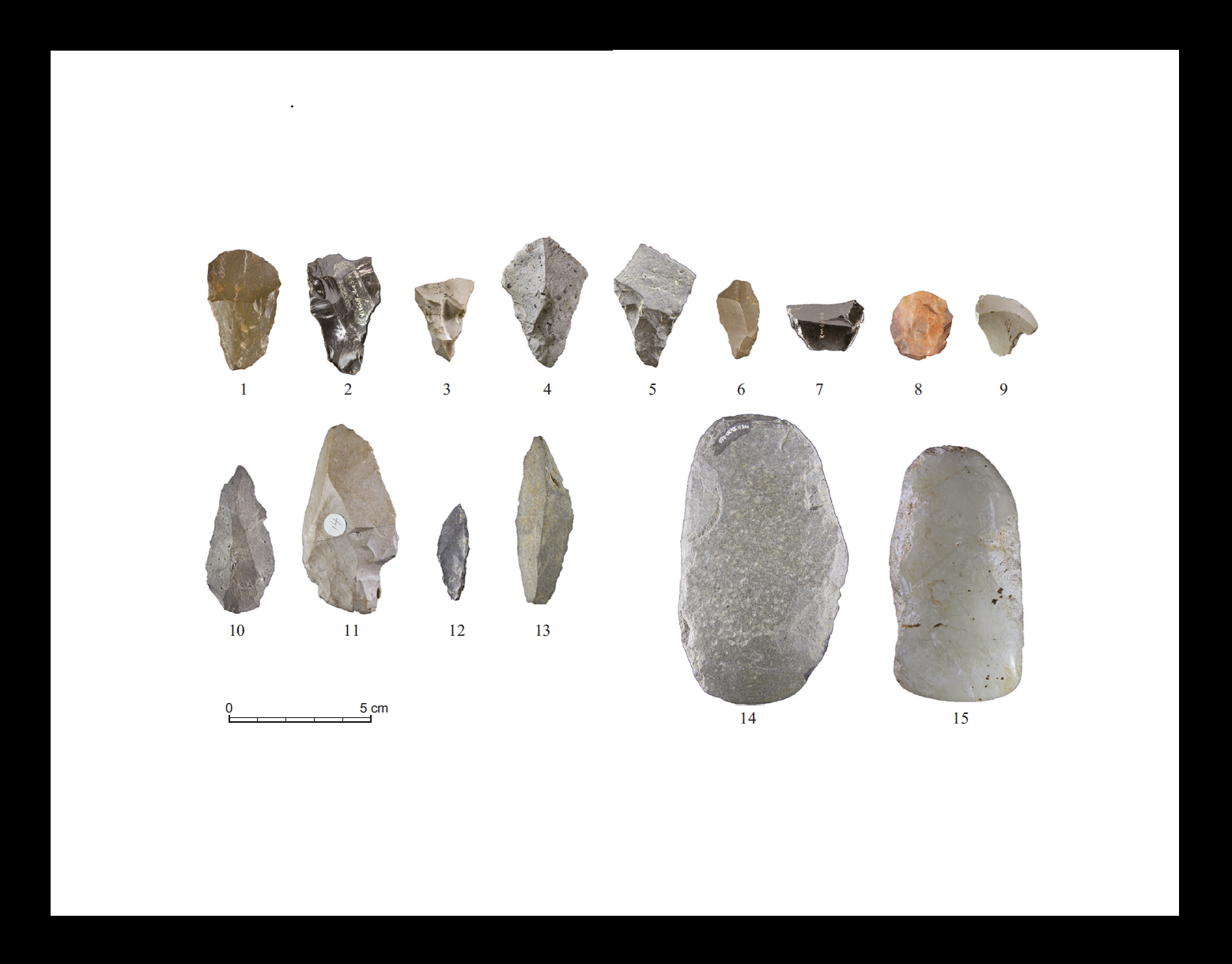
Unlike the Initial Upper Paleolithic industries known from parts of continental Eurasia, the early Upper Paleolithic assemblages of Japan developed their own character. They included trapezoid stone tools, blade technologies, edge-ground axes, and large circular concentrations of stone artefacts.
To better understand when and how these traditions formed, the researchers reviewed radiocarbon evidence from early Upper Paleolithic sites across Japan. They examined 453 radiocarbon dates from 81 sites, then selected 353 reliable dates from 61 sites for Bayesian chronological modelling and kernel density analysis.
The results indicate that early Upper Paleolithic occupation began around 38,000 years ago. The earliest reliable sites, dating to about 38,000–37,000 years ago, were geographically limited and contained trapezoids, scrapers, borers, and retouched flakes, but no blade-based tools.
Between 37,000 and 36,000 years ago, the number of sites began to increase slightly. The earliest blade assemblages appeared during this phase, along with early edge-ground axes and circular lithic concentrations. However, these elements were still relatively limited in number and distribution.
A major change occurred between 36,000 and 34,000 years ago. During this period, the number of sites increased dramatically, and occupation expanded northward across Paleo-Honshu. The density of radiocarbon dates also peaked around 35,000 years ago, suggesting a real increase in population and settlement activity.
At the same time, stone-tool assemblages became more complex. Trapezoid tools became more varied, with three different types appearing across many sites. Blade technologies became more widespread, edge-ground axes were produced more frequently, and large circular lithic concentrations became common.
These circular lithic concentrations may represent aggregation camps, where different hunter-gatherer groups gathered for social interaction, exchange, and possibly cooperative hunting or processing activities. The presence of raw materials from different sources supports the idea that these places were hubs of intergroup contact.
The researchers argue that population growth created the conditions for innovation. Larger groups and stronger social networks would have increased opportunities for sharing skills, testing new tools, and transmitting technical knowledge between communities.
This may explain why the early Upper Paleolithic in Japan became so distinctive. The cultural complexity seen around 36,000–34,000 years ago was not simply imported from the continent. Instead, it likely developed locally as modern human groups adapted to the environments of Paleo-Honshu.
Climate may also have played a role. The population expansion coincided with a relatively warm interstadial phase known as Dansgaard-Oeschger 7. Warmer conditions may have allowed hunter-gatherers to expand their territory northward and increase their population size.
After the peak in activity between about 36,000 and 34,000 years ago, the number of sites declined, and some characteristic early Upper Paleolithic features became less common. Trapezoids, edge-ground axes, and large circular lithic concentrations gradually decreased, while new blade technologies and backed points became more important.
This shift may reflect population fluctuations linked to later cooling conditions. The study suggests that the transition from the early to the middle Upper Paleolithic in Japan may have begun locally, without requiring a new migration from the continent.
Overall, the research provides a new quantitative framework for understanding the first modern human communities in Japan. It shows that demographic growth, social interaction, environmental opportunity, and local innovation together shaped the emergence of complex Paleolithic culture on Paleo-Honshu.
Published on: 18-07-2026
Edited by: Abdulmnam Samakie
Source: Nature Communications