- Archaeological News
-
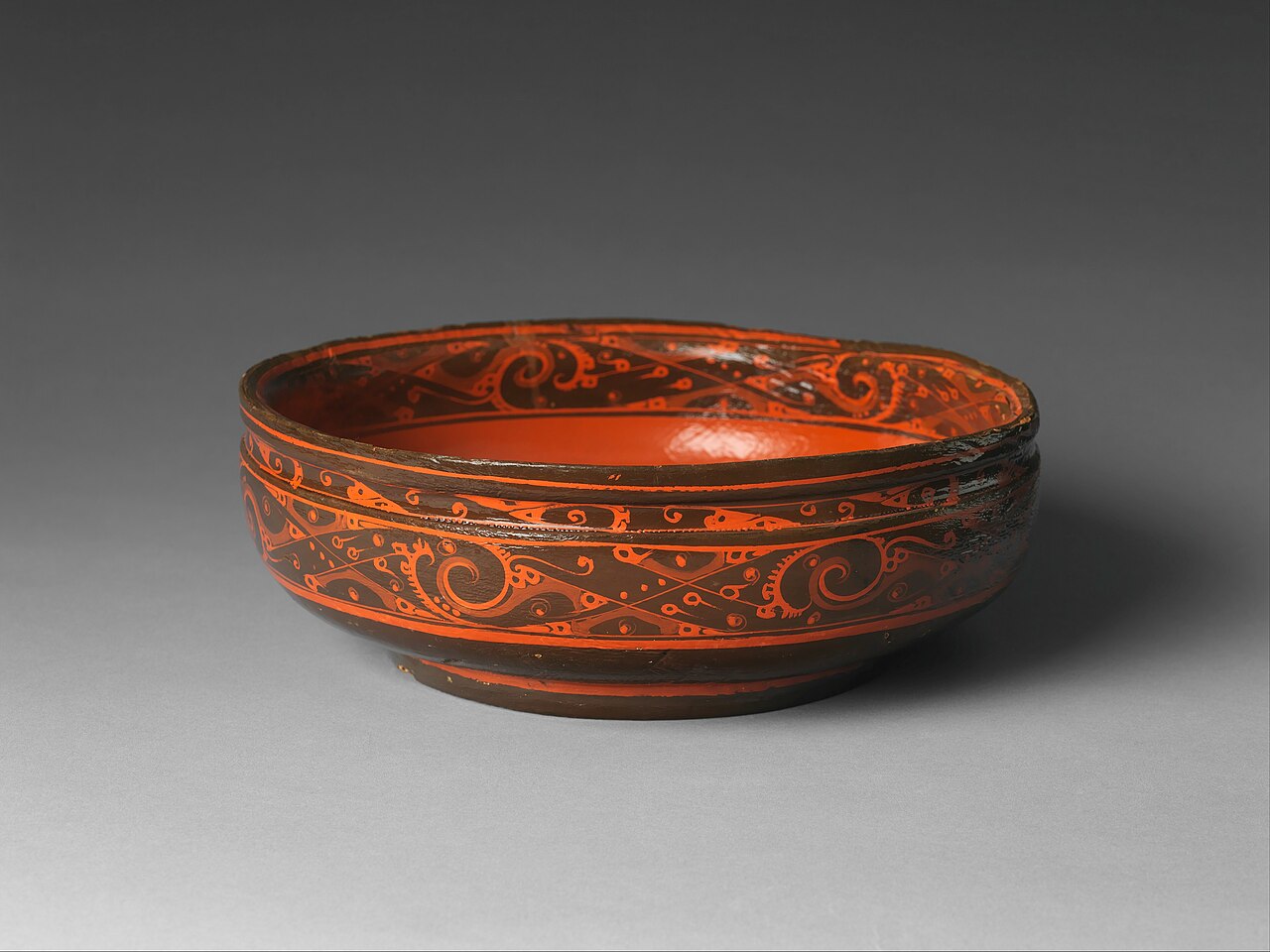
 Image Credit:
Metropolitan Museum of Art, CC0, via Wikimedia Commons
Image Credit:
Metropolitan Museum of Art, CC0, via Wikimedia Commons
3D Thermography Offers a Safer Way to Detect Hidden Damage in Lacquerware
A new study presents a non-contact 3D thermography method that can detect hidden defects inside lacquerware artifacts while also recording their surface shape.
Lacquerware is a complex form of cultural heritage. It often combines a wooden core with multiple lacquer layers, pigments, decoration, and polished surfaces. Over time, these objects can develop hidden problems such as cracks, voids, splitting, material loss, and internal fractures. Such defects may not be visible from the outside, but they can weaken the object and affect future conservation decisions.
Traditional inspection methods can be limited because sampling may damage the artifact, while some imaging techniques only provide two-dimensional information. Infrared thermography is useful because it can reveal hidden structural changes through differences in heat flow. However, conventional thermal imaging often lacks direct three-dimensional information about the object’s surface.
To address this issue, the study introduces a monocular 3D active thermography system based on laser line scanning. The system uses only one infrared camera and one line laser, without requiring an external 3D scanner. This makes the method lighter, simpler, and potentially more practical for heritage conservation.
The line laser performs two roles at the same time. First, it gently heats the object’s surface in a controlled way, allowing the infrared camera to record how heat moves through the material. Second, the laser line provides spatial information that allows the system to reconstruct the surface geometry of the object.
The method links thermal data with three-dimensional coordinates through a unified spatiotemporal mapping framework. In simple terms, each point on the reconstructed surface can be connected with its own temperature-response history. This allows conservators to see not only where a thermal anomaly appears, but also how it relates to the object’s actual shape and decoration.
The researchers tested the method on an antique-style lacquer plate made with a wooden substrate and multiple natural lacquer layers. To simulate hidden deterioration, nine flat-bottom holes were created on the back of the plate. These artificial defects varied in diameter and depth, allowing the team to test how well the system could detect defects of different sizes.
The experiments showed that the method could detect subsurface anomalies while keeping the temperature rise low. During scanning, the maximum temperature increase was about 1.61°C, suggesting that the technique can produce useful thermal responses under mild heating conditions. This is especially important for organic heritage materials, which can be sensitive to heat.
The study found that defects with larger diameter-to-depth ratios were easier to detect. Under the tested conditions, defects with ratios between 5 and 15 could be identified in the thermal images. Smaller and deeper defects, especially those with lower ratios, were harder to detect and sometimes remained invisible.
The researchers also applied several thermal signal-processing methods, including pulsed phase thermography, principal component thermography, and thermographic signal reconstruction. These methods helped enhance weak defect signals and reduce background interference. Among them, thermographic signal reconstruction produced clearer defect boundaries and more stable results in some cases.
The 3D reconstruction also captured surface details of the lacquer plate, including raised patterns and subtle relief. This is important because surface decoration, pigment colour, lacquer thickness, and emissivity can all affect thermal signals. Darker regions, for example, may absorb more laser energy and show stronger temperature responses than lighter regions.
By combining thermal and geometric information, the method helps distinguish between true internal defects and background variations caused by surface texture or decoration. The resulting 3D temperature model provides a more intuitive view of how hidden damage relates to visible surface features.
The study also notes some limitations. Rich surface decoration can interfere with defect detection, and smaller defects near complex central patterns may be masked by geometric and thermal interactions. Physical features such as supporting feet on the back of the object can also produce thermal anomalies that may be mistaken for defects if not carefully interpreted.
Overall, the research demonstrates a promising approach for the digital preventive conservation of lacquerware. By combining laser scanning, infrared thermography, and 3D reconstruction in a single system, the method offers a safer and more integrated way to inspect delicate cultural artifacts without touching or sampling them.
Published on: 13-07-2026
Edited by: Abdulmnam Samakie
Source: npj Heritage Science