- Archaeological News
-
 Image Credit:
Dronepicr, CC BY 3.0, via Wikimedia Commons
Image Credit:
Dronepicr, CC BY 3.0, via Wikimedia Commons
Curaçao’s Cultural Landscapes Reveal 5700 Years of Human–Environment Interaction
New archaeological and palaeoecological research on Curaçao is revealing nearly 5700 years of human activity and environmental adaptation on the Caribbean island.
The Curaçao Cultural Landscape Project investigated two coastal landscapes, Rif Sint Marie and Jan Thiel, between 2022 and 2025. By combining archaeological survey, excavation, geophysical work, zooarchaeology, geoarchaeology, and lagoon sediment coring, the project reconstructed a long history of settlement, land use, and environmental change.
The results show that Curaçao was occupied earlier than previously documented, placing it among the earliest-settled islands in the Caribbean. The project also highlights how different communities adapted to the island’s dry, high-sunlight environment over thousands of years.
At Rif Sint Marie, excavation of the C-1426 rock shelter produced the earliest recorded dates for human activity on Curaçao. Charcoal dates indicate occupation between about 3785 and 3365 BC, pushing back the known beginning of settlement on the island by approximately 300 to 850 years.
The location of the rock shelter appears to have been carefully chosen. It lies on an escarpment that provides shade from the afternoon tropical sun, while also offering wide views over the surrounding landscape. The site contained rich deposits with stone and coral artefacts, shells, bones, and repeated-use combustion features.
The animal remains from C-1426 show a strong reliance on marine resources. Reef fish were common and may have been caught beyond the salina, about two kilometres away, probably by canoe. Marine molluscs also formed a major part of the assemblage, especially oysters and West Indian murex associated with mangroves and mud flats.
These finds suggest that Salina Sint Marie was already a sheltered, mangrove-fringed bay around 5500 years ago, similar in some ways to the landscape seen today. Ongoing pollen analysis from lagoon cores is expected to refine this environmental reconstruction.
The Rif Sint Marie landscape also preserves later colonial remains. These include plantation features, an enslaved village area, water-management structures, a storehouse, a corral, and salt-production facilities. Archival records and lidar imaging helped identify features linked to the Rif Sint Marie Plantation, established around 1680.
Finds from the colonial period include glassware, sheep/goat and pig bones, Ford Model T parts, tobacco pipes, bricks, and domestic ceramics of Dutch, English, and German origin. These materials show how Curaçao became connected to wider commercial networks from the seventeenth to twentieth centuries.
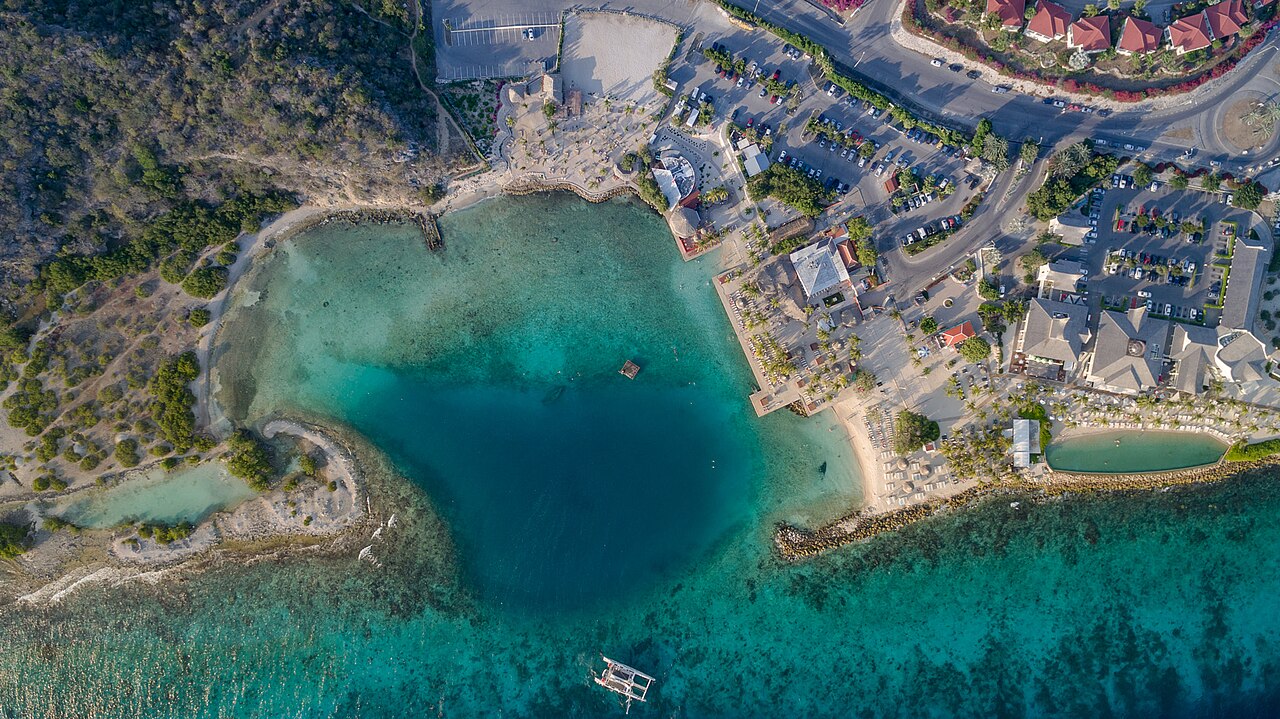
At Jan Thiel, the project confirmed five Indigenous-period shell middens. These shallow and localized deposits contained mainly shellfish remains and few artefacts, suggesting intermittent harvesting rather than dense permanent occupation.
Dating the shell middens remains difficult because of the lagoon’s carbonate geology, which can complicate chronological interpretation. The researchers therefore emphasize the need for alternative dating approaches.
Jan Thiel also preserves major traces of colonial salt production. Its salt flats retain evaporation ponds, walls, and dams built to manage water and salinity for commercial salt extraction. These structures may still influence the modern wetland environment by retaining freshwater and improving habitat conditions for some waterbirds.
Today, Jan Thiel is both a conservation and recreation area, while Rif Sint Marie includes a Ramsar wetland and national park. In both landscapes, modern hiking and cycling paths intersect with archaeological remains, showing how cultural heritage continues to shape contemporary use of the land.
The project demonstrates that Curaçao’s present-day landscapes are not simply natural environments. They are cultural landscapes shaped by Indigenous settlement, marine resource use, colonial plantation systems, salt production, water management, livestock introductions, and modern development.
Overall, the findings provide a rare long-term perspective on human adaptation to an arid Caribbean island. They show how people repeatedly selected, reused, engineered, and transformed coastal landscapes in response to climate, resources, mobility, trade, and social needs.
The study also highlights the importance of historical ecology for conservation. Understanding how past communities shaped wetlands, biodiversity, and coastal environments can help guide heritage protection and environmental management for Curaçao’s local communities today.
Published on: 14-07-2026
Edited by: Abdulmnam Samakie
Source: Antiquity