- Archaeological News
-
 Image Credit:
Rivera Jiménez et al., Antiquity (2026)
Image Credit:
Rivera Jiménez et al., Antiquity (2026)
Ancient Stelae Reveal a Crossroads of Memory and Exchange in Spain
A new archaeological study at Las Capellanías in south-west Spain has revealed important evidence about the role of prehistoric stelae, burial practices, and ancient communication routes in Iberia.
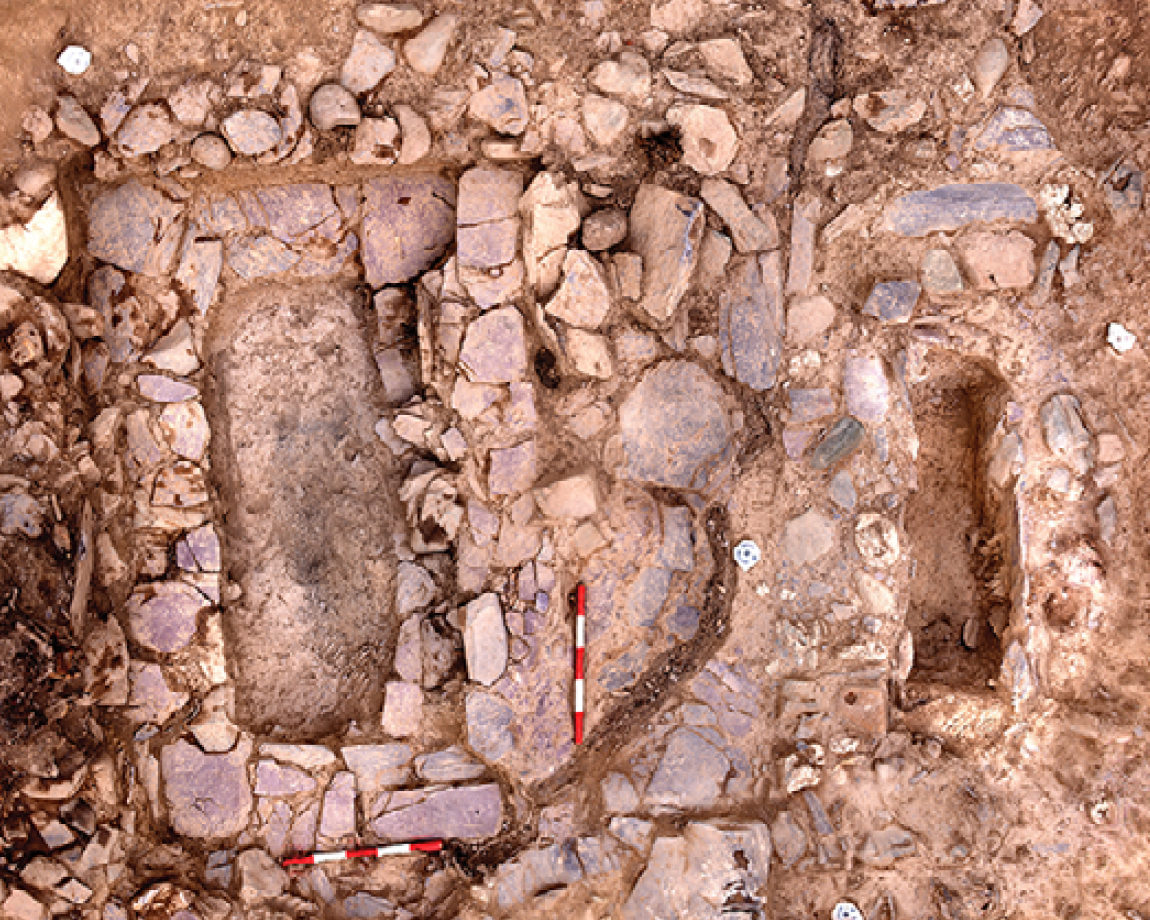
The site, located in Cañaveral de León in Huelva province, came to attention after the chance discovery of a decorated “diademated” stela in 2018. Subsequent surveys and excavations led to the discovery of two additional stelae, along with a burial complex containing 18 funerary structures. These findings provide rare contextual evidence for monuments that are often found without clear archaeological associations.
For decades, Iberian "warrior" and "diademated" stelae have been difficult to interpret because many were discovered accidentally or away from excavated contexts. Scholars have debated whether they served as grave markers, territorial signs, or symbols connected to movement and social identity. The discoveries at Las Capellanías now offer strong evidence that these stelae could serve both as burial markers and as landmarks connected with a routeway.
The excavations revealed different types of graves, including Bronze Age-style cist tombs, Iron Age slab-lined pits covered by cairns, and more complex composite structures. Several tombs contained cremated human remains, pottery vessels, metal objects, beads, and ornaments. Radiocarbon dating of the cremated bones places much of the funerary activity between about 800 and 550 BC, corresponding to the Early Iron Age, though some evidence suggests a longer history of use at the site.
The stelae were closely associated with both burials and the ancient trackway. One stela stood near a burial structure, another was embedded in a mound, and a third partly covered a funerary feature. Their position near the route suggests that the monuments marked not only the dead, but also a place of movement, encounter, and memory.
The material culture from Las Capellanías points to a mixture of local traditions and wider Mediterranean influences. Handmade vessels reflect long-standing Bronze Age ceramic practices, while wheel-thrown urns of La Cruz del Negro type show connections with forms introduced through Phoenician contacts. Metal ornaments, glass beads, a silver earring, fibulae, a belt buckle, and other objects also link the site to broader Early Iron Age networks in south-western Iberia.
This combination of burial architecture, stelae, imported or inspired objects, and local traditions suggests a process of cultural hybridisation. Rather than replacing older practices, new influences appear to have been incorporated into existing funerary traditions. The site therefore reflects both continuity and change during a period of expanding contacts across Iberia and the wider Mediterranean world.
The study also emphasizes the importance of the Las Capellanías trackway. The route appears to have connected the lower Guadalquivir Valley and the middle Guadiana basin, regions where similar stelae and burial traditions have been documented. This suggests that the site was part of a broader landscape of movement, exchange, and symbolic communication.
Overall, Las Capellanías offers one of the clearest archaeological contexts yet for understanding Iberian prehistoric stelae. The site shows that these monuments were not isolated objects, but part of a living landscape where burials, roads, ancestral memory, and cultural exchange came together over many generations.
Published on: 01-07-2026
Edited by: Abdulmnam Samakie
Source: Antiquity