- Archaeological News
-
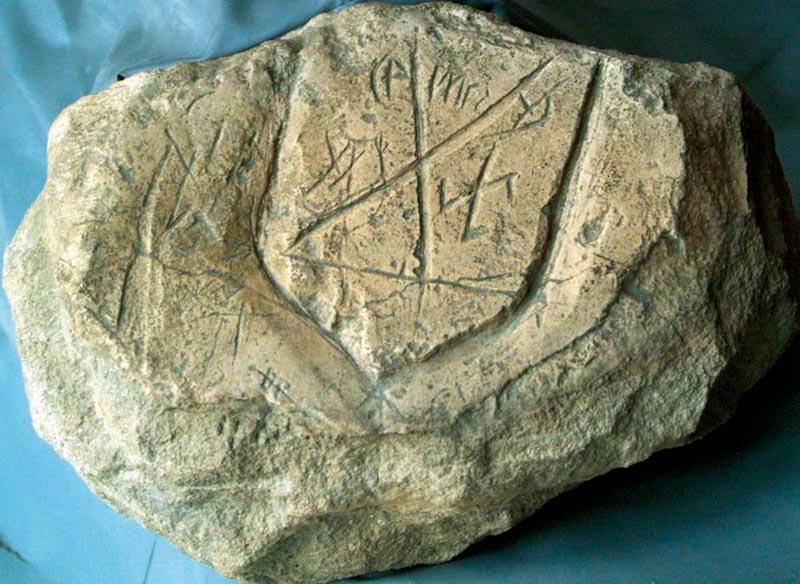
 Old Hungarian Script (Székely-Hungarian Rovashs)
Image Credit:
Public domain, via Wikimedia Commons
Old Hungarian Script (Székely-Hungarian Rovashs)
Image Credit:
Public domain, via Wikimedia Commons
AI-Based Analysis Traces the Evolution of Ancient Writing Systems
A new heritage science study proposes a computational method for reconstructing how historical writing systems evolved, using patterns in surviving inscriptions rather than relying on a predefined model of how individual symbols changed through time.
The approach treats writing systems as structured “pattern systems” made up of symbols, rules for combining them and conventions governing their visual arrangement. Inscriptions, manuscripts and other physical examples of writing are treated as observable “graph sequences” that preserve only part of the larger system known to their creators.
The study introduces a framework called Deep Feature Phylogenetics, designed for cases where researchers do not know the probability that one graphical feature will change into another. Unlike biological phylogenetics, where DNA mutation models can often be specified in advance, the evolution of human-made symbolic systems may follow cultural, technological and cognitive pathways that are much harder to predict.
Instead of assuming a fixed evolutionary model, the method compares the structural features present in surviving inscriptions and reconstructs relationships among them. The study also introduces weighted measures intended to account for an important archaeological problem: some inscriptions preserve much more information than others.
Short inscriptions may contain only a few signs or features, while longer examples preserve a larger portion of the writing system. Treating all inscriptions as equally informative could therefore distort the reconstruction. The newly proposed weighted indices reduce the influence of sequences that preserve comparatively little information.
To test the approach, the research analysed 55 examples belonging to four traditionally recognized Rovash script systems historically associated with the Eurasian steppe and Carpathian Basin. Each inscription was described using 119 binary graphical features indicating whether particular characteristics were present or absent.
The dataset included Turkic Rovash, Székely-Hungarian Rovash, Carpathian Basin Rovash and Steppe Rovash. Most of these historical systems disappeared roughly a millennium ago, while Székely-Hungarian Rovash remains in use. Because many surviving examples are short and difficult to date precisely, their conventional classification is not always certain.
Researchers compared the inscriptions using two multivariate methods. Neighbour-Joining analysis produced tree-like relationships based on similarities among their features, while Principal Coordinate Analysis represented the same relationships spatially.
The results strongly supported the traditional grouping of the Turkic Rovash and Székely-Hungarian Rovash examples. Their inscriptions formed particularly coherent groups in the analysis.
The distinction between Steppe Rovash and Carpathian Basin Rovash was less clear. Their lower classification scores suggest that some surviving inscriptions share features across the conventional boundary between the two systems.
The study offers several possible explanations. Traditional categories may not perfectly reflect historical relationships, similar graphical characteristics may have developed independently, or different traditions may have interacted and hybridized. In the last case, the history of these scripts might be better represented as an interconnected network rather than a simple branching tree.
The researchers emphasize that the reconstructed relationships do not represent direct descent from one surviving inscription to another. Each inscription is instead understood as a partial reflection of the broader writing knowledge possessed by its scribe.
This distinction is particularly important for archaeology because ancient writing survives unevenly. Some scripts are known from extensive inscriptions, while others may be represented by only short or fragmentary texts.
Although tested on Rovash scripts, the proposed framework is intended for wider use. It could potentially be applied to undeciphered writing systems, epigraphic collections and other symbolic heritage datasets where evidence is incomplete and evolutionary pathways are uncertain.
The study therefore demonstrates how computational modelling and artificial intelligence may complement traditional palaeography by identifying hidden structural relationships among inscriptions and testing whether long-established classifications accurately reflect the evolution of ancient writing traditions.
Published on: 09-08-2026
Edited by: Abdulmnam Samakie
Source: npj Heritage Science