- Archaeological News
-
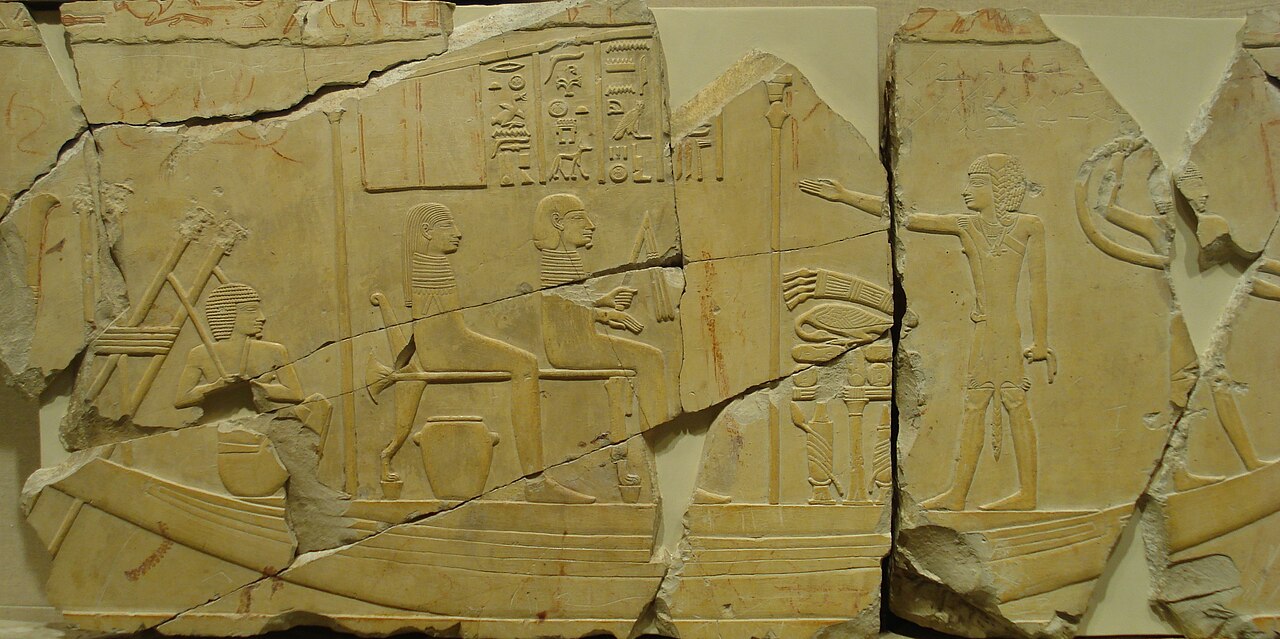
 An ancient Egyptian relief sculpture depicting a high-ranking official and his wife on a ritual pilgrimage. The artwork dates back to the Late Period (Twenty-Sixth Dynasty), during the reign of Pharaoh Psammetichus I.
Image Credit:
David Liam Moran, CC BY-SA 3.0, via Wikimedia Commons
An ancient Egyptian relief sculpture depicting a high-ranking official and his wife on a ritual pilgrimage. The artwork dates back to the Late Period (Twenty-Sixth Dynasty), during the reign of Pharaoh Psammetichus I.
Image Credit:
David Liam Moran, CC BY-SA 3.0, via Wikimedia Commons
Old Bones, New Evidence Reopen the Human Sacrifice Debate at Abydos
A modern reassessment of human remains excavated more than a century ago at Abydos in southern Egypt is challenging long-standing interpretations of some of the earliest royal burials in Egyptian history, revealing evidence of injuries that earlier excavators either missed or misunderstood.
The remains come from subsidiary graves surrounding First Dynasty royal funerary complexes at Umm el-Qaab, dating to roughly 3078–2900 BC. Hundreds of individuals—likely members of the royal household, court officials and craftspeople—were buried around the tombs and associated funerary enclosures of early Egyptian rulers. Because many of the graves appear to have been closed within closely related burial events, archaeologists have long debated whether these individuals died naturally or were deliberately killed to accompany their ruler into the afterlife, a practice known as retainer sacrifice.
When the burials were excavated in the early 20th century, investigators reported no clear evidence of lethal trauma. That absence became central to later arguments against sacrifice, even though the original excavators themselves still suspected that some form of ritual killing had taken place. Another dramatic suggestion proposed that certain individuals may have been buried alive, partly because several bodies were found with limbs in unusual positions. Modern bioarchaeology is now changing that picture.
A reassessment of 46 preserved skulls from the subsidiary burials identified perimortem cranial trauma in 18 individuals, or about 39% of the sample. Perimortem injuries occur around the time of death, before bone has fully dried and become brittle. Linear fractures across the skull were the most common injuries, but researchers also identified several sharp-force wounds, including a penetrating injury to the side of the head and another severe injury around the eye.
The finding doesn’t prove that every individual was sacrificed, or even that all of the observed injuries directly caused death. Some of the people buried around the royal complexes may have died from other causes. Yet the presence of potentially lethal trauma on a substantial portion of the surviving skulls changes a debate that had long rested partly on the supposed absence of violence.
It also suggests that early excavators may actually have seen some of these fractures. Paraffin wax was widely applied to fragile skulls during early conservation work, and in several cases it was placed directly around fractured areas. The new analysis proposes that the breaks were probably noticed but interpreted as damage that occurred after burial rather than injuries sustained close to death. A century of advances in forensic anthropology now allows researchers to distinguish these processes with far greater precision.
The older idea that some retainers were buried alive is also being reconsidered. Body positions once interpreted as signs of desperate movement can result from the way corpses shift during decomposition, from the gradual collapse of soft tissues or from the manner in which graves fill with sediment. The surviving photographs and excavation records therefore don’t provide firm evidence that the individuals were conscious when buried.
Even the nature of the injuries remains uncertain. The common linear fractures don’t closely resemble the depressed injuries expected from heavy stone maces, despite the familiar Egyptian imagery of kings striking enemies with such weapons. Experimental evidence instead suggests that some fractures of this type can result from impact with broad, relatively flat objects. The precise circumstances of death remain unresolved.
The study is also constrained by what survives. The 46 preserved skulls represent only a small fraction—estimated at roughly 5% to 15%—of the burial populations associated with the funerary enclosures. Many graves had already been disturbed in antiquity, much of the rest of the skeletons is no longer available for study, and historic conservation treatments sometimes obscure skeletal surfaces.
For that reason, the research stops short of declaring the question settled. Retainer sacrifice at Abydos remains a plausible interpretation, perhaps stronger than it appeared when trauma was thought to be absent, but the funerary practices surrounding Egypt’s earliest kings were probably more varied and complicated than a single explanation can capture.
More broadly, the work shows how museum collections excavated generations ago can still produce new discoveries. Sometimes old interpretations survive renewed examination. Sometimes they change completely. And sometimes, as at Abydos, old bones make the past considerably more complicated.
Published on: 06-10-2026
Edited by: Abdulmnam Samakie