- Archaeological News
-
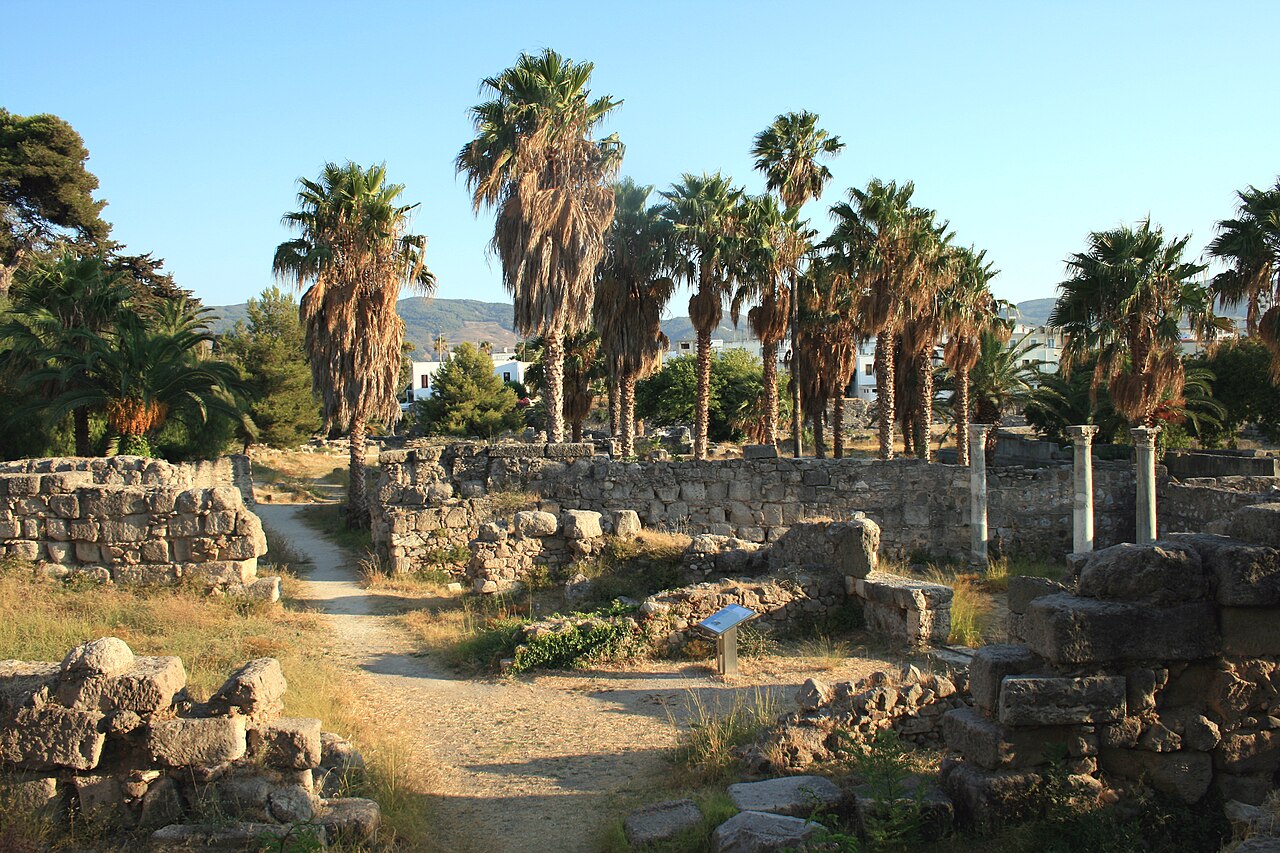
 The Ancient Agora of Kos, Greece, where archaeological investigations have revealed a late Hellenistic workshop associated with pigment production and lead metallurgy.
Image Credit:
Karelj, via Wikimedia Commons
Ancient Workshop on Kos Reveals a Different Way of Making Egyptian Blue
A remarkably preserved workshop on the Greek island of Kos is changing how archaeologists understand the production of Egyptian blue, revealing that craftspeople in the late Hellenistic period manufactured pigments and worked lead within the same space—and may have used a firing method that differed from the one described by ancient writers.
The workshop occupied part of the eastern stoa of the agora in the ancient city of Kos and dates to the second century and first half of the first century BC. Excavations uncovered built fire installations alongside Egyptian blue pellets, mineral pigments, tools, lead waste and other remains of manufacturing activity. Together, the finds point not to a workshop devoted to one specialized product, but to a place where several closely connected crafts operated side by side. Egyptian blue was one of antiquity’s best-known artificial pigments. Producing it required controlled heating at high temperatures, making its manufacture more technically demanding than simply grinding naturally coloured minerals into powder. At Kos, archaeologists recovered 98 rounded Egyptian blue pellets around one fire installation and another ten elsewhere in and around the workshop. Most measured between two and four centimetres across. Their condition provides some of the strongest evidence that the pigment was actually manufactured there. About 47% of the analysed pellets were successfully fired and uniformly blue, while 23% were only partly successful, displaying blue alongside green, grey or brown. Another 30% consisted of failed or waste products in shades ranging from brown and grey to purple. A mixture of finished products and unsuccessful batches is difficult to explain if the material had simply been imported for sale or use.
Yet something expected was missing. The Roman architect Vitruvius described Egyptian blue being fired inside ceramic vessels, often called saggars, and such containers have been associated with production at several other Mediterranean sites. None were found in the Kos workshop. Rather than treating their absence as proof that Egyptian blue wasn’t made there, the new study argues that the pellets themselves point to another method. They remained separate during firing and commonly have one flattened face, suggesting they may have been spread individually across a flat surface rather than packed together inside ceramic containers. Their comparatively large size strengthens that interpretation.
Egyptian blue was only part of the workshop’s palette. Archaeologists also identified red, yellow, brown, green, violet and other colouring materials, including pigments based on hematite, goethite and celadonite. Mortars and other tools could have been used to grind and refine some of these materials, although their exact functions can’t always be established.
At the same time, workers were processing lead. Around 50 rods of litharge, a lead oxide produced during metallurgical operations, were discovered alongside numerous fragments, amorphous lead lumps and droplets. Their distribution suggests that litharge was reduced to metallic lead inside the workshop. A cupel was also reported, raising the possibility of silver-processing activity, although the study stresses that this remains uncertain and requires further investigation.
The close physical relationship between these activities is central to the study. Rather than imagining pigment makers and metalworkers as entirely separate specialists, the evidence suggests a multicrafting environment in which knowledge, fire installations, tools, raw materials and working techniques overlapped. Lead detected in some Egyptian blue could even reflect interaction between the two processes, although its precise role remains unresolved.
Location mattered too. The workshop stood near one of the ancient city’s main commercial streets, with direct access toward the port. Hellenistic Kos occupied an important position in maritime networks linking the eastern Mediterranean and Black Sea, giving craftspeople access to imported minerals, fuel, metals and technical knowledge.
The findings therefore challenge the idea that ancient pigment production always followed a single standardized recipe. At Kos, Egyptian blue appears to have emerged from a flexible workshop culture where several crafts interacted and local artisans adapted established technologies to their own working conditions. Further analysis of the metallurgical remains may reveal just how closely those crafts were connected.
Published on: 16-10-2026
Edited by: Abdulmnam Samakie
Source: Cambridge Archaeological Journal