- Archaeological News
-
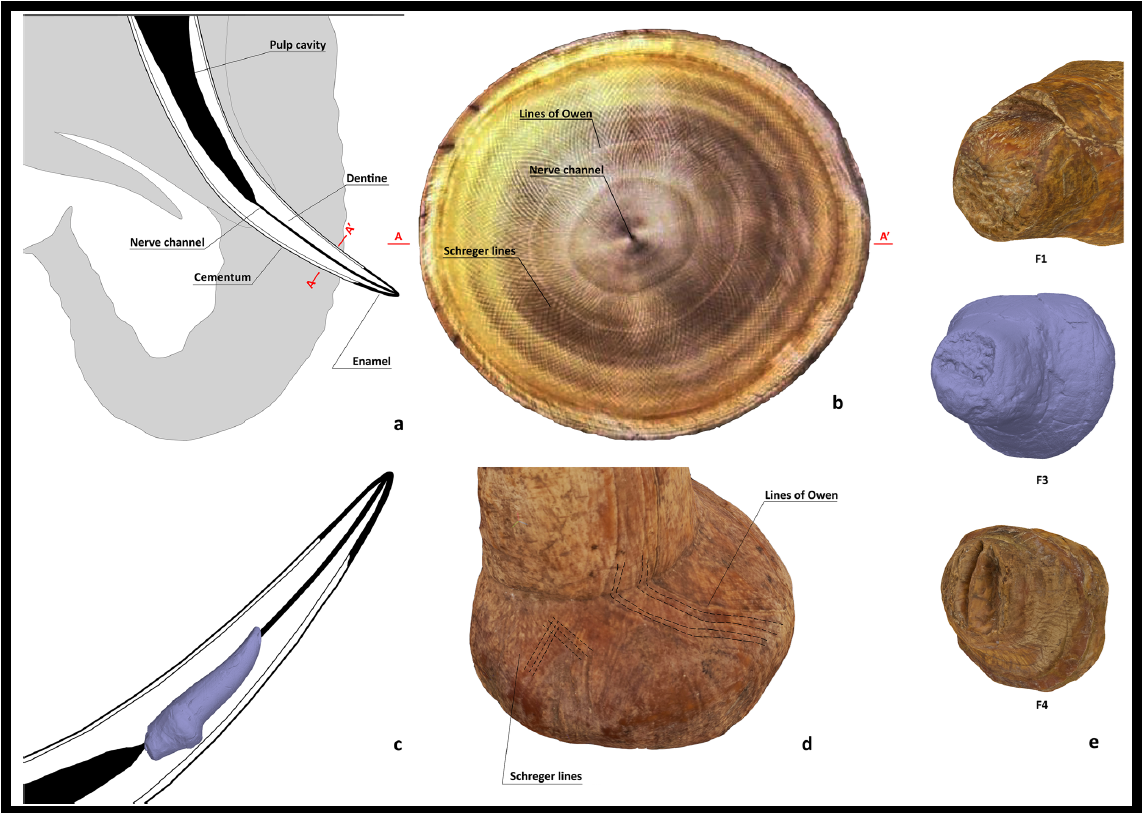
 Internal structure of mammoth ivory and the reconstructed positioning of Mizyn figurines within the tusk, showing Owen’s and Schreger lines that influenced their manufacture and decoration.
Image Credit:
Radchenko et al., npj Heritage Science (2026)
Internal structure of mammoth ivory and the reconstructed positioning of Mizyn figurines within the tusk, showing Owen’s and Schreger lines that influenced their manufacture and decoration.
Image Credit:
Radchenko et al., npj Heritage Science (2026)
Hidden Patterns in Mammoth Ivory Inspired Ice Age Art in Ukraine
Digital and microscopic analysis of 18 mammoth-ivory figurines from the Upper Palaeolithic site of Mizyn in northern Ukraine has revealed that Ice Age artists did more than carve decorations onto the material: they appear to have drawn inspiration from the ivory’s own internal structure. Natural growth patterns inside mammoth tusks were echoed in zigzags, meanders and other geometric designs, suggesting that the material itself played an active role in shaping artistic choices.
The figurines date to roughly 18,800–17,400 years ago, shortly after the Last Glacial Maximum, and form the largest known collection of Palaeolithic female depictions in Eastern Europe from this period. Mizyn is also known for large circular arrangements of mammoth bones interpreted as dwelling remains, together with objects made from bone, ivory and shell. Mammoths were therefore deeply embedded in the material world of the communities that occupied the site.
Most of the figurines were discovered during excavations in the early twentieth century. Eleven came from an area associated with one mammoth-bone structure, while seven were found near another. Three were reportedly recovered beneath or possibly within a mammoth skull incorporated into one of these structures, a context that may indicate deliberate deposition.
To investigate how the objects were made, high-resolution 3D models were created and their surfaces examined microscopically. The digital approach allowed extremely small production traces and engravings to be recorded without extensive handling of the fragile originals. It was also part of an effort to digitally preserve Ukrainian heritage threatened by the ongoing war.
The analysis showed that all 18 anthropomorphic figurines were made from the central portions of mammoth ivory. Their long axes closely follow the longitudinal direction of the tusk, while internal features known as Schreger lines and Owen’s lines helped reveal how each blank had been positioned within the original ivory. Makers used cutting, percussion and pressure flaking to extract the blanks, followed by shaping, scraping, abrasion and polishing.
The engravings were then added with flint tools. Cross-sections of the marks indicate repeated sawing or unidirectional cutting motions, producing U-, V- and W-shaped grooves. Different tools appear to have been substituted during the process, probably as cutting edges became worn.
The most striking finding concerns the geometric decoration. Eleven figurines carry patterns that include zigzags, parallel lines, chevrons and meanders. Many of these designs closely echo the natural crosshatched Schreger pattern visible inside mammoth ivory. Other engraved lines correspond to Owen’s lines, the concentric growth rings within the tusk. In several cases, these motifs were placed precisely where the natural internal patterns would have been most visible.
This suggests that the artists were not simply applying a decorative convention to an indifferent raw material. Instead, they were responding to the visual properties of the ivory and incorporating them into the finished image. Intentional abrasion sometimes made the internal structure more visible before elaborate ornamentation was added.
The figurines combine three-dimensional carving with two-dimensional engraving. Their bodies were shaped as elongated, rounded forms, while one face carried stylised anthropomorphic features and the reverse often displayed geometric decoration. This combination distinguishes the Mizyn group from many other European Palaeolithic figurines.
A wider review of 650 radiocarbon dates from European sites also places the Mizyn figurines among the earliest schematised anthropomorphic images known after the Last Glacial Maximum. Comparable styles became widespread in Central Europe only later. The new chronology therefore supports the view that Mizyn represents a distinct local artistic development rather than simply an eastern version of later Central European traditions.
Together, the findings show how closely technology, material and artistic expression were intertwined. For the people of Mizyn, mammoth ivory was not merely a surface on which images were placed; its structure, working properties and visual patterns helped shape the art itself.
Published on: 14-09-2026
Edited by: Abdulmnam Samakie
Source: npj Heritage Science