- Archaeological News
-
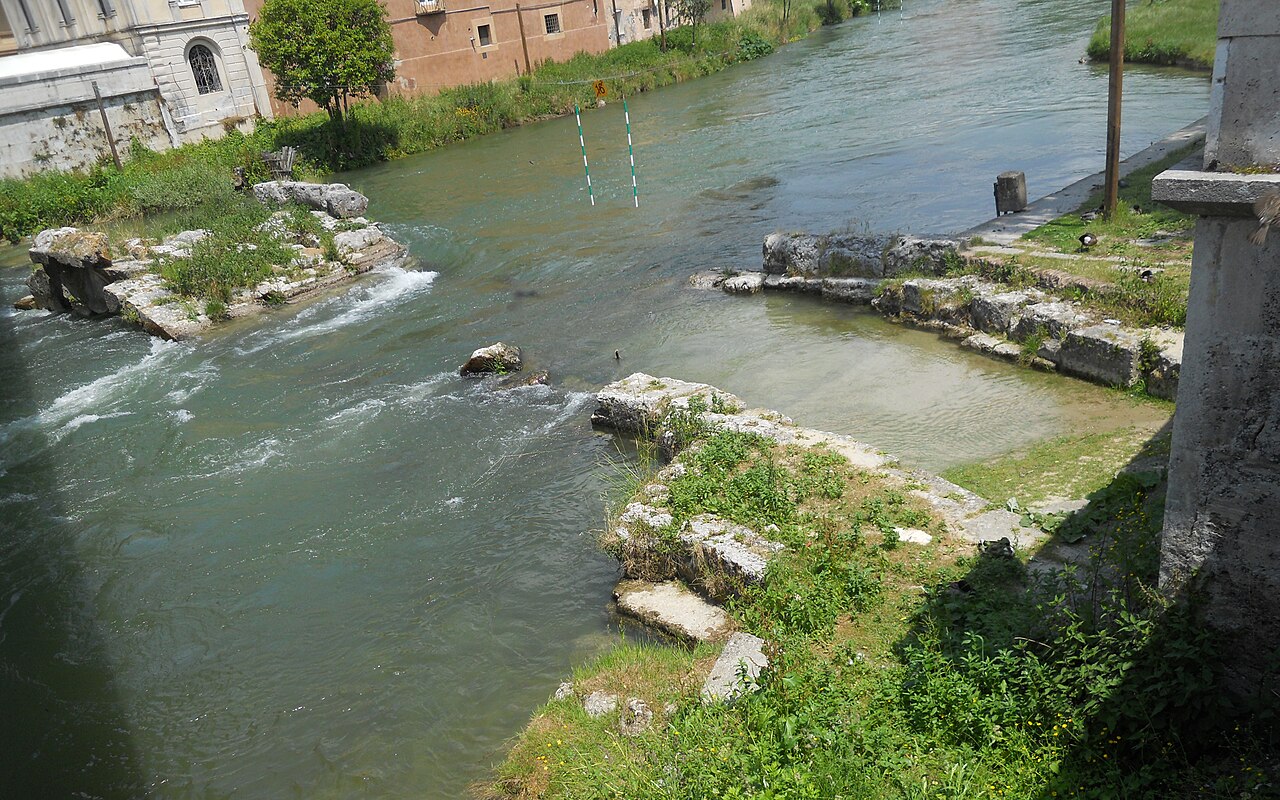
 Remains of the Roman bridge over the Velino River at Rieti, Italy, along the ancient Via Salaria. The Roman road provides an example of how routes, landscapes and movement could become part of religious experience.
Image Credit:
Alessandro Antonelli, CC BY 3.0, via Wikimedia Commons
What Made Roman Pilgrimage Special? Archaeologists Look Beyond Temples and Destinations
What made a religious journey in the Roman world different from worship performed at home or at a nearby shrine? A new archaeological perspective suggests that the answer may lie less in the rituals performed at a destination and more in the experience of movement itself.
A recent article by archaeologist Emma-Jayne Graham reflects on research into Roman pilgrimage and the difficulties archaeologists face when trying to identify it in the material record. People in the Roman world clearly traveled both short and long distances to take part in religious activities, yet the rituals they performed often resembled those practiced closer to home, including offerings, sacrifices, prayers and ritual gestures directed toward similar gods and intended to achieve similar outcomes.
This creates a fundamental problem. A sanctuary visited by travelers cannot automatically be classified as a pilgrimage center simply because people came from elsewhere. Archaeological interpretations have sometimes relied too heavily on comparisons with medieval or Christian pilgrimage, introducing assumptions about accommodation, healing, hardship or specialized religious services that may not apply to Roman practices.
Graham proposes a different way forward. Rather than first trying to define who counted as a “pilgrim” or which places qualified as pilgrimage destinations, archaeologists could examine how religious experience was shaped by movement. This approach places greater emphasis on the relationships that developed during a journey between people, objects, landscapes, animals, materials, divinities and other elements of the surrounding world.
The argument draws on what archaeologists call “assemblage thinking.” In simple terms, religious experience is understood as emerging from changing relationships rather than from people acting in isolation. A traveler might encounter roads, milestones, unfamiliar landscapes, local foods, different dialects, inscriptions, sacred places and other travelers. Each encounter could add another layer to the experience of leaving home and moving toward a religious destination.
From this perspective, pilgrimage was not simply a sequence of home, journey and sanctuary. Movement repeatedly placed travelers within new combinations of people, places and things. These changing relationships could produce experiences that were more varied and intense than those associated with familiar worship at a household shrine or local temple. Graham suggests that this complexity may help explain why sacred travel could feel distinctive or worthwhile.
Examples discussed in the article show how ordinary materials could become part of this process. Along the Via Salaria in Italy, travelers carrying salt might divert toward nearby sanctuaries of Hercules and offer some of the material they were transporting. Salt could therefore shift from an economic commodity to a ritual offering depending on the circumstances of the journey.
Elsewhere, the relationship between land and water at Lydney Park in Britain, the experience of descending a staircase tunnel at Arsameia, and clusters of inscriptions at Monte do Facho illustrate how landscapes, architecture and traces of earlier visitors could shape religious encounters. Reading dedications left by previous visitors, for example, could connect a traveler with people who had passed through the same sacred landscape in earlier times.
The approach does not claim that archaeologists can now identify every Roman pilgrim or reconstruct exactly what each traveler felt. Instead, it accepts uncertainty as part of the archaeological evidence. The aim is to move away from rigid definitions and from searching for a single feature—distance, hardship, remoteness or a famous sanctuary—that supposedly transformed a journey into a pilgrimage.
Roman pilgrimage, in this interpretation, was shaped by movement through a continually changing world. Roads, objects, landscapes and encounters were not merely background scenery on the way to a sacred destination; they helped shape the religious experience itself. By focusing on these relationships, archaeologists may be able to understand sacred travel in the Roman world without forcing it into models derived from later religious traditions.
Published on: 14-11-2026
Edited by: Abdulmnam Samakie
Source: Journal of Roman Archaeology