- Archaeological News
-
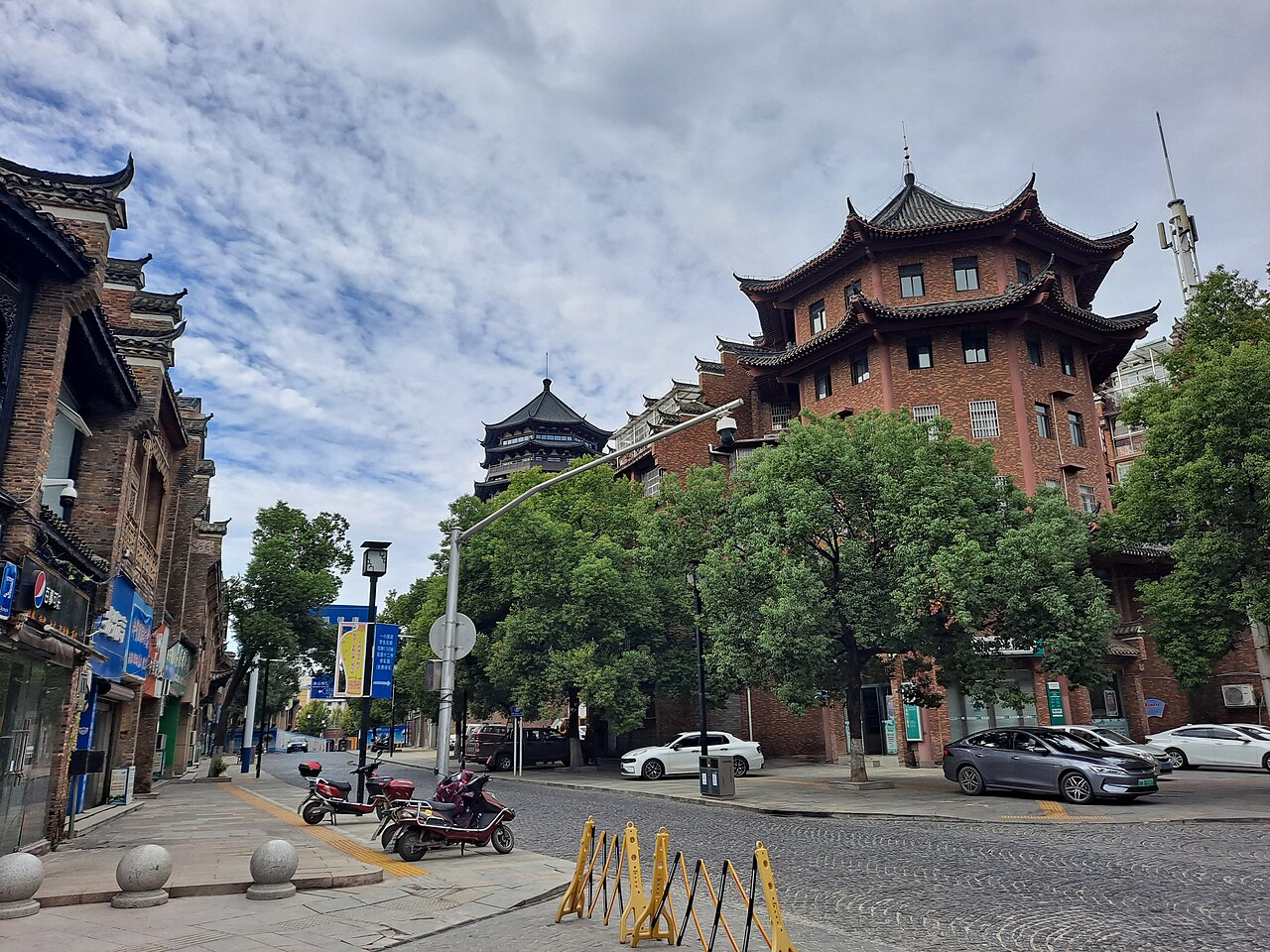
 Dou Fu Nong, a historic street area in Jingdezhen, China, preserving elements of the city’s traditional urban architecture.
Image Credit:
EditQ, CC BY-SA 4.0, via Wikimedia Commons
Dou Fu Nong, a historic street area in Jingdezhen, China, preserving elements of the city’s traditional urban architecture.
Image Credit:
EditQ, CC BY-SA 4.0, via Wikimedia Commons
Virtual Reality Rebuilds the Historic Porcelain City of Jingdezhen
A major virtual-reality project in China is attempting something far more ambitious than digitally reconstructing a vanished building: it is recreating the streets, workshops, kilns, trade networks and everyday life of historic Jingdezhen, while carefully distinguishing what archaeology can prove from what researchers must reasonably infer.
The project focuses on Jingdezhen in Jiangxi Province, a city whose identity has been tied to porcelain production for more than a thousand years. During the Yuan, Ming and Qing dynasties, it became one of the world’s most important centres of ceramic manufacture, producing innovations that circulated far beyond China. Yet much of the historic industrial landscape has disappeared through centuries of rebuilding, leaving archaeology, documents, surviving architecture and museum collections to preserve different pieces of the story.
Researchers developed the immersive project as part of Jingdezhen’s World Heritage nomination work. Rather than concentrating only on surviving monuments, the team set out to reconstruct an entire historical environment, combining urban form with porcelain production, commerce, ritual and social life. The resulting VR experience followed extensive research between 2024 and 2025 and was publicly launched in October 2025.
That scale created an immediate problem. The heritage area covers more than 200 hectares, including streets, houses, public buildings, workshops and kilns, while its archaeological evidence spans almost a millennium. Recreating everything with the same degree of certainty would be impossible—and misleading. The team therefore built a workflow around four stages: collecting and evaluating evidence, writing a spatial narrative, constructing the three-dimensional environment and producing the final interactive assets.
A central part of the method is the distinction between evidence that can be directly verified and evidence that requires interpretation. Surviving archaeological remains, standing buildings, measured surveys, topography and other physical records form the strongest category. Researchers documented key areas using techniques including 3D scanning, high-resolution drone photography and detailed recording of objects and architectural remains.
Where physical evidence had disappeared, the project turned to excavation reports, historical maps, old photographs, written descriptions, local memories and comparisons with traditional architecture elsewhere in the region. These sources didn’t all carry equal weight. Instead, they guided different levels of reconstruction, allowing well-documented structures to be modelled closely while missing buildings were recreated more cautiously from architectural types and regional patterns.
The virtual city was then built at several scales. Researchers first reconstructed the wider street and river network, then examined building types and plot arrangements, and finally added landscapes, furnishings, artifacts, people and activities. The goal wasn’t simply to create attractive architecture. It was to show how Jingdezhen functioned as a porcelain-producing city.
Visitors can move through workshops and kiln districts, follow the manufacture and circulation of porcelain and experience scenes connected with trade and ritual. The narrative deliberately mixes human-scale exploration with aerial views, helping audiences understand how streets, waterways, production areas and the Imperial Kiln Factory formed a connected urban system.
Technology imposed its own limits. Standalone VR headsets can’t render every architectural surface and object at maximum detail, especially across a city-sized environment. The developers therefore concentrated computing power on elements visitors encounter at close range while simplifying distant buildings and surfaces. In this approach, technical reduction becomes part of the heritage strategy rather than simply a compromise.
The finished experience operates in a roughly 300-square-metre venue equipped with 40 standalone VR headsets and can accommodate about 100 participants at once. Initial professional evaluations and public responses were positive, although the researchers stress that more controlled user testing would be needed to measure its educational effectiveness reliably.
One challenge remains especially important: how clearly should a virtual world tell visitors which parts are certain and which are reconstructed? The project places strongly supported archaeological elements near visitors and pushes more hypothetical architecture farther into the background, but explicit uncertainty warnings were reduced in the final public version to preserve immersion. The study identifies this tension between transparency and storytelling as an area that still needs improvement.
The result is therefore not a claim to have recreated Jingdezhen exactly as it once looked. Instead, the project offers a structured way to rebuild complex urban heritage from evidence of different strengths, while making archaeology, architecture and historical interpretation work together inside the same virtual landscape.
Published on: 14-10-2026
Edited by: Abdulmnam Samakie
Source: npj Heritage Science