- Archaeological News
-
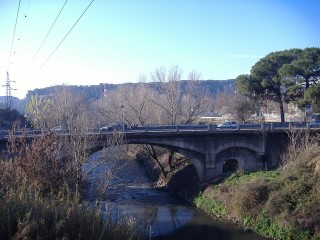 Ponte Salario over the Aniene River in Rome, where the ancient Via Salaria crossed the river on its route toward central Italy.
Image Credit:
Bikediablo, CC BY-SA 3.0, via Wikimedia Commons
Rome’s Via Salaria Reconsidered as a Pilgrimage Route
One of ancient Italy’s most important trade roads may have carried more than merchants, livestock and salt. A new study argues that the Via Salaria, the route linking Rome with the interior of central Italy and eventually the Adriatic coast, can also be understood as a form of pilgrimage route where commerce, religious practice and travel repeatedly intersected.
The Via Salaria was among the oldest major routes in central Italy. It connected Rome with the Sabine interior before crossing the Apennines toward the Adriatic. Although parts of the route may have existed long before the Roman period, its later importance was closely associated with the movement of salt from coastal production areas into inland communities.
Rather than viewing the road simply as economic infrastructure, the study proposes a “braided” network in which different kinds of movement overlapped. Traders, herders and other travelers could use the same roads while pursuing different purposes, and commercial journeys could bring people into contact with sanctuaries, rituals and sacred landscapes. In this interpretation, trade and pilgrimage were not necessarily separate activities.
A central part of the argument concerns the worship of Hercules. In central Italy, Hercules was closely associated with traders, livestock and seasonal movement of herds. Archaeological and inscriptional evidence also places his cult at numerous locations connected with the Via Salaria and its side roads. An earlier survey cited in the study recorded six sanctuaries or temples associated with Hercules, 16 inscriptions, 17 small bronze figures, two clay figurines and a ceramic vessel linked to the god. The evidence ranges from the end of the Archaic period to the beginning of the second century AD.
Their locations are particularly significant. With only two documented exceptions, the known or proposed Hercules cult sites discussed in the study were not directly on the main Via Salaria or at the centers of cities. Instead, they tended to occupy settlements or secondary routes branching away from the main road. This pattern raises the possibility that travelers deliberately left the principal route to visit sacred places.
Salt provides another link between travel, trade and religion. It was essential to Roman life, serving in food preservation, cheese production, animal husbandry, medicine, leather working and many other activities. As salt moved away from coastal production areas, transport costs and scarcity increased its value, making it an especially important commodity in inland regions.
But salt also carried religious significance. Roman sacrificial practice used mola salsa, a preparation of spelt and brine associated with the Vestal Virgins and sprinkled on sacrificial victims. Salt could also help preserve meat after animal sacrifices, allowing portions to be stored, transported or shared beyond the immediate ceremony. The study cautions that archaeological evidence does not prove that salt was used in rituals at every Hercules sanctuary along the Via Salaria. Instead, it presents this relationship as a way of understanding how an ordinary trade commodity could acquire additional sacred meaning when carried into religious settings.
Seen this way, the Via Salaria was not simply a road for moving goods between two coasts. It was a landscape in which merchants, herders, worshippers, sanctuaries and commodities interacted. Salt could shift from being merchandise to becoming part of sacrifice, while a commercial journey could acquire religious dimensions. The study therefore offers a broader picture of Roman pilgrimage—one in which trade, movement and worship could form different strands of the same journey.
Published on: 24-11-2026
Edited by: Abdulmnam Samakie
Source: Journal of Roman Archaeology