- Archaeological News
-
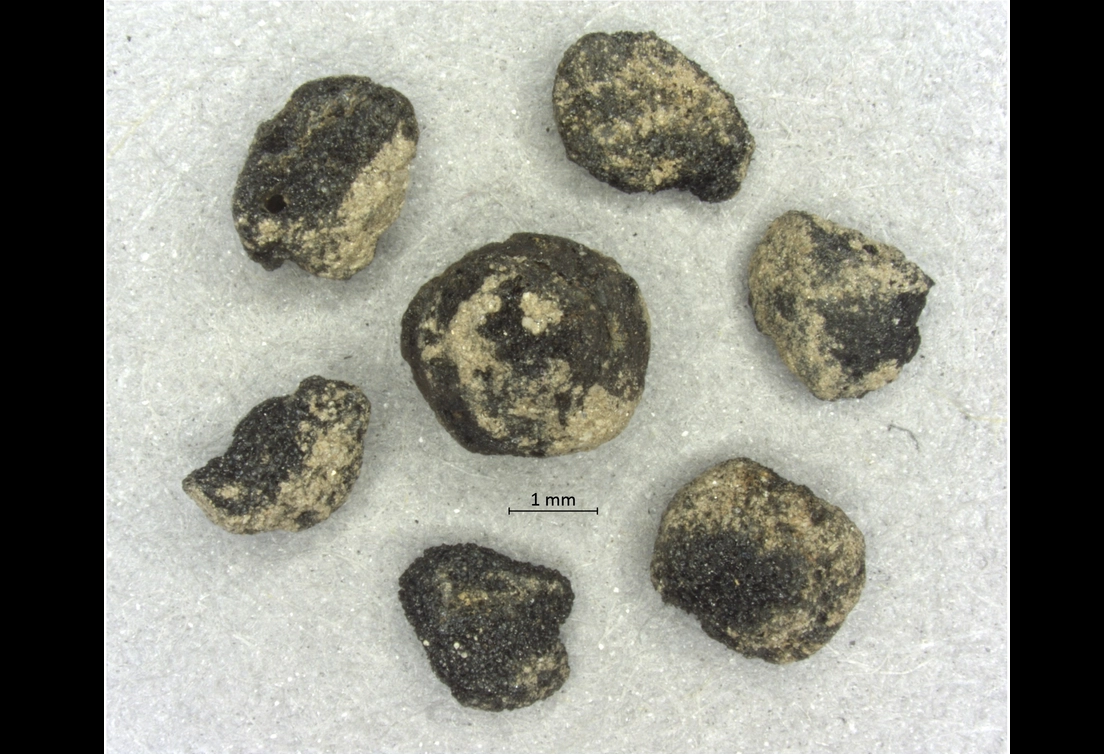
 Charred fragments of large legume seeds recovered from House 10 at Harestadkrysset, dated to 579–645 AD.
Image Credit:
Dawn Elise Mooney, Frontiers in Environmental Archaeology (2026)
Charred fragments of large legume seeds recovered from House 10 at Harestadkrysset, dated to 579–645 AD.
Image Credit:
Dawn Elise Mooney, Frontiers in Environmental Archaeology (2026)
Charred Legumes Hint at New Farming Strategies in 6th-Century Norway
A rare concentration of charred legume seeds discovered inside the remains of a Merovingian-period longhouse in southwestern Norway is providing new evidence for how farming communities may have adapted their agriculture during a period of climatic and social disruption around 1,400 years ago. The unusually large seeds appear to represent cultivated legumes and could point to greater diversification of crops at a time when cereal production was declining.
The remains were recovered at Harestadkrysset in Rogaland during large-scale archaeological excavations carried out ahead of road construction. Among hundreds of archaeological features spanning several periods were timber-built houses dating to the Merovingian period, conventionally placed between AD 570 and 793 in Norway. Only postholes, wall trenches and other traces of these buildings survived beneath the ploughed landscape.
The most significant plant remains came from House 10, a longhouse in the southern part of the site. Archaeobotanical samples from its wall ditch and a posthole produced 14 fragments of unusually large legume seeds, provisionally assigned to a group that includes vetches, vetchlings and peas (Vicia/Lathyrus/Pisum). Several of the fragments were directly radiocarbon dated to AD 579–645, firmly placing them within the Merovingian period.
Although 14 pieces may appear modest, the concentration is exceptional in the local archaeological record. Cultivated plant remains from Merovingian houses in Norway are generally scarce, and the number of legumes recovered from House 10 was equal to the number of cereal finds there. Their seeds were also substantially larger than those of wild vetches normally encountered in the region. Together, their size, quantity and distribution support the interpretation that these plants were deliberately cultivated rather than simply growing as weeds around the settlement.
The poor preservation of the seeds prevents precise identification. Their outer coats and other diagnostic features have largely disappeared, making it impossible to determine whether they were peas, broad beans or another cultivated legume. Their original purpose is also uncertain. They may have been grown for human food, animal fodder or to improve agricultural soils.
The discovery becomes particularly interesting when viewed against the environmental conditions of the sixth century. Beginning around AD 536, a series of major volcanic eruptions contributed to a sharp decline in temperatures across parts of the Northern Hemisphere. The following decades are often described as the Late Antique Little Ice Age. In southwestern Norway, archaeological evidence from this period points to declining settlement numbers, reduced cereal production and broader changes in agriculture.
At Harestadkrysset, plant remains from Merovingian houses are much less abundant than those from some earlier periods. At the same time, the assemblage becomes more varied. Hulled barley and oats remained important, but wild resources such as hazelnuts and berries became more visible, while unusual crops including legumes also appeared. Similar evidence elsewhere in Rogaland suggests experimentation with rye during this period. Together, these patterns may reflect attempts to spread agricultural risk as growing conditions became more difficult.
One intriguing possibility is that legumes were grown together with cereals. Legumes can improve soil fertility by contributing nitrogen, and planting them in the same fields as cereals can help farmers obtain more than one crop from the same land. A traditional practice from the Jæren region involved growing a local pea variety alongside oats, with the cereal supporting the climbing peas while the legumes helped maintain fertile soil.
However, there is no direct archaeological evidence that the Merovingian farmers at Harestadkrysset actually practiced this form of intercropping. The legumes could equally have been planted separately or used within a crop-rotation system. Even finding cereal and legume remains together would not by itself prove that they grew in the same field.
The significance of the discovery therefore lies less in proving one particular farming technique than in revealing an unexpectedly diverse agricultural system. The charred seeds suggest that cultivated legumes were present in western Norway centuries before they become common in later historical records. Alongside declining grain surpluses and increased use of wild foods, they offer a glimpse of farming communities responding to changing conditions through experimentation, diversification and potentially new ways of managing their fields.
Published on: 28-09-2026
Edited by: Abdulmnam Samakie