- Archaeological News
-
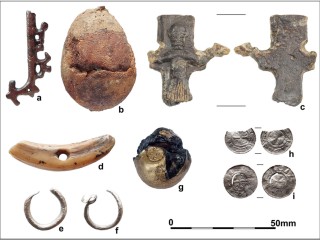 Selected artefacts from the medieval stronghold at Pyrzyce, including objects associated with both Slavic Pagan and Christian traditions.
Image Credit:
Janowski et al., Antiquity (2026)
Selected artefacts from the medieval stronghold at Pyrzyce, including objects associated with both Slavic Pagan and Christian traditions.
Image Credit:
Janowski et al., Antiquity (2026)
Pagan and Christian Finds Reveal a Religious Crossroads in Medieval Poland
Archaeological excavations at the early medieval stronghold of Pyrzyce in north-western Poland are revealing material traces of a community living through one of the region’s most important religious transformations, when long-established Slavic beliefs began to coexist with—and gradually give way to—Christianity during the 12th century.
The investigations focus on a stronghold closely connected in historical sources with the Christianisation of Pomerania. In 1124, a missionary campaign reached Pyrzyce as part of a wider effort to convert communities across the region, where many inhabitants still followed Slavic Pagan traditions. The mission was religious, but it also unfolded within a complex political landscape in which neighbouring Christian states sought alliances and greater influence over Pomerania.
Written accounts describe Pyrzyce as the starting point of this campaign, although they don’t agree entirely on how readily the local population accepted the new religion. One account suggests that only some inhabitants initially converted, while others wanted the decision approved by local leaders and elders. A later narrative presents a much more complete conversion, including mass baptisms, the construction of a church and the appointment of a priest.
Archaeology is now testing that historical picture on the ground. The Pyrzyce stronghold was once one of the important fortified centres of Pomerania. Airborne laser scanning shows an oval complex measuring roughly 150 by 110 metres and covering about 1.6 hectares, divided into two main areas. Documentary evidence also records defensive embankments, a moat and a fortified hill, while earlier excavations had identified traces of defences that are no longer visible on the surface. Ground-penetrating radar surveys begun in 2022 revealed something more unusual: a rectangular feature measuring about 15 by 8 metres, buried roughly one metre below the surface near the stronghold’s defensive zone. Excavations in 2023 and 2024 then exposed the foundations of a poorly preserved building, probably constructed partly with timber posts sealed with clay. The structure appears to date from the second half of the 11th century or the first half of the 12th century, placing it directly within the period surrounding the region’s conversion to Christianity.
Its purpose remains uncertain. The stone foundations were built without mortar on a small artificial clay rise, and the objects recovered around the building point in more than one religious direction. Among them was a knife-sheath fitting decorated with anthropomorphic and animal motifs interpreted as representing the tripartite Pagan cosmos, along with a clay egg-shaped rattle associated with ideas of new life and an amulet made from an animal tooth. Beside these objects, however, archaeologists found a distinctive lead crucifix dating to the 12th century. Silver temple rings, weights and coins from the 10th and 11th centuries add further evidence that this was an important and active part of the settlement, connected not only with belief but also with exchange and everyday social life.
The combination is striking. Pagan and Christian objects occur within the same archaeological setting, capturing a period when religious identities were not necessarily replaced overnight but may have overlapped during a wider process of social change.
The excavated building itself is unlikely to be the church described in medieval accounts of the missionary campaign. The researchers are cautious on that point. Yet its location, construction and associated objects raise the possibility that it served some form of communal, ritual or assembly function, making it an important context for understanding the transition taking place at Pyrzyce.
The discoveries therefore don’t provide a simple archaeological confirmation of the written story. Instead, they reveal something more complex: a stronghold where older Slavic traditions and Christianity left material traces side by side during a period of religious and political transformation.
At Pyrzyce, conversion appears not as a single moment preserved in the soil, but as a landscape in transition.
Published on: 11-10-2026
Edited by: Abdulmnam Samakie
Source: Antiquity