- Archaeological News
-
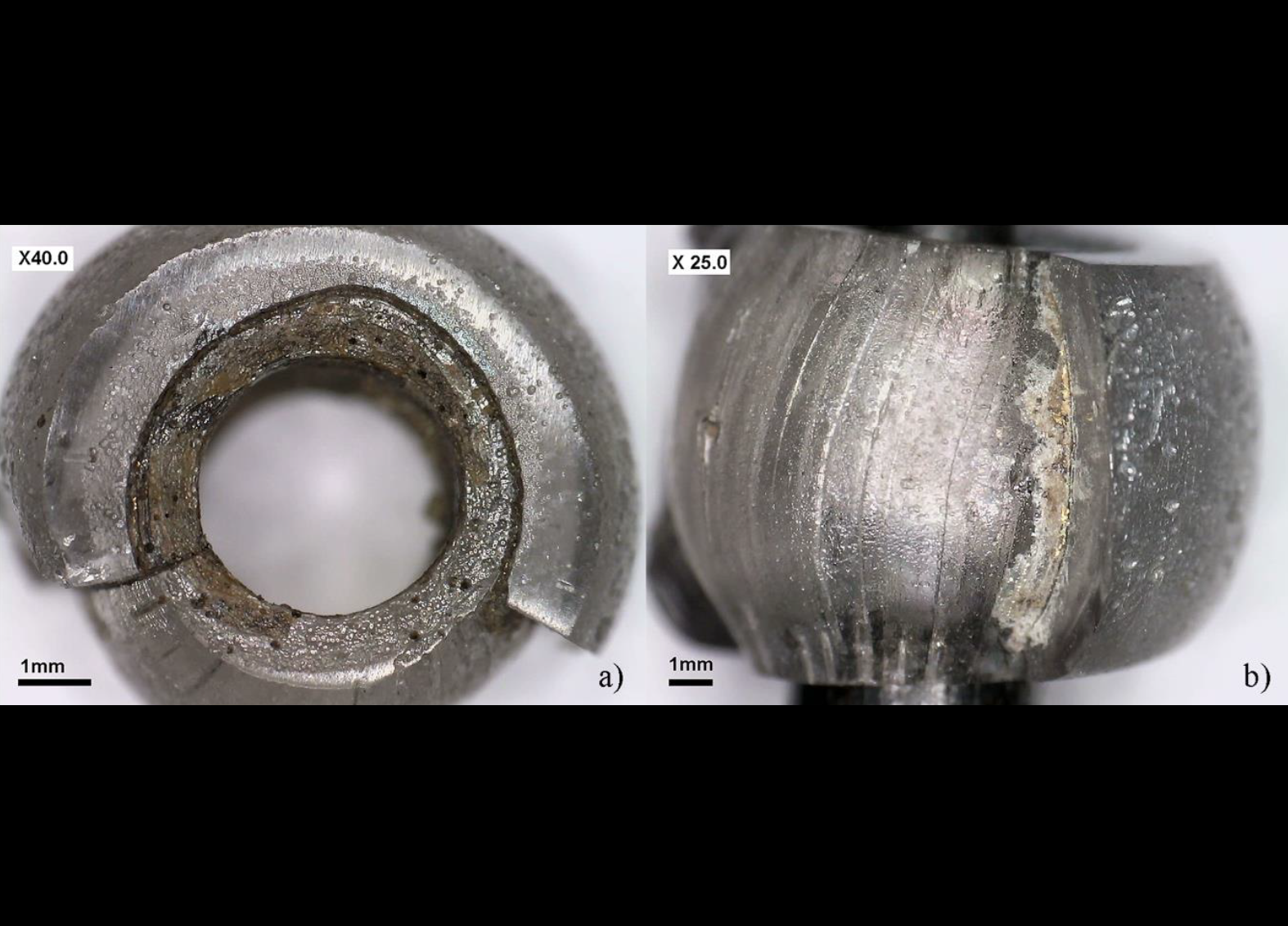
 Microscope views of the KZ-16 gold-in-glass bead, showing its layered glass structure and exposed gold foil.
Image Credit:
Agnes Puiyee Sung, Sung et al., npj Heritage Science (2026)
Microscope views of the KZ-16 gold-in-glass bead, showing its layered glass structure and exposed gold foil.
Image Credit:
Agnes Puiyee Sung, Sung et al., npj Heritage Science (2026)
Gold-in-Glass Beads Reveal Ancient Exchange Across the Eurasian Steppe
A new archaeological study of two gold-in-glass beads from eastern Kazakhstan has revealed how sophisticated glassmaking traditions associated with the Mediterranean continued to circulate through the Eurasian steppe during the third and fourth centuries CE.
The beads were discovered in 2023 in Burial 54 at the Tautekeli cemetery in the Kazakh Altai, an important corridor linking the central and eastern steppe. The burial contained a young adult and a child and has been radiocarbon dated to 256–326 CE, corresponding to the Xianbei period. The two gold-in-glass beads and a third paste bead were found near the neck area.
Gold-in-glass beads are composite ornaments made by enclosing an extremely thin layer of metal foil between two layers of glass. The technique creates a bright metallic appearance while protecting the foil beneath the glass. Such ornaments are strongly associated with Hellenistic and Roman Mediterranean glassmaking, with evidence for their production at centres including Rhodes and Alexandria.
Their appearance thousands of kilometres farther east has long raised questions about how objects, raw materials and technological knowledge travelled across Eurasia.
To investigate the Tautekeli examples, researchers combined optical microscopy, scanning electron microscopy with energy-dispersive spectroscopy, and X-ray micro-computed tomography. The latter allowed them to examine the internal structure of the beads without destroying them.
The analysis showed that both ornaments were constructed from two glass layers separated by gold foil. Their inner cores were made from drawn glass tubes, indicated partly by elongated air bubbles aligned with the perforations.
The findings also help resolve a long-running debate about how the outer glass covering of such beads was produced. One theory proposed inserting the gold-covered inner tube into a second glass tube. The Tautekeli examples instead show irregular outer layers largely lacking the elongated bubbles expected from a drawn tube.
Researchers conclude that the outer glass was probably applied while molten or highly viscous, coating the gold-wrapped core before the bead was reheated and separated into its final form. The foil itself was wrapped around the core as a sheet rather than applied as gold powder.
The two beads were not manufactured identically. One has relatively flat ends, suggesting limited reheating after separation, while the other has rounded edges indicating additional heat finishing. Their glass compositions also differ slightly, suggesting that artisans could combine different batches or adapt their methods rather than following one rigid production recipe.
Chemical analysis produced another important result. Both beads are made from soda-lime-silica glass with low levels of magnesium and potassium, identifying them as natron glass.
Natron glass was characteristic of Mediterranean glassmaking traditions during the Hellenistic and Roman periods. Earlier gold-in-glass beads made from similar material have been documented across the Black Sea region and as far east as Mongolia.
The Tautekeli finds are particularly significant because they date to the third or fourth century CE. By this time, plant-ash glass was becoming increasingly common across parts of Central and Inner Asia, yet these beads retained the earlier natron-glass tradition.
The researchers caution that this does not prove the beads travelled directly from the Mediterranean to Kazakhstan during the lifetime of the individuals in the burial. They could have circulated for long periods, been preserved as heirlooms, or been produced from recycled natron glass.
Nevertheless, their presence shows that Mediterranean-derived glass traditions remained part of Central Asian material networks later than previously assumed.
Archaeological evidence indicates that pastoral societies across the steppe participated in wide-ranging systems through which glass, metalwork, textiles and other prestige goods moved between the Mediterranean, Central Asia and East Asia. These exchanges may have taken place through trade, diplomacy, alliances, gifts and tribute rather than along a single commercial route.
The Tautekeli beads therefore provide more than evidence of ancient craftsmanship. They illustrate a connected Eurasian world in which materials and technologies could travel enormous distances, be adapted by different communities and remain in circulation across generations.
Published on: 17-08-2026
Edited by: Abdulmnam Samakie
Source: npj Heritage Science